
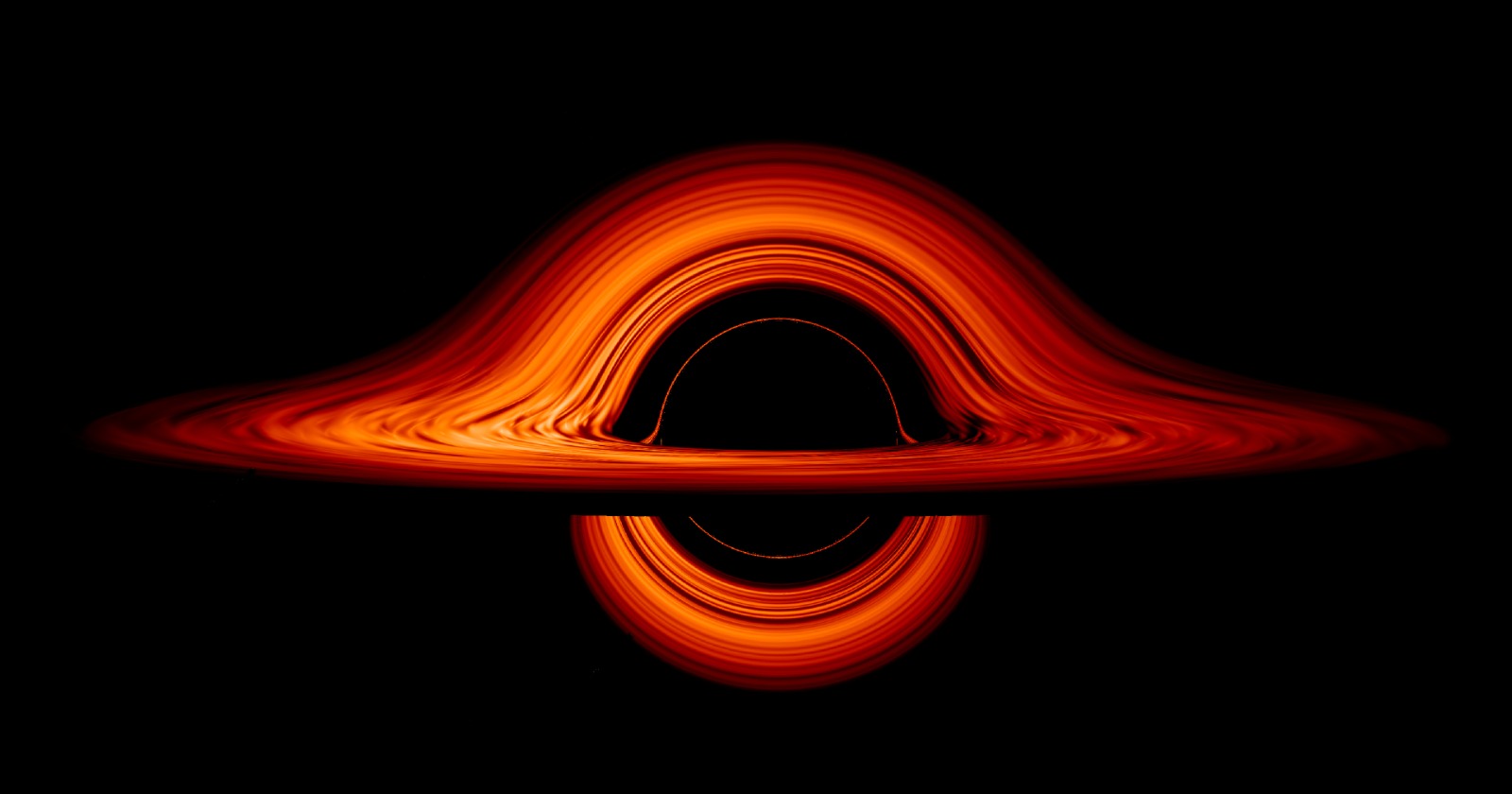
When a very massive star burns through its fuel, the textbook ending is bleak. Nothing is left to push back against gravity, the core caves in on itself, and everything funnels down to a single point of infinite density called a singularity, wrapped in an event horizon that lets nothing escape. A black hole. Two theoretical physicists at Goethe University Frankfurt have now written down a different ending, one in which the same collapse triggers something like a miniature Big Bang inside the star and stops short of a black hole entirely.
In their solution to Einstein’s equations, a tiny region of dark energy switches on at the center of the imploding star and begins to expand, the way our own universe did in its first instant. That expansion pushes outward just as gravity pulls in, and if the two forces settle into balance, the collapse freezes. What remains is a gravastar: an object almost as compact as a black hole, but with no singularity at its heart and no horizon around it.
What a gravastar actually is
The gravastar, short for gravitational vacuum condensate star, is not a new idea. It was first proposed in 2001 by physicists Pawel Mazur and Emil Mottola, who suggested that gravitational collapse might end not in a singularity but in a ball of dark energy held together by a thin shell of ordinary matter.
Dark energy is the same repulsive ingredient that cosmologists invoke to explain why the universe’s expansion is speeding up. Inside a gravastar, it would exert an outward pressure that props up the object’s enormous mass, which would otherwise keep falling inward. The thin shell of matter at the surface, helped by gravity, acts like a belt holding the whole thing in place.
The appeal is that a gravastar sidesteps the two features of black holes that physicists find hardest to accept. There is no singularity, the point where the equations of general relativity stop making sense, and there is no event horizon, the one-way boundary that traps everything behind it. Mazur and Mottola argued their version would also be thermodynamically stable and would dodge the information paradox, the long-running puzzle of what becomes of the information that falls past a horizon. The trade-off is that a gravastar can be made nearly as dense and compact as a black hole, which is also the problem: from the outside, the two would look almost identical.
For about 25 years that idea sat with a hole in it. Researchers could describe what a finished gravastar might look like, and a few had modeled one forming from a collapsing shell of matter, but no one had shown how a solid, collapsing ball of matter would actually turn into one. That is the gap the new work tries to close.
The Big Bang that stops a collapse
The Frankfurt physicists started from one of the oldest models in the field, the Oppenheimer-Snyder description of a uniform sphere of pressureless matter, or dust, collapsing under its own weight. Left alone, that sphere becomes a black hole. The new step was to seed an expanding patch of dark energy, technically a de Sitter region, at the very center and follow what happens as the two meet. They did this within ordinary general relativity, without the exotic modifications to gravity that such black hole alternatives often require, which is part of why the result drew notice.
In the model, the dark energy bubble starts from zero size and grows outward while the dust falls inward. As the bubble approaches the Schwarzschild radius, the size at which an object of that mass would tip over into a black hole, its expansion naturally slows. If it comes to rest just as it meets the infalling matter, the inward and outward motions cancel and a static gravastar is born. The authors compare the seed to a small Big Bang going off inside the dying star.
There is a delicate handoff where the growing bubble meets the falling dust. In the model a surface tension along that boundary keeps the dark energy from simply engulfing the matter; instead the dust is nudged outward as the region expands against it. Because the dust is treated as collisionless, the two do not slam together in a shock, they just pile up slightly at the seam. That is what lets the configuration settle rather than tear itself apart.
Daniel Jampolski worked out the solution in his master’s thesis, supervised by Luciano Rezzolla, a professor of theoretical astrophysics at the university. To find configurations that actually balance, the pair did not run the collapse forward. They started from a finished gravastar and integrated the equations backward in time to learn which starting conditions could have produced it, a standard trick when only a narrow set of inputs yields the configuration they were after.
Where the picture is still idealized
This is a result on paper, not a sighting in the sky, and the authors are careful about what it does and does not establish. The balance that produces a gravastar is one of only three possible outcomes in their model. The other two are a plain black hole or an object that never settles into equilibrium. Landing on the gravastar requires fine-tuning the starting conditions, which means the scenario is possible in the mathematics rather than obviously common in nature.
There are other simplifications baked in. The collapsing matter is treated as idealized dust with no internal pressure, and the collapse is assumed to be perfectly spherical, conditions no real star fully obeys. The dark energy bubble is assumed to begin at exactly zero size, which the authors describe as a mathematical convenience that a fuller quantum treatment would have to replace. And the model finds a ceiling on how compact the original star can be: above an initial compactness of three-eighths, in the units physicists use, the collapse to a black hole becomes unavoidable no matter what.
Rezzolla has been blunt that none of this is a case against black holes. Looking for alternatives, he has said, should not suggest skepticism toward black holes, which remain the most natural and simplest explanation for what gravitational collapse produces. The point is to test whether the exotic alternatives can even form in principle, and now one of them has at least a formation story.
How we would ever tell the difference
If gravastars look so much like black holes from the outside, the obvious question is whether anyone could distinguish them. Using light to tell the two apart is still a matter of open debate among physicists. The more promising route runs through gravitational waves. When two compact objects merge, the new object left behind rings like a struck bell as it settles, and a gravastar with no horizon should ring at different frequencies than a black hole with one.
Those tremors are exactly what detectors have been recording since 2015, when the first gravitational waves were observed. So far the signals fit ordinary black holes well, and the difference a gravastar would make is subtle enough that picking it out would take more sensitive instruments than exist today.
For now the work adds a worked example to a long-running argument about what really sits at the end of a star’s life. The equations permit something other than a singularity, at least in an idealized case, which is not the same as saying nature chooses it. Whether the universe ever takes that option is a question the math cannot answer on its own.