
When the James Webb Space Telescope launched on 25 December 2021, it carried a list of 344 single points of failure. Each one was a step or a part where a single fault would have crippled the mission, with no second chance and no way to send anyone to fix it. The telescope cleared all of them. It now sits about a million miles from Earth, doing the most sensitive infrared astronomy ever attempted, on roughly the power of a household kettle.
Both halves of that are true, and both are worth taking apart, because the figures are precise and the precision is the point.
344 ways to fail
The number comes from Mike Menzel, Webb’s lead mission systems engineer at NASA, who has said the observatory launched with 344 single-point failures on its books. A single point of failure, in engineering terms, is a place where one thing going wrong takes everything with it. Most spacecraft have a handful. Webb had hundreds.
About 80 per cent of them were tied to the deployment, the slow unfolding of a telescope that had been folded up to fit inside its rocket. That sequence relied on roughly 140 release mechanisms, 70 hinge assemblies, eight motors, some 400 pulleys, and around a quarter of a mile of cable, each of which had to work on command, in order, the first time.
What made the list so unforgiving was the destination. Webb was not going to low orbit, where Hubble could be visited and repaired by astronauts five times. It was going somewhere no crew can reach, which meant the usual safety net, send someone up to fix it, did not exist. Every one of the 344 had to hold on its own.
The fortnight that decided it
The riskiest part was the sunshield, a five-layer screen the size of a tennis court that has to separate and tension without tearing or snagging. It is the single most complex deployment ever flown, and it is the reason so much of the risk was packed into the first two weeks.
The sunshield reached its final, tensioned shape on 4 January 2022, ten days after launch. The project manager at the time, Bill Ochs, told reporters that finishing it retired somewhere between 70 and 75 per cent of the single-point failures on the original list. The rest fell away as the mirror segments locked into place over the following days. By the end of the fortnight, the most dangerous machine NASA had ever unfolded had unfolded.
Less power than a kettle
Here the popular line is right, with one number worth pinning down. The spacecraft and its four instruments run on about one kilowatt. The solar array is built to deliver closer to two kilowatts, but that extra capacity is margin, sized so the telescope still has enough as the panels degrade over its mission.
So the working figure is about a kilowatt, and a lot of household kettles draw more than that, particularly the three-kilowatt kind common outside North America. A telescope unpacking the early universe really does run on less electricity than the appliance that makes your tea.
The reason it can is the sunshield again. Webb has to keep its detectors extraordinarily cold, down to around 7 kelvin on one instrument, and cooling is usually the most power-hungry thing a cold spacecraft does. By parking the sunshield between the telescope and the Sun, Webb does most of that cooling passively, simply by sitting in deep shade, rather than by running power-hungry refrigeration. The shade that protects it also keeps its electricity bill tiny.
A million miles out
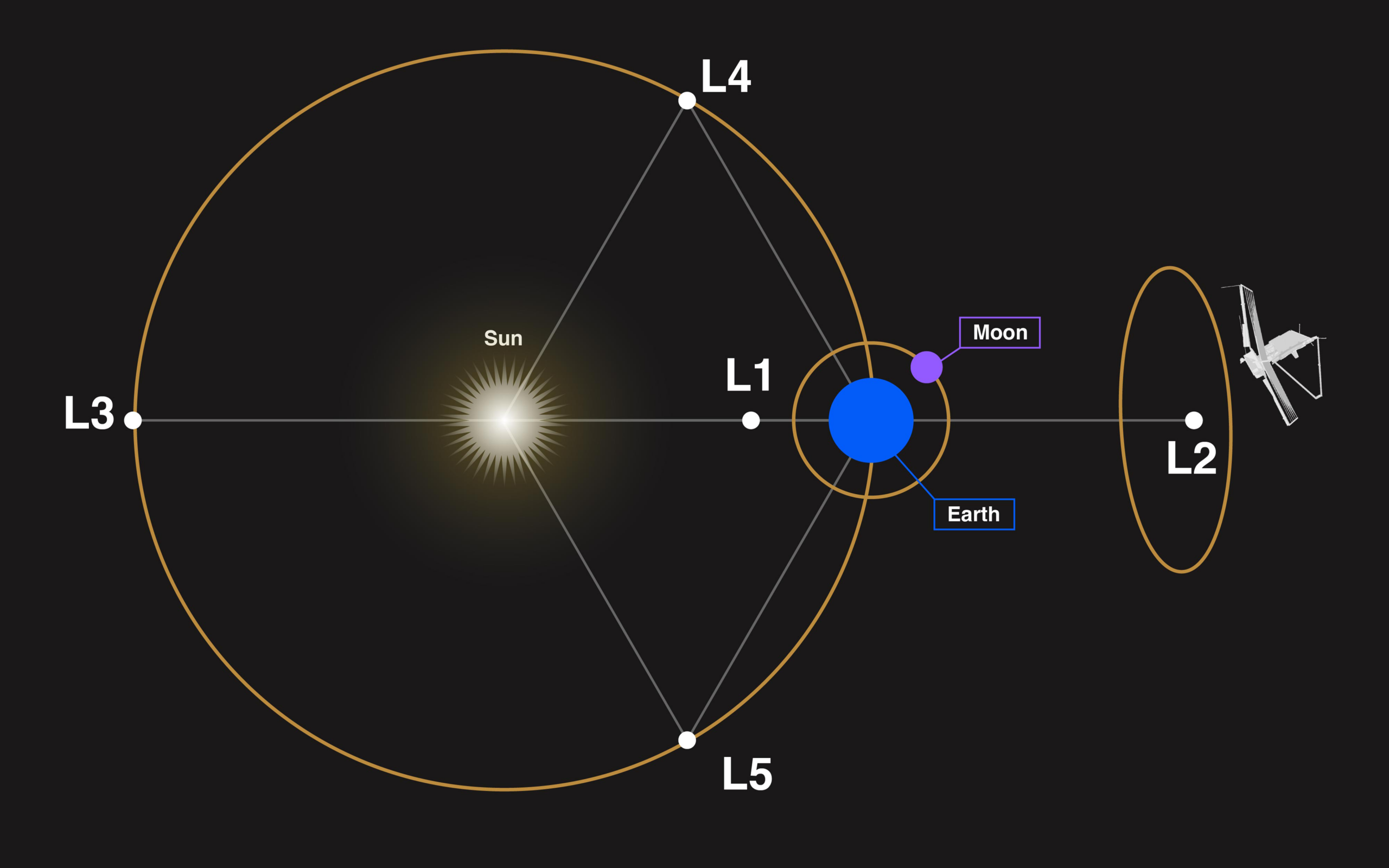
That deep shade only works at the right address. Webb orbits the Sun-Earth point known as L2, about 1.5 million kilometres away, near enough a million miles, where it can keep the Sun, Earth, and Moon all behind a single shield.
It also means the telescope is on its own. The same distance that makes the observatory work is the distance that made the 344 single points of failure so tense, because none of them could be reached if they jammed. The achievement was not just building something this delicate. It was building something this delicate that had to survive its own unpacking, unattended, a million miles from the nearest spanner.
It has been returning science since July 2022.
The list of 344 is now history, which is the only acceptable place for a list like that to end up.