
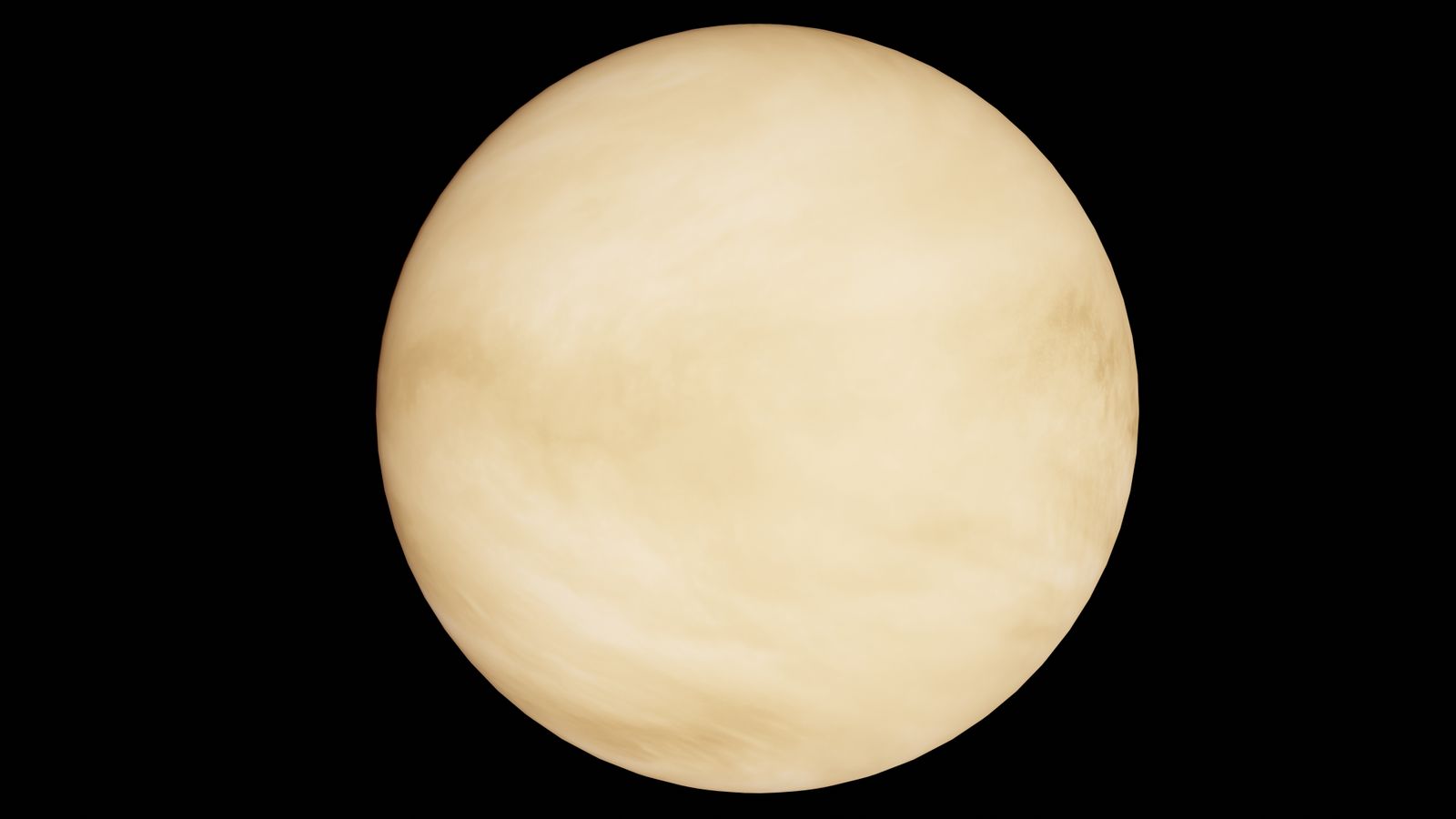
Venus today is the most hostile planet in the solar system. Its surface sits at about 465 degrees Celsius, hotter than Mercury despite being almost twice as far from the Sun, under an atmosphere of carbon dioxide pressing down at roughly 90 times Earth’s. Yet some climate models suggest it may not always have been this way, and that the planet next door could once have held liquid water and mild temperatures before a transformation tipped it into the furnace it is now.
That is a hypothesis, not a settled history.
It is also sharply contested, and the disagreement is the interesting part.
The case that Venus was once habitable
The strongest version of the habitable-Venus idea comes from climate modelling by scientists at NASA’s Goddard Institute for Space Studies. Running the same kind of models used for Earth, Michael Way and Anthony Del Genio found scenarios in which Venus held a shallow ocean and surface temperatures a person could tolerate, potentially for up to two billion years.
The mechanism they proposed turns on the planet’s slow spin. A Venus day is longer than a Venus year, so the dayside bakes for weeks at a time, which in their model drives rainfall and builds a thick deck of cloud that shades the surface like an umbrella. In that picture, the same sluggish rotation that seems hostile actually helped keep an early Venus cool enough for water.
There is a separate clue in the planet’s air. Venus has an unusually high ratio of deuterium, a heavy form of hydrogen, to ordinary hydrogen, which is the kind of fingerprint a world carries after losing a great deal of water to space over time. It does not prove there were oceans, but it is consistent with a Venus that once had far more water than the trace amount left in its atmosphere now.
The volcanic trigger
If Venus was habitable and then was not, something ended it. One leading idea points to the planet’s own geology.
Venus has a relatively young, oddly uniform surface, which many researchers read as the mark of a global resurfacing, a period when widespread volcanism repaved much of the planet within the last several hundred million years. An episode like that could have vented enormous quantities of carbon dioxide into the atmosphere. Add a Sun that has slowly brightened over billions of years, and the result is a runaway greenhouse: warming evaporates water, water vapour is itself a greenhouse gas that drives further warming, and the cycle runs until the oceans are gone and the heat is locked in.
In this telling, the volcanism did not just reshape the surface. It helped close the door on the planet’s habitability for good.
The contesting view
The neat story has a serious challenge, and it is worth giving plainly.
A 2021 study in Nature, led by Martin Turbet, modelled early Venus and concluded that water may never have condensed into oceans at all. In those simulations, clouds formed preferentially on the planet’s night side and produced a powerful warming effect, keeping the surface too hot for water vapour to fall as rain and pool. If that model is closer to the truth, Venus was never the temperate world of the habitable scenario. It was hot from very early on.
The two camps are not arguing over the figures so much as over how clouds behaved on a young Venus, which is one of the hardest things to model. The fair position is that whether Venus ever had oceans is an open question, not a known fact.
What is settled, and what comes next
What no one disputes is the present. Venus is in a runaway greenhouse state now, wrapped in dense carbon dioxide, hot enough to melt lead at the surface. The argument is entirely about its past: whether it lost an ocean, or never managed to make one.
That past may not stay out of reach. Three missions are headed Venus’s way in the coming years, NASA’s DAVINCI and VERITAS and the European Space Agency’s EnVision, designed to study the atmosphere, the surface, and the history written into both. The deuterium record, the age of the surface, and the chemistry of the air are exactly the kinds of evidence they are built to read. Whether Venus was ever a second habitable world, or always the one that went wrong, is a question the next decade has a real chance of settling.
