
The oldest solid material ever identified on Earth did not form on Earth, or anywhere near it. It came down inside a meteorite that fell near the town of Murchison, in country Victoria, on a spring morning in 1969. Sealed in that rock were microscopic grains of stardust, and the oldest of them formed roughly 7 billion years ago, well before the Sun.
The claim is accurate, with one detail worth keeping straight: 7 billion years is the age of the oldest grains, not of all of them.
The meteorite
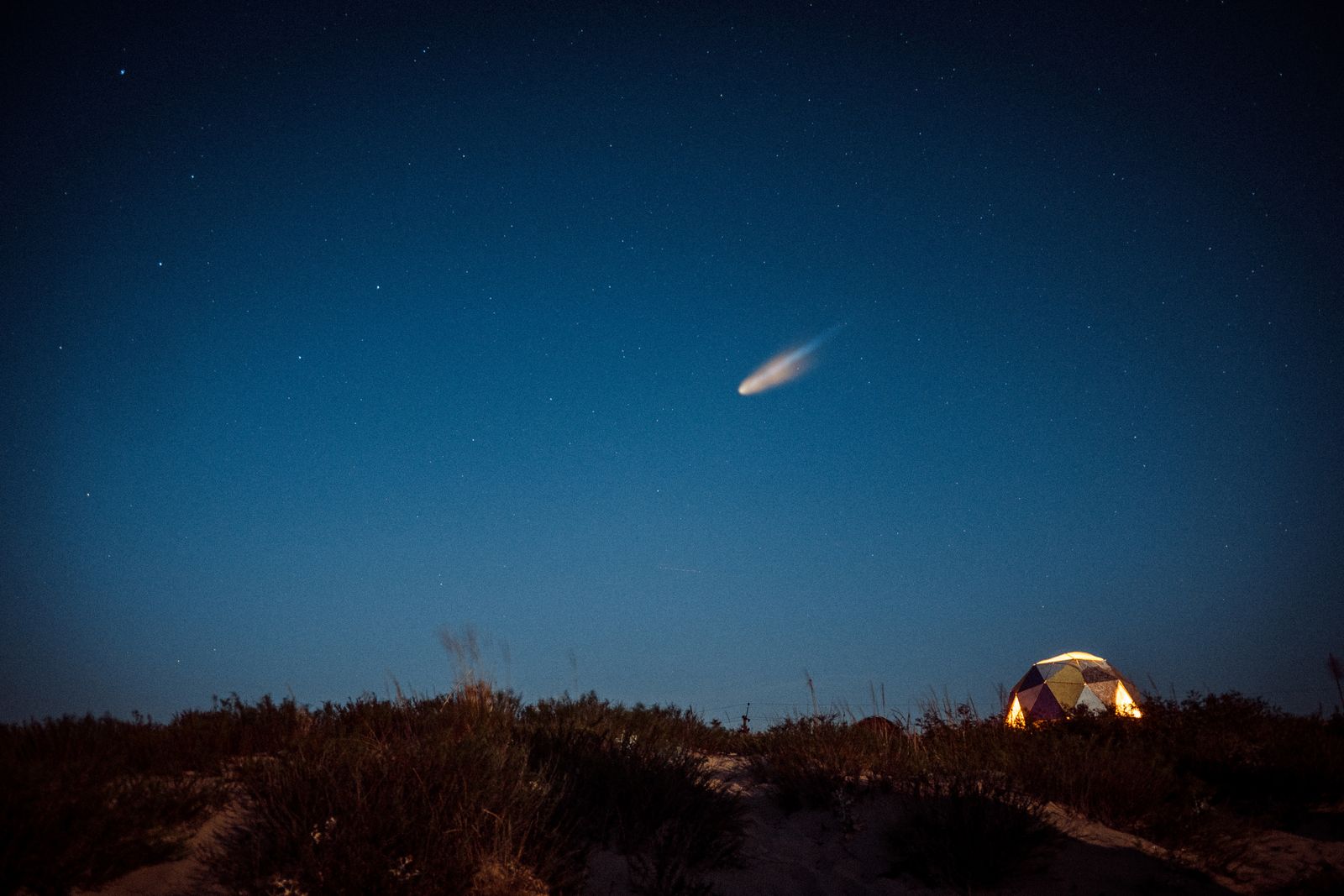
At about 11 in the morning on 28 September 1969, people around Murchison heard a series of booms and saw a fireball trailing smoke across the sky. Fragments came down over several square kilometres, and more than 100 kilograms were eventually collected.
The rock is a carbonaceous chondrite, a primitive type rich in carbon compounds, and because the fall was witnessed and the material gathered quickly, Murchison became one of the most studied meteorites in the world. The grains that matter here are tiny pieces of silicon carbide, far smaller than a grain of sand, recovered by dissolving the surrounding rock in acid until only the most durable specks remain.
How you date a grain older than the Sun
These specks are not dated the way a rock on Earth is. They are dated by how long they drifted through space.
Before they were swept into the cloud that became our solar system, the grains spent a very long time as free-floating interstellar dust. Out there they were exposed to galactic cosmic rays, high-energy particles that strike solid matter and, now and then, transform an atom inside it into a new isotope. One of those products, a form of neon, builds up at a roughly steady rate. Measure how much has accumulated, and you can work out how long the grain was adrift before it was sheltered inside the meteorite.
That is the method a team led by Philipp Heck of the Field Museum and the University of Chicago used in a study published in 2020. They measured cosmic-ray exposure ages for 40 large presolar silicon carbide grains from Murchison, the largest such dating effort of its kind.
Most are old, and the oldest are very old
This is where the precision matters. Most of the grains the team dated formed in the few hundred million years before the Sun, clustering around 4.6 to 4.9 billion years ago. A smaller number were older. The oldest reached about 7 billion years, roughly 2.5 billion years beyond the 4.54-billion-year age of Earth and the solar system.
So the headline figure is the extreme of the range, not the average. Even the youngest of these grains, though, still predates the Sun, which is what makes the whole population presolar. They are older than the star our planet orbits.
What the grains actually are
Each grain is a piece of another star.
Silicon carbide of this kind condenses in the cooling outflows of dying stars, the kind that puff their outer layers into space late in life. Those expelled grains travel the galaxy until some are caught up in the formation of a new system, which is how a fragment of a star that died before the Sun ended up in a paddock in Victoria.
The clustering of ages led Heck’s team to a further suggestion, offered as interpretation rather than settled fact: that many of the grains may have formed during a burst of star formation in the galaxy around 7 billion years ago, a busier-than-usual stretch of stellar birth and death. That reading is debated, and the dating itself does not depend on it.
What is not in question is the simpler thing. A rock that fell on an Australian farming town within living memory carried, intact, solid matter that is older than the Sun, the Earth, and everything else ever measured on this planet. It had been drifting for billions of years before there was a planet here to land on.