
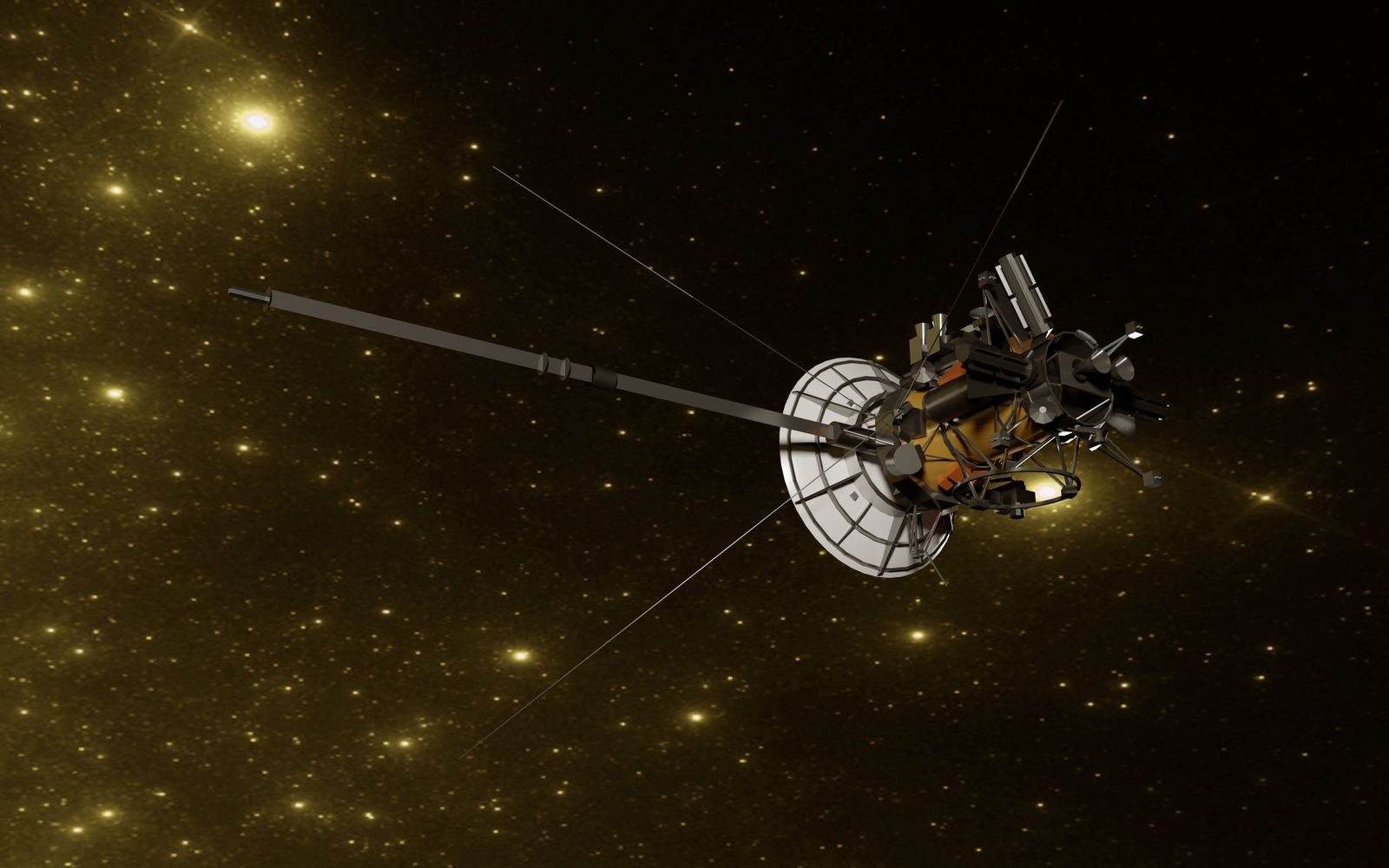
The two Voyager spacecraft, launched in 1977, each carry a gold-plated copper phonograph record holding sounds and images of Earth. On the aluminium cover of each record is a detail that gets less attention than the music: a small sample of uranium, put there so that whoever finds it can work out how long it has been travelling.
The claim that it functions as a built-in clock is true.
What needs correcting is the timescale, which is far longer than the figure usually attached to it.
How the clock works
The cover carries an ultra-pure source of uranium-238, electroplated onto a patch of the surface about two centimetres across rather than pressed in, with a radioactivity NASA puts at about 0.00026 microcuries. Uranium-238 is radioactive, and it decays at a fixed, well-measured rate. Half of any quantity of it turns into other elements over about 4.51 billion years, a span known as its half-life.
That steady decay is what makes it a clock. A finder who measures how much uranium-238 is left, against how much of the decay product has built up beside it, can calculate how long the process has been running. That figure is the time since the sample was placed on the spacecraft, which is to say the age of the record.
It is an elegant choice, because it needs no shared language and no working knowledge of human history. Any civilisation that understands radioactive decay arrives at the same number.
Why “a billion years” undersells it
The figure commonly quoted for the record is roughly a billion years, and it is worth being clear about what that number actually describes.
A billion years is the rough estimate for how long the physical disc should survive in the near-vacuum of interstellar space, where there is little to erode it. The uranium clock is a separate matter. With a half-life of about 4.51 billion years, the sample remains readable as a clock for far longer than the disc is expected to last, and in principle for several billion years. The limit on dating the record is not the uranium running out. It is the disc itself wearing away.
So the clock does not keep time for “roughly a billion years”. It keeps time for as long as there is measurable uranium left, which is a much longer window than the object it is attached to will physically endure.
It is not the only clock on the cover
The uranium was never meant to be trusted on its own. The same cover carries a second, independent way of fixing the date, in the form of the pulsar map.
That diagram, the starburst of lines also etched on the earlier Pioneer plaques, shows the position of the Sun relative to 14 pulsars, rapidly spinning stars that flash with very regular periods. Those periods are encoded on the cover in binary. Because pulsars slow down slightly and predictably over time, a finder could compare the periods as recorded against the periods as measured, and read the gap as elapsed time.
Two clocks, built to check each other rather than to be taken on faith. If the uranium and the pulsars disagreed, that disagreement would itself be informative.
The catch is being found at all
For all the care in the dating, the harder problem is the one the record cannot solve, which is reaching anyone.
The Voyagers are not aimed at any particular star, and they are in no hurry. Voyager 1 will not pass within a couple of light-years of another star for roughly 40,000 years, and even then “pass” means an enormous distance rather than an encounter. The odds that either record is ever recovered and read are, on any honest accounting, very small.
That is the part the uranium clock quietly acknowledges. The people who built it were not betting on a finder. They engineered a way to answer a question that may never be asked, and built it to stay accurate long after the civilisation that made it is gone. The clock will keep good time whether or not anyone is ever there to read it.
