
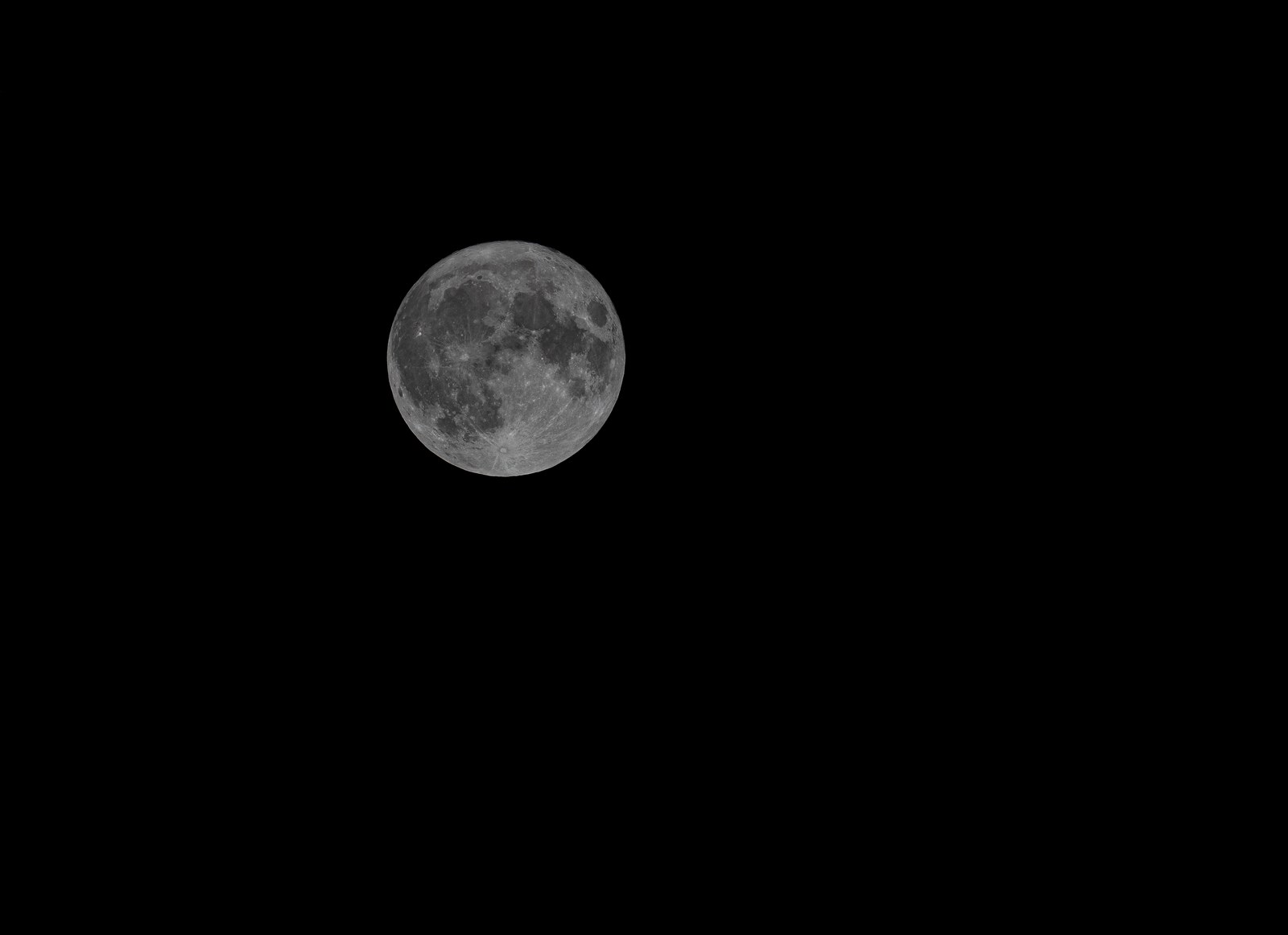
Take the Moon’s average distance from Earth, line up the other seven planets of the solar system end to end in the gap, and they fit, with roughly 4,400 kilometres left over. It is a tidy way to feel just how far away the Moon actually is.
It is also true only under two assumptions that most versions of the fact leave unstated. Change either one and the planets no longer fit.
The arithmetic
Start with the distance. The Moon sits, on average, about 384,400 kilometres from Earth, a figure drawn from NASA’s planetary data.
Now the planets. “Every other planet” means the seven that are not Earth: Mercury, Venus, Mars, Jupiter, Saturn, Uranus, and Neptune. Pluto, reclassified as a dwarf planet in 2006, is not in the count. Using each planet’s average diameter, the widths add up to about 380,010 kilometres. Subtract that from the 384,400-kilometre gap and you are left with roughly 4,390 kilometres of empty space, which rounds to the figure usually quoted.
So the headline number checks out.
The interesting part is how little has to change before it stops being true.
Why the diameter you choose decides the answer
Planets are not perfect spheres. The gas giants spin fast enough to bulge at the equator and flatten at the poles, so each one has two different widths. Jupiter, for instance, is about 142,984 kilometres across its equator but closer to 133,700 kilometres pole to pole. Saturn is more lopsided still.
The 4,400-kilometre margin comes from using average diameters. Line the planets up by their widest measure instead, the equatorial diameter, and the seven widths sum to about 387,940 kilometres. That overshoots the average Earth-Moon distance by more than 3,500 kilometres, and the planets spill past the Moon.
The fact survives, in other words, only if you turn the gas giants pole-up and measure them at their slimmest. Stand them on their equators and the line is too long.
And the Moon does not stay put
The second assumption is hiding in the word “average”. The Moon’s orbit is an ellipse, not a circle, so its distance changes constantly. At apogee, its farthest point, it is about 406,700 kilometres away, and the planets fit with more than 26,000 kilometres to spare. At perigee, its closest approach and the cause of the so-called supermoon, it is about 356,500 kilometres away.
At perigee the planets do not fit at all. The same seven worlds that cleared the average gap now overshoot a close Moon by more than 20,000 kilometres.
The fact is real, then, but it is a statement about a long-run average, not about the Moon on any particular night.
What it actually shows
The planets really do, on the usual reckoning, fit in the gap, and that is worth sitting with. Every other world in the solar system, including Jupiter and Saturn, strung together in a line, and the Moon is still slightly farther away than the end of it.
What the margin reveals is how thin the result is. That 4,400 kilometres is barely over one per cent of the total distance, which is why the answer flips so easily between fits and does not fit. The fact is less a fixed property of the solar system than a near-coincidence that holds on average and breaks at the edges.
The gap between Earth and its only natural satellite is wide enough to swallow every other planet we have, and on a night when the Moon is drawn in close, not even quite that.
