
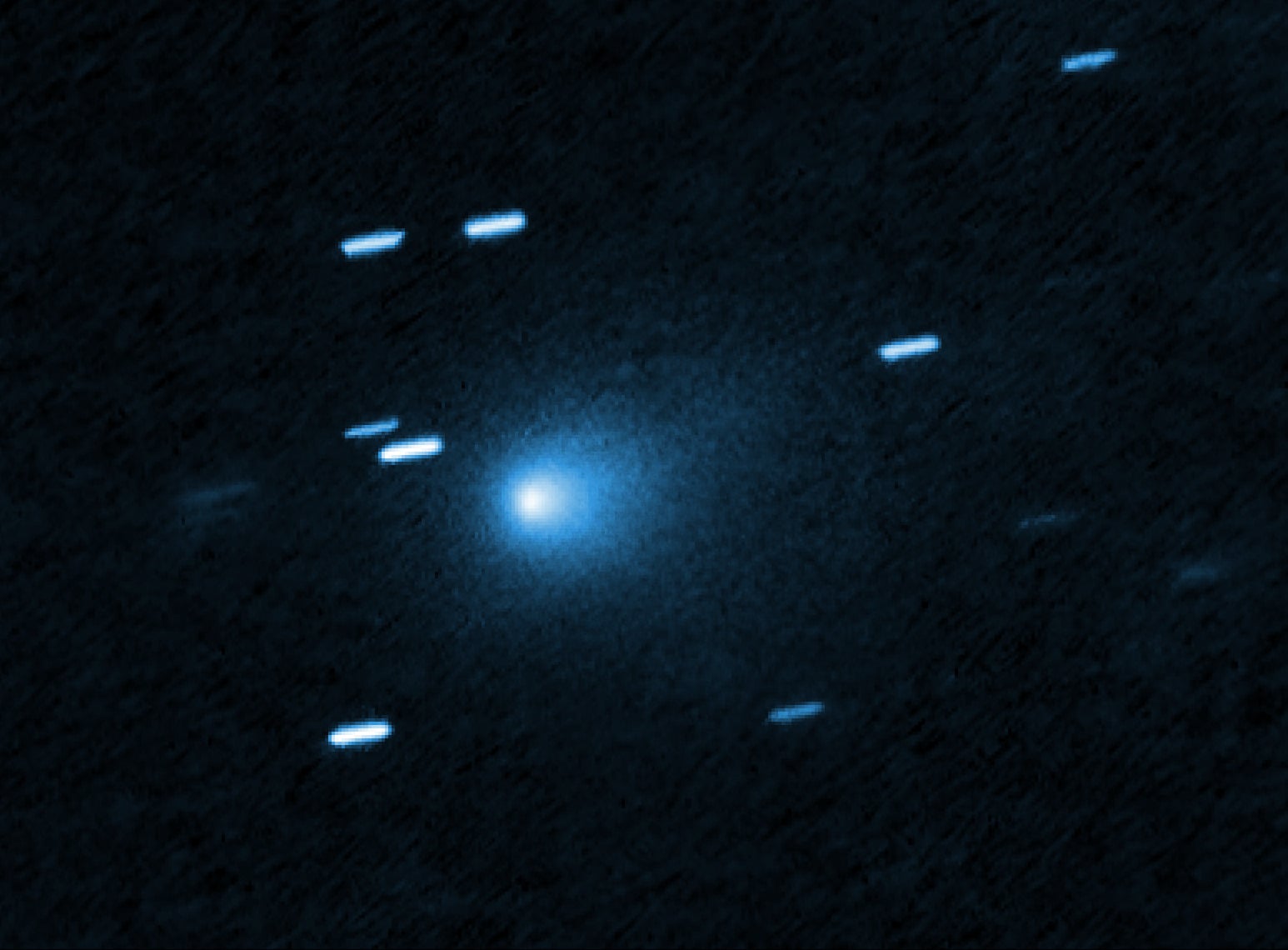
Update, 15 September 2026: this article reports the Oxford thick-disk analysis as it stood in June 2026. Isotope measurements published in Nature later that month revised the estimate upward, placing the formation of 3I/ATLAS at up to roughly 12 billion years ago. The seven-billion-year figure described below is that earlier estimate, not the current one.
On the morning of 1 July 2025, the ATLAS survey telescope at Río Hurtado in Chile detected an unusual moving point of light against the background stars. Within a few hours, follow-up observations from other telescopes had confirmed the object’s trajectory: this was not a solar-system comet on a long elliptical orbit, but a body moving through the inner solar system on a hyperbolic path, travelling too fast and at too steep an angle to have originated from any region gravitationally bound to the Sun. The object was, in other words, an interstellar visitor — only the third such object ever confirmed, after 1I/’Oumuamua in 2017 and 2I/Borisov in 2019. It was named 3I/ATLAS in honour of the survey that detected it. By the time the discovery announcement reached the broader astronomical community, a graduate student at the University of Oxford had already started running it through a predictive model he had spent the previous several years developing — and what the model returned was, by every available indication, the most remarkable interstellar visitor humanity has yet encountered.
According to the Royal Astronomical Society’s announcement of the Oxford analysis, the graduate student was Matthew Hopkins, who had defended his PhD thesis just one week before 3I/ATLAS was discovered. Hopkins had developed, with co-author Chris Lintott and colleagues at the University of Canterbury in New Zealand, what they call the Ōtautahi-Oxford Model — a statistical framework for inferring the origin and age of interstellar objects from their orbital trajectories. The discovery of 3I/ATLAS turned out to be the first real-time test of the model on a brand-new object. Hopkins ran the analysis. The result was striking enough that Hopkins, who had been planning to start a holiday, instead spent the following days comparing the data to his model’s predictions. The headline conclusion: 3I/ATLAS has approximately a two-thirds probability of being older than the solar system, with a statistical best estimate of approximately 7 billion years — making it, by the Oxford team’s analysis, the oldest comet humanity has ever observed.
What “the thick disk” actually means
As reported by Space.com’s coverage of the Hopkins-Lintott analysis, the key piece of evidence pointing toward the extreme age of 3I/ATLAS is its steep angle of approach. The Milky Way galaxy is not a uniform structure. Most of its stars, including the Sun, sit in a relatively thin disc that rotates around the galactic centre — a flat layer of younger, metal-rich stars approximately 1,000 light-years thick. Above and below this thin disc lies a substantially larger, more diffuse structure called the thick disc — a population of older stars, typically 10 to 12 billion years old, that orbit the galaxy on inclined paths and pass through the thin disc rather than residing within it. 3I/ATLAS arrived from a steep angle that traces directly back to the thick disc population. Its trajectory was the diagnostic signature that allowed Hopkins’s team to conclude, with statistical confidence, that the comet had formed around a star far older than the Sun.
The thick disc is older than the thin disc but is not the oldest component of the galaxy. The Milky Way’s stellar halo — a much more diffuse population of stars extending well above and below the disc — contains stars approximately 12 to 13 billion years old, dating to within a billion years of the Big Bang itself. Globular clusters, which orbit the galaxy in three dimensions rather than in the disc plane, contain some of the oldest known stars. But the thick disc is the oldest component dense enough to be a plausible source of interstellar comets reaching the inner solar system on observable trajectories. The previous two interstellar objects, 1I/’Oumuamua and 2I/Borisov, both originated in the thin disc and were therefore comparable in age to the Sun or younger. 3I/ATLAS is the first sample any human telescope has ever obtained from material formed in the much older star systems that populate the thick disc.
What 3I/ATLAS is made of
Per EarthSky’s coverage of the chemical composition of 3I/ATLAS, initial spectroscopic observations have identified the comet as water-ice-rich, with apparent enhancement in volatile compounds relative to comets formed within the solar system. The chemistry is consistent with formation around an older, lower-metallicity star — one whose protoplanetary disc would have contained different ratios of light elements, carbon compounds, and water than the disc that produced the Sun and its planets. Comets are, in cosmochemical terms, frozen samples of the protoplanetary disc material from which they formed. A comet from a 7-billion-year-old star system therefore preserves, in its volatile inventory and isotopic ratios, direct evidence of what the chemistry of the galaxy looked like at a substantially earlier point in its evolution than anything previously available to direct sampling.
This makes 3I/ATLAS scientifically valuable beyond its status as a single remarkable object. The comet is, in effect, a small frozen specimen of the early Milky Way, delivered to the inner solar system by approximately 7 billion years of interstellar drift. By the time it passed closest to the Sun on 29 October 2025 and closest to Earth on 19 December 2025 — at a safe distance of 168 million miles — astronomers had used Hubble, ground-based telescopes, and several space-based instruments to gather as much spectroscopic and imaging data as the brief window allowed. The comet has now passed its closest approach and is heading back out of the solar system, never to return. The data collected during its passage will be analysed for years.
What comes next
The discovery of 3I/ATLAS is, by every available indication, the leading edge of what is likely to become a substantially larger field of interstellar-object science over the next decade. The Vera C. Rubin Observatory, currently beginning operations in Chile, is expected to detect interstellar objects at a far higher rate than any previous survey — possibly several per year rather than one every few years. The statistical case for the existence of approximately one interstellar object per year passing through the solar system was already well-established from the ‘Oumuamua and Borisov detections; most have simply been too small, too dim, or too transient to be caught by existing surveys. The Rubin Observatory’s combination of wide field of view, deep sensitivity, and rapid cadence should change this. Each future interstellar visitor will be a new opportunity to test the Hopkins-Lintott statistical framework, to compare chemical compositions across objects of different ages and galactic origins, and to assemble a substantially more complete picture of what the rest of the Milky Way is made of.
3I/ATLAS itself will not be back. Its hyperbolic trajectory carries it out of the solar system and back into interstellar space on a path that will not bring it near the Sun again. Whatever further drift it makes through the Milky Way over the next several billion years — whether it eventually encounters another stellar system, drifts indefinitely between them, or is scattered into the galactic halo — is now no longer accessible to terrestrial observation. The Oxford team’s analysis, if their two-thirds statistical confidence holds up to further scrutiny, places the comet’s formation in a galactic environment approximately 2.4 billion years older than the Sun. That number alone makes 3I/ATLAS the oldest piece of material from outside the solar system that humans have ever knowingly sampled, by a margin of approximately the entire previous age range of observed comets combined.
NOW WATCH: Billionaires are Quietly Buying the Sky (our new YouTube video)
