

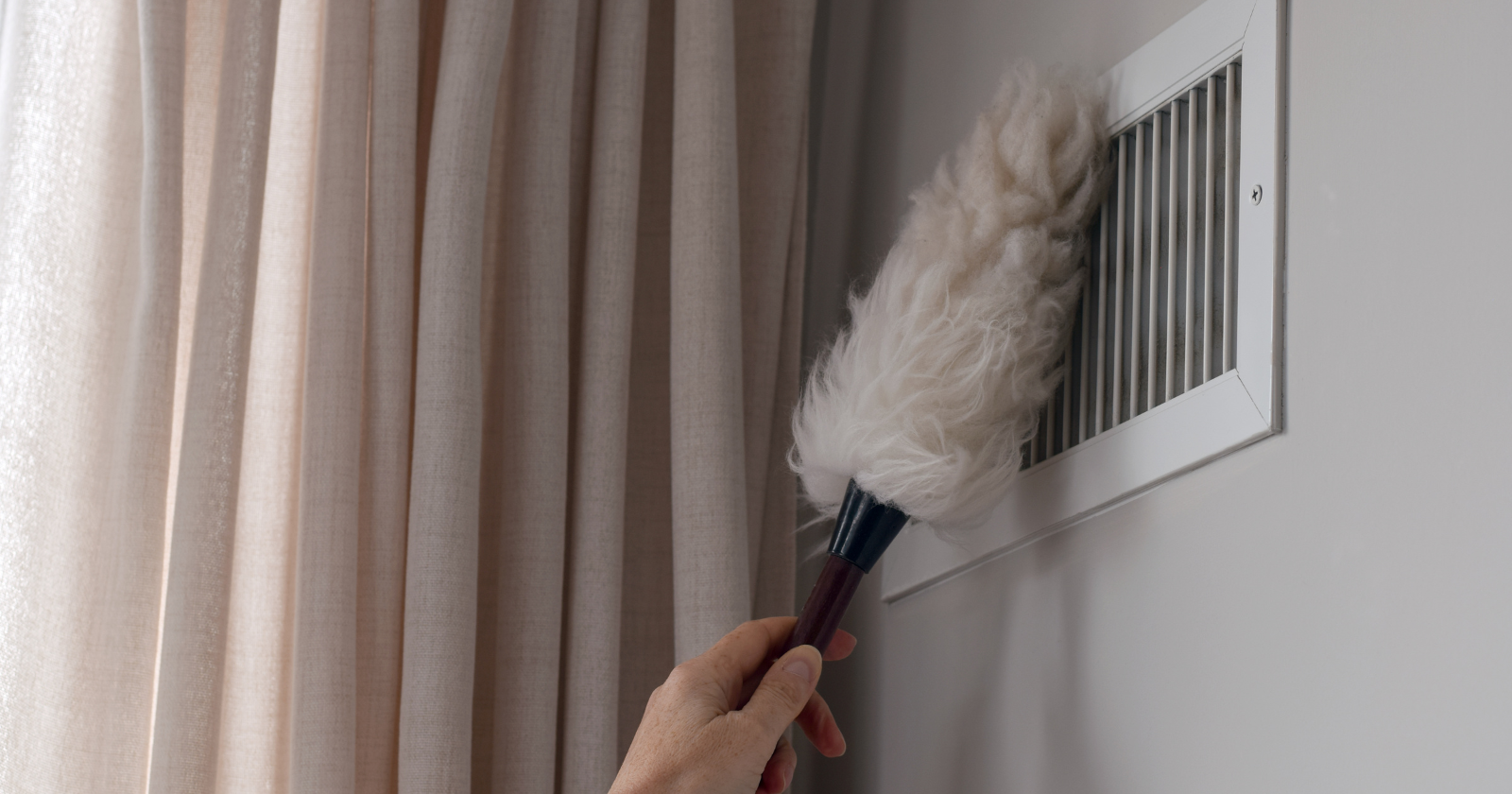
Look at a windowsill after a week without cleaning and you are looking at a material document. The grey film gathering there is not simply grime from outside. It is a composite, built layer by layer from everything that moves through the space: the people who live in it, the air that passes through, the products used, the seasons outside. Analysed carefully, household dust can be read almost like a log. Researchers have learned to do exactly that.
We are writers, not chemists or environmental scientists. What follows is a reading of several years of research into what dust is, not guidance on what to do about it.
What the mixture contains
House dust is usually described first in terms of skin. The figure most commonly cited is that humans shed something in the order of millions of skin cells per day — one widely cited estimate puts it at 500 million, with the outer layer renewing roughly every two to four weeks. Some of that settles. But the claim, still circulating widely, that household dust is mostly dead skin has been questioned by researchers who point out that skin cells account for a meaningful portion of the organic fraction, not the whole of the dust itself. The rest is a longer list.
Clothing and textiles contribute substantially. As fabric moves and wears, it releases fibres, and in homes with synthetic materials that means microscopic strands of polyester, nylon, acrylic and other polymers shed into the air and settle. Outdoor soil arrives on shoe soles and through ventilation. Pollen enters on clothing, on pets, through open windows; research published in Building and Environment found that indoor pollen loads track outdoor seasonal patterns closely, meaning the species composition of the dust in any given room shifts across the year. Insect fragments, particularly from dust mites and cockroaches, are present in most samples. Smoke particles, whether from cooking, candles, or outdoor air pollution tracked inside, add to the mix. Fungal spores, drawn in from outside, contribute to the biological fraction.
Then there is the microbial layer, which has attracted significant attention as sequencing technology has improved. A 2016 paper in PLOS One characterised the bacterial and fungal communities in indoor dust across a range of homes, finding that bacteria in indoor environments are largely derived from the inhabitants themselves, with genera including Staphylococcus, Streptococcus, Corynebacterium, and Lactobacillus dominating the profile. Fungi, by contrast, arrive mostly from outdoors, their community composition shifting with outdoor vegetation and season. The result is a microbial record that reflects both who lives in the space and what surrounds it.
The outdoor world inside
Around two-thirds of the material in household dust is estimated to originate outside, though this varies significantly by study, region, and building type. It is tracked in on shoes, carried in on air currents, attached to clothing, or brought in on pets. The remaining third is generated internally: by the bodies present, by the materials in the room, by whatever is cooked, burned, or sprayed. The ratio shifts in tightly sealed buildings and in homes with poor ventilation.
This outdoor contribution means dust is not simply a domestic record. It is also a local environmental one. Homes near high-traffic roads tend to carry higher loads of combustion particles and certain metals. Homes near agricultural land can carry pesticide residues. Seasonal pollen patterns are legible in indoor samples. In this sense the windowsill is not sealed off from the street outside; it is continuously receiving it.
The chemical accumulation
Dust also accumulates what is harder to see: the chemical load from consumer products in the home. Environmental chemist Miriam L. Diamond of the University of Toronto has described dust as holding a “long memory” of the contaminants introduced to a house. Flame retardants migrate off the foam in furniture and off electronics. Phthalates leach from vinyl flooring. Fragrance compounds shed from personal care products attach to airborne particles before settling. These compounds continue to accumulate in dust over time, and because homes are tightly sealed environments, the accumulation is persistent. Diamond has noted that dust from older homes can still carry traces of DDT and PCBs, banned in many countries for decades.
A 2016 analysis published in Environmental Science & Technology by Susanna D. Mitro of George Washington University and colleagues — including Robin E. Dodson of the Silent Spring Institute and Veena Singla of the Natural Resources Defense Council — reviewed more than two dozen dust studies covering 45 compounds. They found that ten compounds appear in 90 percent or more of US household dust samples, including phthalate plasticisers, flame retardants, and phenol preservatives from cosmetics. These are findings from that particular dataset, not universal claims about all households or all exposures. The health picture is genuinely uncertain: researchers have established that dust is a source of exposure to these substances, but determining the extent of any health risk requires more work, and for many of the compounds present, no clear safety thresholds have been set.
Microplastics have been found in indoor dust samples from across the world. A 2024 review in Indoor and Built Environment noted that synthetic textiles are among the primary sources, with polyester and polypropylene fibres dominant in most samples. The concentration varies by household, and the long-term health picture from microplastic inhalation and ingestion is still being established.
What the archive tells us
P. Lee Ferguson, an environmental chemist at Duke University, has described the chemical compounds measurable in household dust as covering only “the few to a hundred compounds that we know are in dust,” against a backdrop of tens of thousands to over a million compounds currently in commercial use. The full chemical archive in any given room is, in that sense, largely unread. Researchers using newer nontargeted mass spectrometry approaches are beginning to identify compounds that were not previously expected: surfactants from cleaning products, azo dyes from textiles, traces of dog flea treatments, and in some samples, cocaine. That last compound appears as a data point about what circulates in the built environment, not as moral commentary. It is a data point about what circulates in the built environment.
The more interesting point, in our reading of this body of work, is what the archive implies about ordinary domestic space. A room that appears clean is still accumulating. The material record builds whether or not anyone is paying attention to it. What settles on a windowsill over a week reflects the people inside, the objects they use, the plants flowering outside, the roads nearby, the products manufactured with compounds that were assumed to stay where they were put.
Dust is not usually studied for its own sake. Researchers study it because it is an unusually honest record of what surrounds us. It does not preserve memory in the way we think of memory. It preserves material presence: what arrived, what shed, what accumulated. Every ordinary surface is doing this, quietly, all the time.