

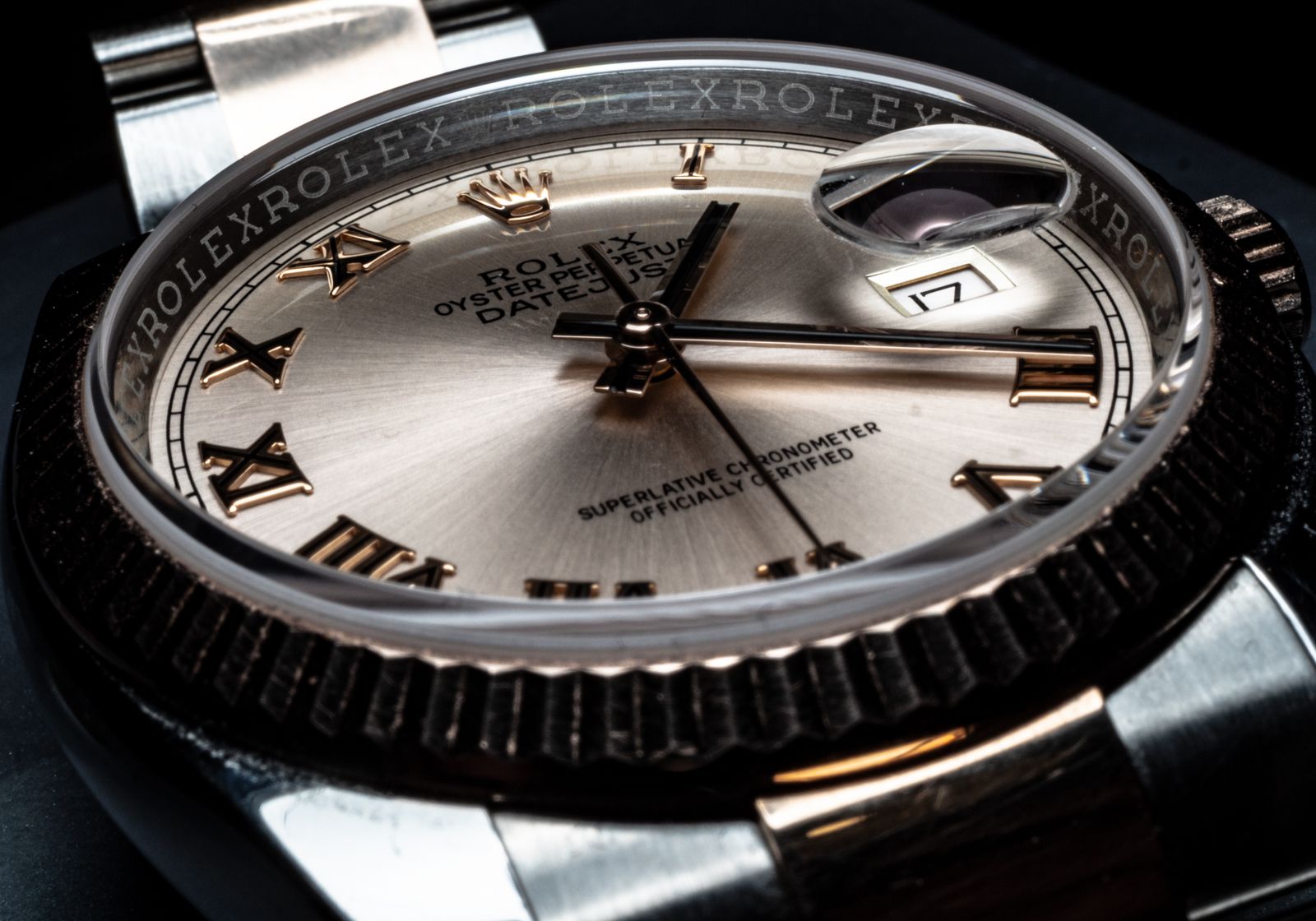
The word Rolex has five letters, two syllables, and works in every language a marketer might want to sell into. It is short enough to sit on a watch dial without crowding the hands, blunt enough to pronounce in German, French, Japanese, and Hindi without distortion, and abstract enough to mean nothing at all. A young Bavarian named Hans Wilsdorf registered it as a trademark in 1908 in La Chaux-de-Fonds, Switzerland, years before he had a factory of his own. The name came first. The watches followed.
That sequence — invent the word, secure the word, then build the company around it — is one of the earliest known examples of what marketers would later call a coined brand. Wilsdorf did it in 1908 for a product he did not yet manufacture.
A word designed for a dial
Wilsdorf had ended up in London after a stint at a watch exporter in La Chaux-de-Fonds. By his mid-twenties he was importing Swiss movements and casing them in England under the unglamorous name Wilsdorf & Davis. He wanted something better. He wanted a name that was short, memorable, pronounceable in any European tongue, and small enough to be legible above the 12 o’clock marker of a wristwatch barely 30 millimetres across.
The constraints were real.
Try the test yourself. Write your favourite watch brand on a dial 30 millimetres wide, leaving room for hour markers, a logo, and the hands. Patek Philippe is thirteen letters and a space. Vacheron Constantin is eighteen. Jaeger-LeCoultre is fifteen and a hyphen. Rolex is five. On a wrist seen from across a room, five wins.
The phonetics of a global product
The cleverness sits in what the word avoids. There is no diphthong that collapses in Mandarin. No silent letter that an English speaker would mispronounce in French. No umlaut. No accent. No consonant cluster that trips an Italian tongue. The two syllables — ro and lex — are phonemes that exist in nearly every major language. A Tokyo retailer and a Geneva concierge say the word almost identically.
This was not accidental. By his own account, Wilsdorf wanted a name that was short, easy to say and remember in any language, and that looked good on a dial — a goal he later described as the reason he ran through hundreds of letter combinations before settling on Rolex, as Rolex itself recounts in its company history. He had also learned, selling watches across the British Empire and into continental Europe, that brand names with national flavour travelled badly.
He got one. Rolex is the closest thing the watch industry has ever produced to a piece of linguistic infrastructure — a sequence of sounds engineered to survive translation.
Trademark first, factory later
Wilsdorf registered the name in Switzerland in 1908 — the surviving registry entry is dated 2 July 1908 and lists the La Chaux-de-Fonds office of Wilsdorf & Davis, as the original trademark record reproduced in horological archives shows. He was still operating out of London and still casing movements supplied by Hermann Aegler’s workshop in Bienne. He did not own a Swiss manufacturing operation. He owned a word, an import-export business, and a hunch that wristwatches — at that point still dismissed as women’s jewellery, a prejudice Space Daily has explored in detail — would become the dominant form of timekeeping for men within a generation.
He was right on both counts. The First World War, with its trench officers needing both hands free, did for the wristwatch what no advertising campaign could. By 1919 Wilsdorf had relocated to Geneva, partly because British post-war duties made exporting from London punishing, and partly because anti-German sentiment in Britain had already pushed him to rename the firm The Rolex Watch Co. Ltd. in 1915, a change Britannica attributes to wartime prejudice against the German-sounding Wilsdorf name. The company that became synonymous with Swissness was Swiss almost by accident of geopolitics.
What a name buys you
Coining a word does something specific that descriptive names cannot. A descriptive name — Universal Geneve, International Watch Company — tells you what the thing is and where it comes from, and that’s the ceiling of its meaning. A coined word is an empty vessel. Whatever you pour into it over decades of advertising, sponsorship, and product, the word holds.
Wilsdorf began pouring almost immediately. The company developed the Oyster case, among the first commercially viable waterproof wristwatches. In 1927 a young London typist named Mercedes Gleitze, the first British woman to swim the English Channel, wore an Oyster during a high-profile Channel swim, and Wilsdorf took out prominent newspaper advertising to promote it. The word Rolex had its first myth.
The dress watch market is still organised around names of this kind. A 2025 Esquire review of a dress watch describes the category in language Wilsdorf would have recognised: thinness, legibility, restraint. The dials of the watches sitting next to it in auction catalogues all carry short, abstract words. Omega. Cartier. Tudor. Seiko. The naming convention Wilsdorf arrived at in 1908 became the default the rest of the industry now follows.
The decision that made Rolex unbuyable
Naming was the first of two structural decisions that made Rolex what it is. The second came after the death of Wilsdorf’s wife, Florence. Childless and grieving, he created the Hans Wilsdorf Foundation and, in his will, left every share of Rolex to it. When he died in 1960, the foundation became the sole owner. That arrangement — which Space Daily has covered separately — means no shareholder can demand a dividend, no rival can buy the company, and no quarterly report has to be filed. Rolex’s finances remain opaque because there is no legal obligation to publish them.
The opacity is the point. Because the company discloses nothing, every revenue figure is an outside estimate: analysts at Morgan Stanley and LuxeConsult put Rolex’s annual wholesale revenue above CHF 11 billion in their most recent reading, while cautioning that the brand publishes no official figures of its own. The foundation, a registered Swiss charitable trust, directs funds to charitable causes, including children’s charities — a nod to Wilsdorf’s own childhood as an orphan.
In 2023, Rolex agreed to buy Bucherer, its largest retailer, consolidating a distribution partner it had worked with for a century. A privately held watchmaker had moved to absorb its own biggest distributor, the kind of step no public company answerable to shareholders would have executed so quietly.
The freedom to make moves like that traces back to two decisions taken decades apart by the same man. First, in 1908, to coin a word with no national origin and trademark it before he had a factory. Second, decades later, to put the company beyond ownership. The first decision gave Rolex a name that could be sold anywhere. The second made sure no one could ever sell Rolex.
What five letters still do on a dial
Pick up a Submariner. The word sits above the centre pinion in a sans-serif crown-logo lockup that has barely changed in eighty years. Five letters. About four millimetres wide on a 40 mm dial. The eye reads it before it registers the hour. On a black bezel diving watch under a cocktail-bar lamp, the word is legible at three metres. On a gold Day-Date across a boardroom table, it’s legible at five.
That legibility is a function of letter count. Six letters would have required a smaller font. Eight would have required either a smaller font or a curved arc that distorts the reading angle. Five fits the optical sweet spot of a wristwatch dial almost perfectly — the horological equivalent of a logo built for a smartphone home screen, except Wilsdorf made the choice in 1908, when the dominant timepiece was still a pocket watch on a chain.
There is a reason the watch industry has not produced another Rolex-style word in the 118 years since. Most of the obvious five-letter, language-neutral combinations were registered long ago. The rest sound like pharmaceuticals. Coining a word that means nothing and survives a century of meaning being poured into it is harder than it looks, and the field is crowded with failures whose names you have already forgotten.
The trademark filing in La Chaux-de-Fonds in 1908 predated the existence of Rolex SA as an independent Swiss manufacturer by years. It predated the Oyster case by nearly two decades. It predated the foundation that owns the company today by several decades. It predated the watch on the wrist of an English Channel swimmer by nearly twenty years. For most of its first decade, the word Rolex sat on watches whose movements were made by other people, in cases assembled by other people, sold under a name that belonged to a young Bavarian importer in a rented London office. The word did the work. The factory caught up later.
Look at a Rolex dial today and you are reading a piece of linguistic engineering that is older than the Russian Revolution, older than the Model T, older than the first transatlantic flight. The hands have moved roughly a billion times around it. The word has not.