
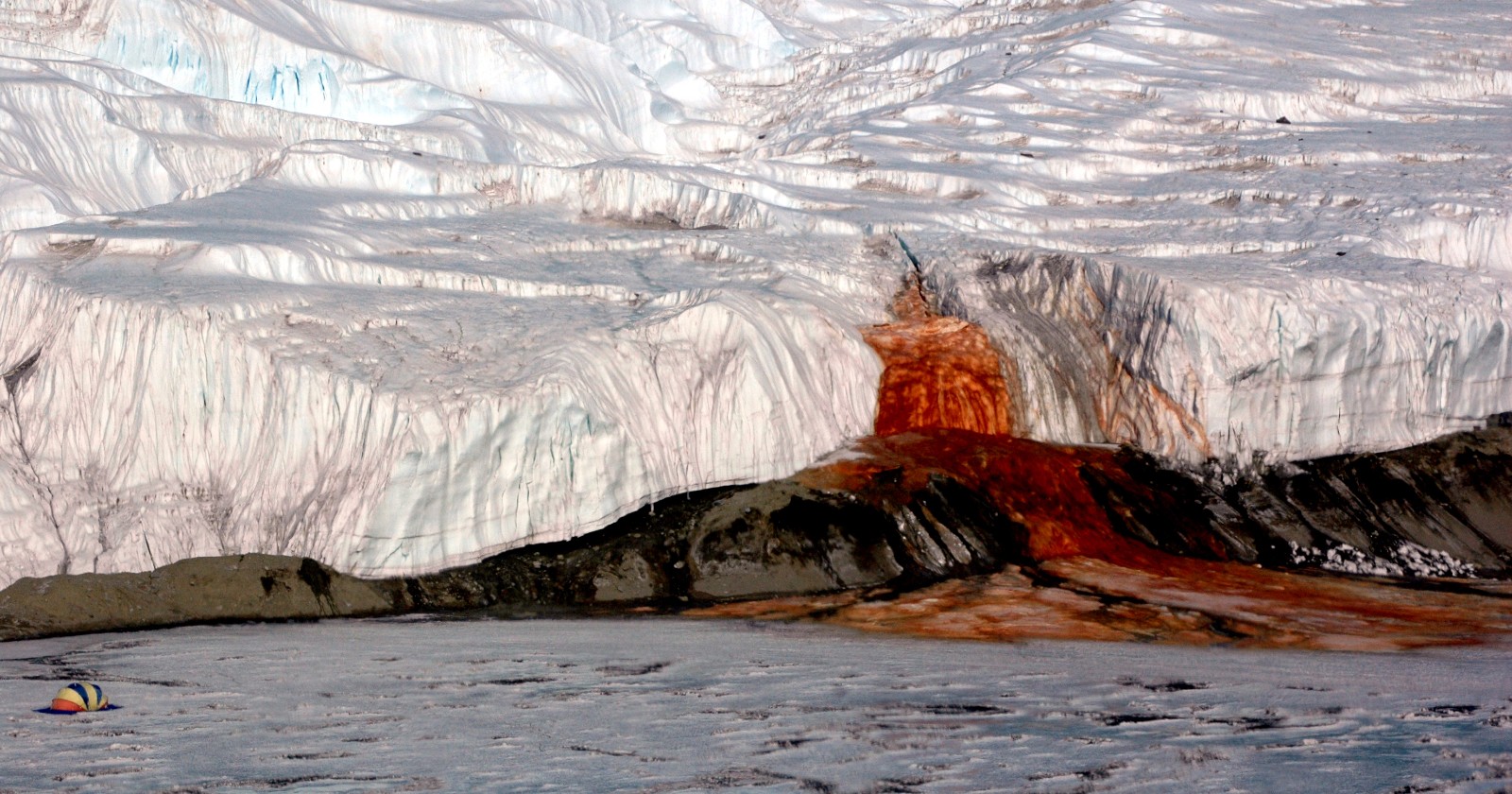
At the end of Taylor Glacier, in Antarctica’s McMurdo Dry Valleys, a sheet of clean white ice is streaked with what looks unmistakably like blood. The stain fans out across the glacier’s snout in a deep red-orange, vivid against a landscape that is otherwise rock, snow and ice. It has been called Blood Falls since explorers first described it more than a century ago.
The color is real, but it is not coming from anything red underground. It comes from iron. Salty water loaded with dissolved iron seeps out from beneath hundreds of meters of ice. When that iron meets oxygen in the air it changes form and reddens, the same basic chemistry that turns a wet nail orange. The water that emerges is not bright red to begin with. The red is what happens to it in the open air.
How it got its name
The stain has been on the maps for over a century. A geologist on Robert Falcon Scott’s Terra Nova expedition described it in 1911, and the glacier itself carries his name, Griffith Taylor. To early eyes the obvious guess was that something living tinted the ice, and red algae were proposed as the culprit before the chemistry was worked out.
The iron explanation came later and held: the red traces to iron carried up from below, not to anything growing on the surface. That much has been settled for decades. What kept Blood Falls a live research problem was the harder question of where the water comes from and what, exactly, makes it red.
Where the water comes from
The fluid feeding Blood Falls is not ordinary meltwater. It is a brine: water so salty it stays liquid at temperatures that would freeze fresh water solid, with a chemistry that looks like heavily concentrated seawater. It sits in a reservoir beneath the glacier and is released in episodes, pushed up through cracks in the ice to the surface where it finally drains out at the glacier’s edge.
That trapped water is also rich in iron and very low in oxygen. Sealed away from the atmosphere, the iron stays in a dissolved, reduced form that carries little color. A community of microbes lives down there in the cold and dark, getting by without sunlight or oxygen by cycling sulfur and iron compounds for energy. By most accounts the brine and its inhabitants have been cut off from the outside world for a very long time. Exactly how long is one of the genuinely unsettled questions, with estimates ranging from thousands of years to more than a million.
When some of that iron-bearing brine finally reaches the surface and contacts air, the dissolved iron oxidizes. The product of that reaction is what carries the color, and the stain spreads across the ice.
What the red is, and what it is not
For a long time the easy explanation was that Blood Falls is simply rusted iron, ordinary iron oxide staining the ice. A 2022 study in Frontiers in Astronomy and Space Sciences complicated that tidy picture. A team led by Elizabeth Sklute and the microbiologist Jill Mikucki examined samples of the red material with a battery of techniques. They reported that the color does not come from the crystalline iron-oxide minerals most people would picture as rust.
Instead, they found the red is produced by tiny amorphous nanospheres: minute, roughly spherical particles rich in iron, but also carrying chlorine, silicon, calcium and magnesium, that form when the dissolved iron in the brine oxidizes on exposure to air. “Amorphous” is the load-bearing word. The particles have no orderly crystal structure, which is why earlier work using X-ray diffraction, a standard tool for identifying minerals, largely missed them. The authors noted that the iron oxides long assumed to give Blood Falls its name were, in their analyses, conspicuously absent as defined crystalline phases.
That does not make the iron story wrong. The redness still traces back to iron oxidizing when the brine meets the air. But the specific thing producing the color turned out to be stranger and harder to pin down than a simple coat of rust, and it took instruments more sensitive than diffraction to see it.
Why a frozen stain interests people who study Mars
Part of the reason Blood Falls gets studied so closely has nothing to do with Antarctica. The McMurdo Dry Valleys are among the coldest, driest places on Earth, and their salty, sulfate-rich soils have long been treated as one of the closest available stand-ins for the surface of Mars. A briny, iron-rich, life-bearing system sealed under ice is exactly the sort of setting astrobiologists have in mind when they ask whether something could survive in a buried reservoir on Mars or in the ocean beneath an icy moon.
The 2022 team leaned into that framing deliberately. They analyzed the red material using the same kinds of instruments carried by Mars rovers, including the spectrometers and mineral-identifying tools flown on missions like the Mars Exploration Rovers and Perseverance. The point was partly practical: if a similar deposit existed on Mars, would the instruments actually there be able to recognize what it was? The fact that amorphous nanospheres slipped past X-ray diffraction is a cautionary note for anyone trying to read Martian chemistry from a distance.
How settled the explanation really is
It is fair to say the broad outline is solid and some of the details are not. The headline mechanism, iron-rich brine emerging and reddening as it oxidizes in air, is well supported. So is the existence of the subglacial brine, its seawater-like chemistry, and the microbial community living in it without light or oxygen.
The softer spots are worth naming. The age of the trapped brine is still a moving target, which is why careful sources give a range rather than a single confident number. The exact makeup of the red particles was revised as recently as 2022 and could be refined again as better instruments are brought to bear. Even an everyday-sounding observation, that the discharge seems to deepen in color as the Antarctic summer goes on, is something researchers have flagged as not yet studied systematically rather than established fact.
None of that dims the basic spectacle. A glacier appears to bleed because water that has been locked away in the dark, carrying dissolved iron and no oxygen, briefly meets the air and turns the color of rust at the exact moment it does. The strangeness is not an illusion to be debunked. It is just chemistry, happening in one of the least hospitable places a person could stand to watch it.
