
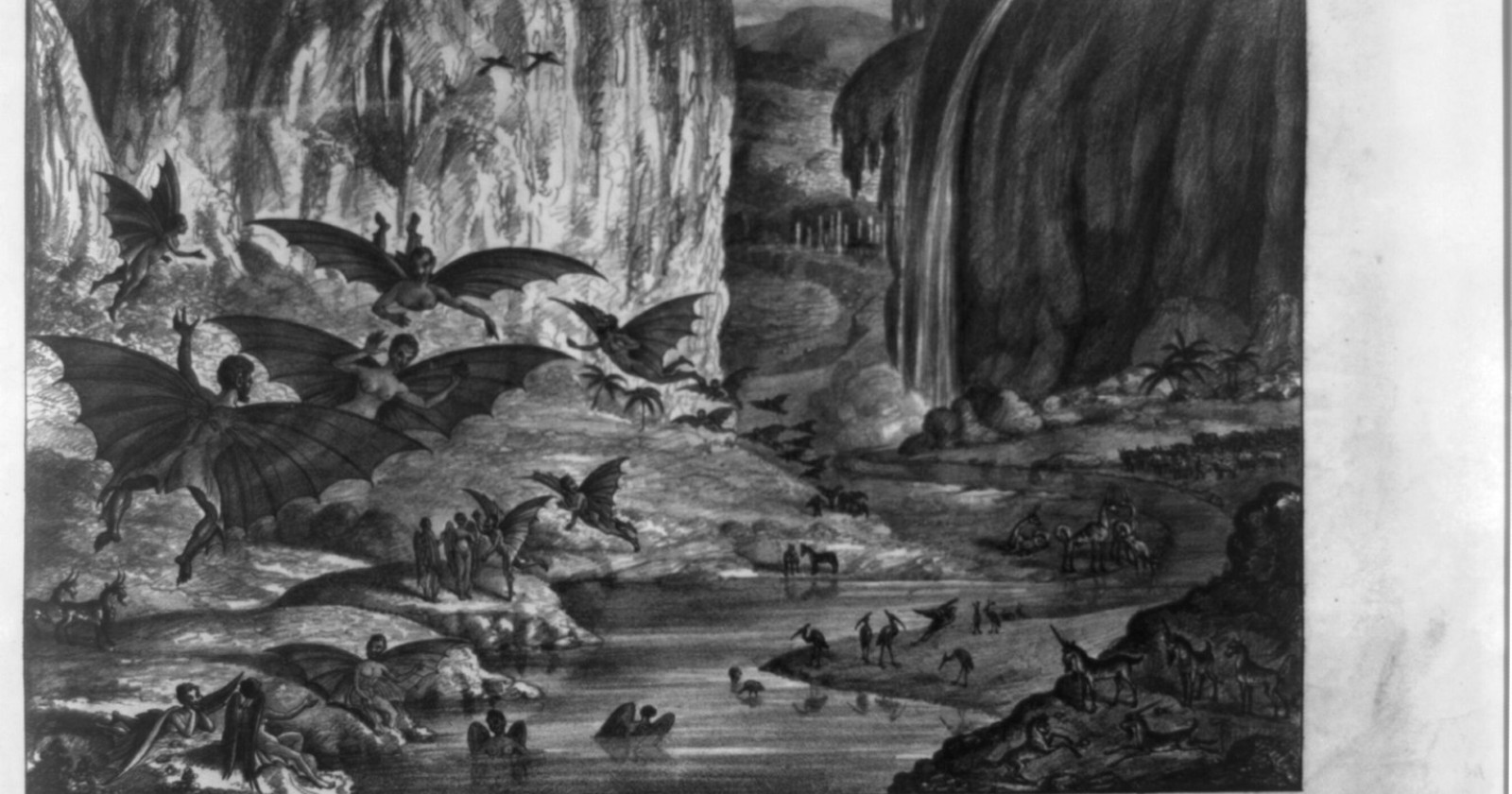
On August 25, 1835, the New York Sun began telling its readers that life had been discovered on the Moon. Over the next six days the paper described lunar forests, inland seas, herds of bison, and beaches of white sand. Strangest of all were the creatures it called man-bats: people roughly four feet tall, covered in copper-colored hair, with thin membrane wings folded across their backs. The discoveries were credited to Sir John Herschel, one of the most respected astronomers alive, observing from an observatory at the Cape of Good Hope.
Herschel had said none of it. He was indeed at the Cape, mapping the southern sky with a real telescope, but he had not seen forests or man-bats or anything like them. The entire account was invented in a newspaper office in lower Manhattan. What makes the episode worth revisiting is not only how strange the claims were, but how plausibly they were staged, and how slowly the public could check them.
How the story was built
The Sun did not simply announce that there were people on the Moon. It claimed to be reprinting a scientific report from a supplement to the Edinburgh Journal of Science, lending the series the weight of a real research publication. The reporting was attributed to a Dr. Andrew Grant, described as a colleague of Herschel’s. Grant did not exist.
The narrative gave Herschel a telescope of fantastic power, built on what it called an entirely new principle, supposedly able to resolve objects on the lunar surface in fine detail. From that invented instrument the paper unspooled its discoveries one installment at a time: first geology and plants, then animals, then, at the climax, the man-bats, which the account named Vespertilio-homo in mock-Latin. There were bison-like quadrupeds, a bluish single-horned animal about the size of a goat, and beavers said to walk upright, carry their young, and live in huts warmed by fire.
The detail is what sold it. The Sun did not gush. It wrote in the flat, measured register of a scientific dispatch, piling up plausible-sounding specifics, which is exactly the texture readers expected from an account carrying Herschel’s name.
Why readers could not easily check
In 1835 there was no transatlantic telegraph cable. A New Yorker who wanted to know whether the Edinburgh Journal of Science had really published such a supplement faced a problem. Confirming it, or checking whether Herschel had said any of this, meant waiting weeks for ships to carry letters across the Atlantic and back. The hoax lived comfortably inside that gap.
It also helped that the named journal could not easily contradict the story, because it had stopped publishing two years earlier, in 1833. A rival editor, James Gordon Bennett of the New York Herald, seized on exactly this point, noting there was no such publication still in print. The defunct journal is one of the cleaner tells that the whole edifice was fiction.
The author is generally identified as Richard Adams Locke, a British-born editor working at the Sun. Years later, in an 1840 letter to another paper, Locke discussed the affair and framed it as satire, a send-up of the era’s overheated speculation about life on other worlds rather than a straight swindle. Whatever his intent, readers took it at face value first and learned the truth later.
What actually happened to belief
The popular memory of the hoax is that all of New York was fooled. Edgar Allan Poe had published his own lunar fantasy, “The Unparalleled Adventure of One Hans Pfaall,” in June of that year, and believed the Sun had borrowed his idea. He later wrote that not one person in ten discredited the story. That line is quoted constantly.
It is also probably too tidy. Historians who have gone back through the New York press of the period find that a good share of the city’s other papers met the Sun’s series with open skepticism. Some reprinted it as entertainment, others picked at its claims, rather than swallowing it whole. The honest version is that the hoax reached an enormous audience and genuinely took many readers in, while a meaningful part of the press was unconvinced from early on.
What is not in dispute is how far the story traveled. Within weeks the series was being reprinted in papers across Europe, and at least one Italian publisher issued a set of lithographs illustrating the supposed lunar discoveries, the man-bats, the temples and the horned beasts among them. By the time the account was widely understood to be fiction, it had already been read, copied and admired on two continents. The hoax outran its own correction, which is part of why it lodged so firmly in popular memory.
How sure are we about the famous circulation numbers
The story usually comes with a triumphant statistic: the hoax supposedly drove the Sun’s circulation to about 19,000 copies, making it, by the paper’s own claim, the most widely circulated daily in the world, ahead of the London Times. The Sun did print a boast to that effect at the height of the series, putting its daily figure at 19,360 and the Times at 17,000.
That number deserves a raised eyebrow. It came from the Sun itself, in the middle of promoting its own sensation, which is not a neutral source. Closer study of the paper’s circulation suggests it was already selling close to twenty thousand copies before the Moon series ran. The popular image of a paper that tripled its readership overnight, on the strength of the hoax, does not hold up well. The Sun’s reach helped the hoax travel; the hoax did not obviously transform the Sun’s reach.
There is a similar wrinkle in how the affair ended. The Sun never published a clean retraction. Around September 16, 1835, it acknowledged, in hedged language, that the account might not be genuine, while still declining to call its own series a fabrication outright. The myth of a bold confession is neater than the record.
Why it still matters
Strip away the man-bats and the Great Moon Hoax looks oddly modern. It worked by borrowing the voice and credentials of real science, attaching a trusted name, citing a source that was hard to check, and releasing the payload gradually so that each installment made the next easier to believe. The barrier to verification then was the width of an ocean and the speed of a sailing ship. The structure of the deception is not so different from things that circulate now.
It is tempting to read the episode as a story about gullible ancestors. It reads better as a story about the machinery of trust: how a claim borrows authority, how long it takes to test, and how a public slowly assembles the habit of asking where, exactly, a remarkable report came from. Herschel, for his part, was reportedly more annoyed than amused at being made the unwitting discoverer of a Moon full of creatures he never saw.
