
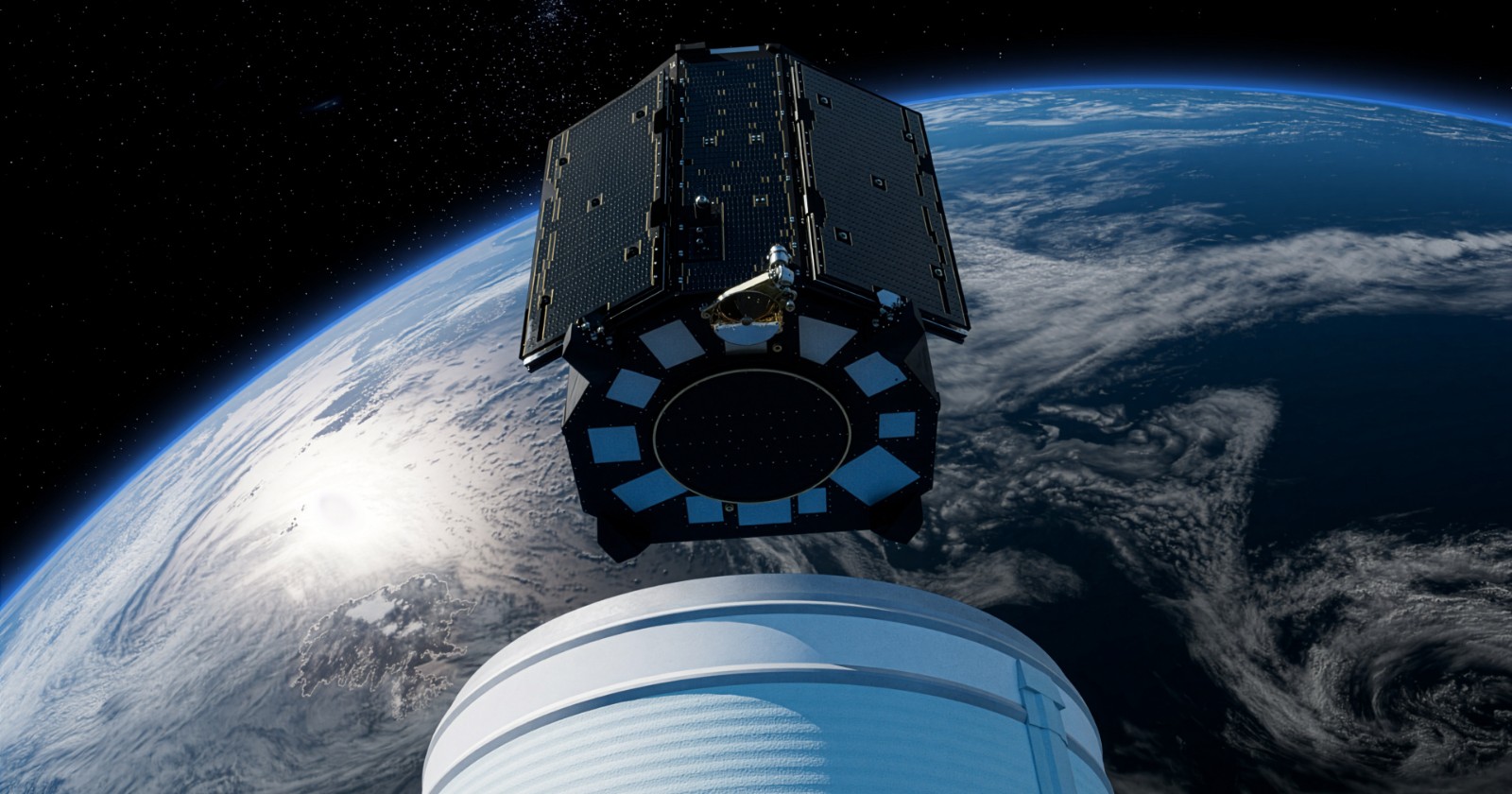
Arianespace is scheduled to launch 36 Amazon Leo broadband satellites aboard an Ariane 6 rocket on Wednesday, June 17, in a flight the company says will carry the heaviest payload ever launched by an Ariane launcher. Liftoff from Europe’s Spaceport in Kourou, French Guiana, is targeted for a window that opens at 11:53 a.m. UTC (8:53 a.m. local time in Kourou), according to Arianespace’s mission announcement.
Designated VA269 by Arianespace and LE-03 by Amazon, the mission is the third Ariane 6 flight dedicated to Amazon’s low Earth orbit constellation and the eighth Ariane 6 launch overall. The 36 satellites are four more than rode each of the two previous Amazon flights, which carried 32 apiece.
Why this flight carries more
The extra payload comes from a hardware change rather than a bigger rocket. VA269 is the first Ariane 64 to fly with four P160C solid-propellant boosters, an upgraded version of the P120C boosters used on earlier Ariane 6 flights.
The upgrade is internal: each P160C holds more propellant, up to 156 tonnes, in a motor about one meter longer than the P120C’s. Arianespace says that raises booster performance by about 10 percent and lifts Ariane 64’s capacity to roughly 22 tonnes in low Earth orbit, an increase of more than two metric tons. The company describes the P160C, built by ArianeGroup, as among the world’s largest one-piece carbon-fiber solid rocket motors.
The 36 satellites sit under the rocket’s 20-meter fairing. If the flight goes to plan, they will separate over a sequence lasting one hour and 51 minutes from liftoff to release of the final satellite.
Where the constellation stands
Amazon Leo, the company’s satellite internet network formerly known as Project Kuiper, is being deployed across several rockets. Amazon says more than 330 of its satellites have been deployed so far across 12 missions, using Atlas V, Ariane 6, Falcon 9 and other launchers.
A successful VA269 would bring to 100 the number of Amazon Leo satellites launched by Arianespace across three missions in under five months, and would mean Europe has launched more than a quarter of Amazon’s growing constellation. Amazon Leo is Arianespace’s largest single customer, with an initial contract for 18 Ariane 6 launches.
“The upgraded P160C boosters are bringing exactly the performance gains we designed them for, and LE-03 will be our most ambitious launch together yet,” Arianespace chief executive David Cavaillolès said in a statement released with Amazon.
What is and is not settled before liftoff
The record and the new booster capability are claims about a flight that has not happened yet. Launch dates and windows commonly slip for weather or technical reasons, and the heaviest-payload milestone and the P160C’s performance gain are only confirmed once the rocket flies and the satellites separate as planned. The figures above are Arianespace’s and Amazon’s own pre-flight numbers; the deployment outcome will not be known until the mission concludes, nearly two hours after liftoff.
Arianespace says the satellites reached Kourou in mid-April and that the rocket’s core stage and four boosters are already assembled on the pad. The company plans to confirm the result after the flight.
