
On 3 February 1966, a 58-centimetre Soviet sphere wrapped in airbags struck the dust of Oceanus Procellarum, bounced across the Moon, rolled to a stop, opened four petals for stability, and began sending the first photographs ever taken from the surface of another world.
The pictures did not first reach most readers through Pravda, TASS, or Soviet television. They reached them through a British newspaper scoop, because the signal from Luna 9 was unencrypted, Jodrell Bank Observatory in Cheshire was listening, and the image format looked close enough to the Radiofax technology used by newspaper picture desks.
The landing that had to bounce
Luna 9 was the Soviet Union’s first successful lunar soft-landing after a string of failed attempts. Earlier spacecraft had missed the Moon, struck it too hard, or failed before they could complete the descent. This one used a blunt solution: slow the main spacecraft, eject the small landing capsule just above the surface, let airbags absorb the impact, and allow the sphere to bounce until the Moon stopped it.
It worked. NASA’s archive describes Luna 9 as the first spacecraft to make a survivable landing on the Moon and return photographs from its surface, in the Oceanus Procellarum region in February 1966. The capsule was small enough to disappear in a landscape of rocks and shadows, but for a few days it became the most important camera in the Solar System.
The landing solved a technical problem and a psychological one. For years, some scientists had worried that a spacecraft might sink into a deep layer of fine lunar dust. Luna 9’s pictures showed a firmer, rock-strewn plain: rough, cratered, and hostile, but solid enough to hold a machine.
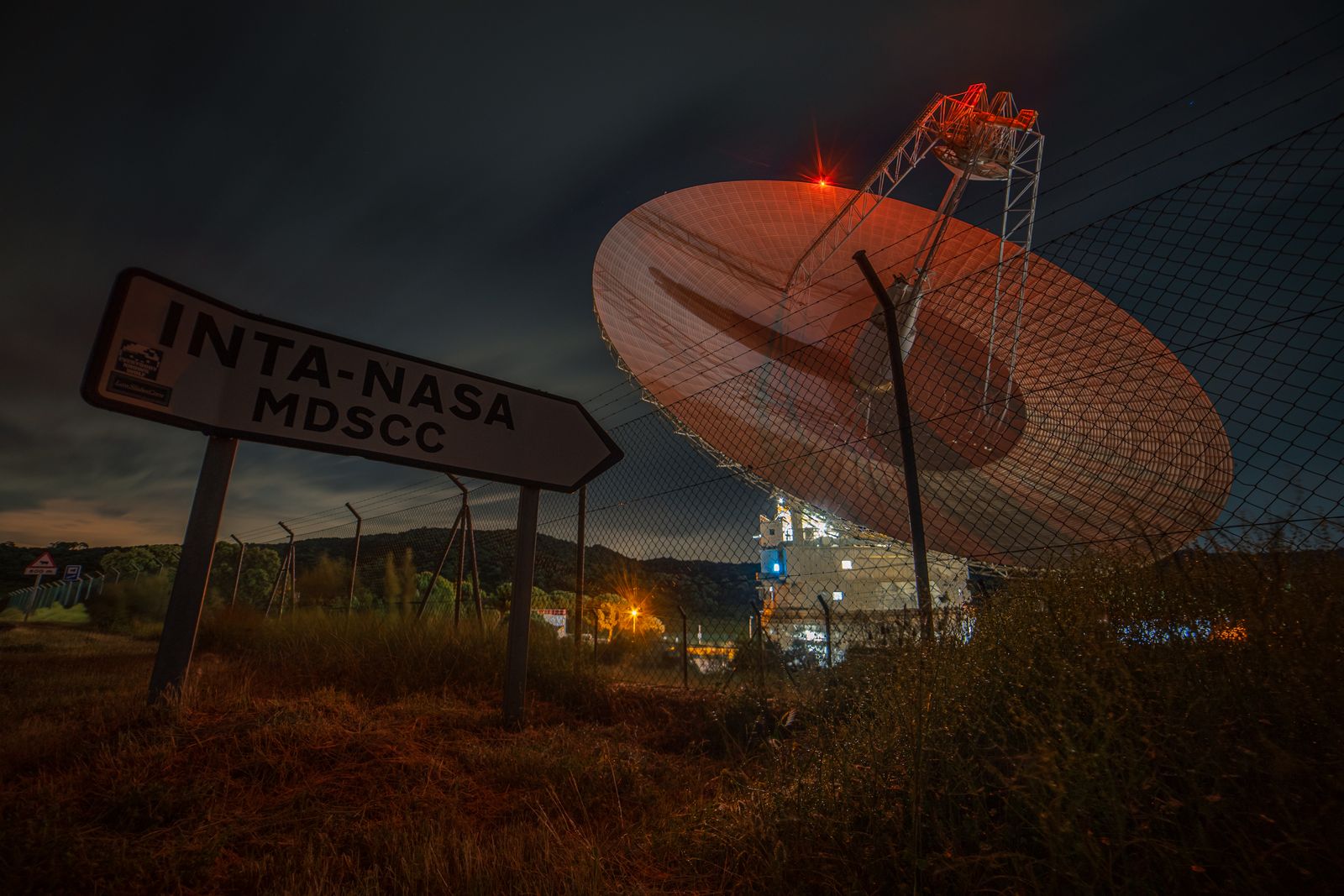
Why Jodrell Bank was already listening
Jodrell Bank was not a passive bystander in the Space Race. The University of Manchester observatory had tracked Sputnik, followed Soviet and American spacecraft, and built a reputation for listening to missions whose governments did not always announce what they were doing in real time.
When Luna 9 reached the Moon, Sir Bernard Lovell’s team was tracking it with the great radio telescope in Cheshire. Jodrell Bank’s own history notes that the observatory received the first images transmitted from the surface of the Moon by the Soviet probe in 1966.
The crucial detail was the shape of the signal. The images were coming down line by line in a form that resembled the Radiofax technology newspapers used to transmit photographs between offices. The Soviets had built a lunar imaging system, but the receiving problem suddenly looked like something a newspaper picture desk already knew how to solve.
The newspaper machine that read the Moon
The Daily Express sent a portable Muirhead picture receiver to Jodrell Bank. The Science Museum Group, which holds the D-700 photographic facsimile receiver associated with the episode, describes it as the machine used to publish the first photographs taken from the surface of the Moon in 1966.
The process was almost absurdly earthly. A signal recorded from a Soviet lunar lander was played through a newspaper facsimile receiver in England, and a picture of the Moon slowly appeared as lines on paper.
The Daily Express published the images on 4 February 1966 before the Soviet authorities made their own official release. The National Air and Space Museum notes that Jodrell Bank’s intercepted version beat the Soviets to publication, although the quality was not ideal.
There was a technical reason for that imperfection. The British receiver was close enough to decode the image, but not perfectly matched to the Soviet geometry. The first newspaper readers to see the Moon from ground level saw a slightly distorted version of it.
What the first surface pictures showed
The pictures were not spectacular in the modern sense. They were grainy black-and-white panoramas, built from scan lines, with nearby rocks, a low horizon, and the hard geometry of sunlight on an airless plain.
But they carried information no telescope on Earth could provide. The rocks had scale. The shadows had shape. The horizon looked close because the Moon is smaller than Earth, and there was no atmosphere to soften the blackness behind the stones.
Luna 9 operated on batteries and lasted only a few days. The National Air and Space Museum says the lander survived long enough to transmit a panorama from very close to the surface, while other mission summaries describe several image transmissions during its brief surface life.
That was enough. Four months later, NASA’s Surveyor 1 made the first American soft landing on the Moon, touching down on 2 June 1966. By then, Luna 9 had already shown that the surface could hold a spacecraft.
The older Soviet camera trick behind it
Luna 9 was not the first time Soviet engineers had turned an impossible-looking imaging problem into a working machine. In October 1959, Luna 3 became the first spacecraft to return pictures of the Moon’s far side, a story that belongs to the same lineage of capture, scan, and radio transmission.
That earlier probe used film, developed it onboard, scanned the result, and transmitted it back to Earth. As Space Daily has covered in its Luna 3 feature, the pictures were crude, but they redrew the map of the Moon.
Luna 9 brought that tradition down to the surface. Instead of showing a hidden hemisphere from space, it showed the ground itself: the place future landers, rovers, and astronauts would have to touch.
The lander that is still missing
After the batteries died, Luna 9 became a silent object somewhere west of Reiner and Marius craters in Oceanus Procellarum. Its reported coordinates were approximate, and the lander was only about the size of a beach ball. From orbit, it could hide among natural rocks, shadows, and small craters.
That uncertainty is the reason the recent search should be handled carefully. A 2026 paper in npj Space Exploration by Lewis J. Pinault, Ian A. Crawford, and Hajime Yano reported several candidate artificial-looking features near the historically uncertain Luna 9 landing area, using a machine-learning system trained on Lunar Reconnaissance Orbiter Camera imagery of known Apollo landing sites.
The paper did not prove the lander has been found. It identified promising candidates near 7.03 degrees north and 64.33 degrees west, and said confirmation would require targeted follow-up imaging under better conditions. Other search efforts have proposed different candidate sites, which means the honest version is still unresolved.
The Moon is full of this kind of archaeological problem now. Lunokhod 1 was also lost for decades before modern lunar imaging helped recover it, and the Apollo sites are still studied from orbit by the shadows of objects and tracks left in dust.
Luna 9 remains different because of what it sent back before it vanished. It was not a rover trail, a reflector, or a flag. It was the first low horizon from another world, stretched through a newspaper fax machine, printed in ink before the country that landed it had finished controlling the story.
The lander is still somewhere in the Ocean of Storms, its batteries dead since February 1966, its petals open to vacuum. If one of the candidate sites is confirmed, the object will not have changed much. There is no rain on the Moon, no wind, no weather to fold the petals shut. The first camera station on another world is still sitting in the dust that made it famous.
