
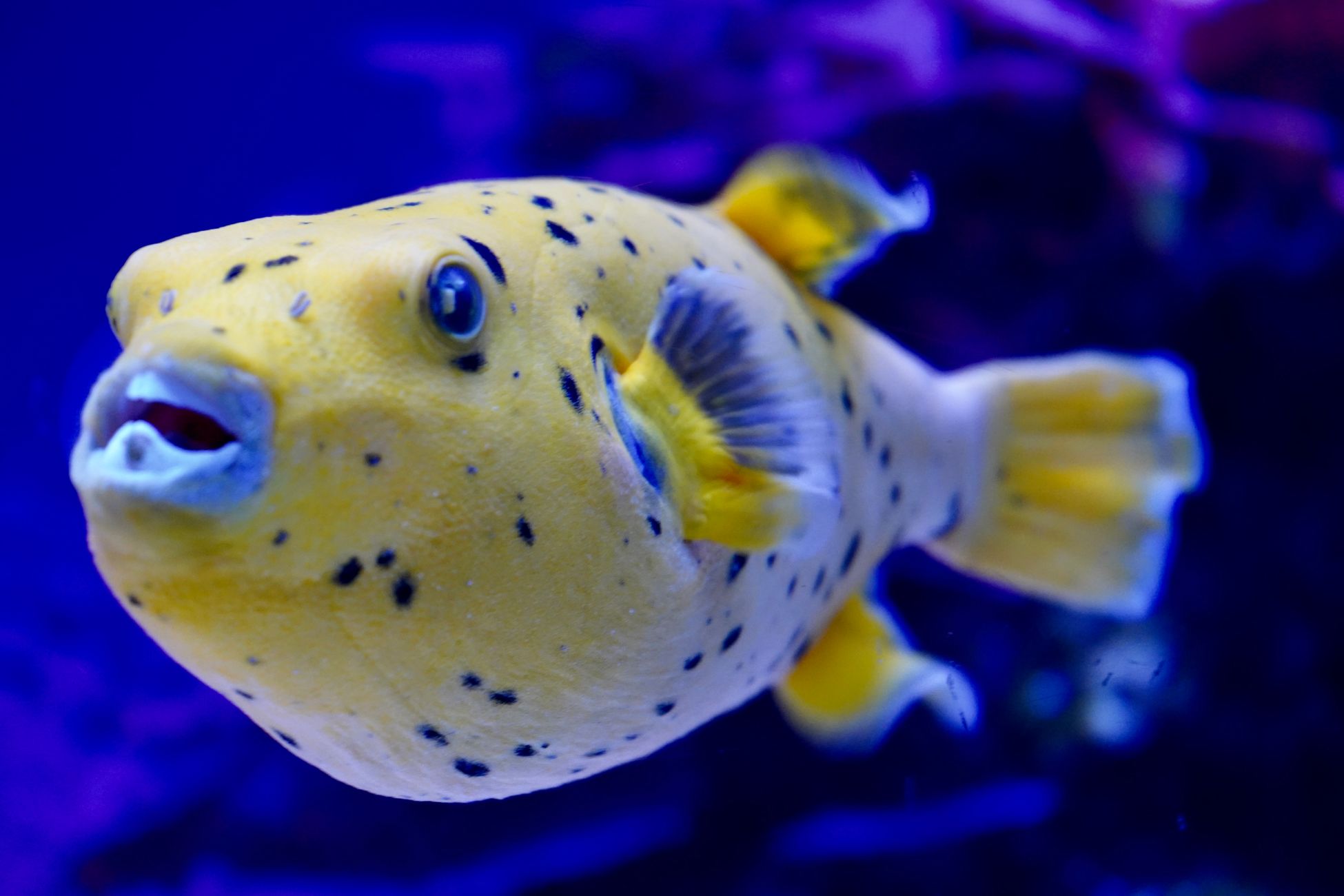
Off the southern coast of Amami Oshima island, about 25 metres beneath the surface of the East China Sea, a male white-spotted pufferfish no larger than a human hand spends roughly a week building a sand mandala almost two metres across. He flutters along the seabed on his side, fins beating against the grains, ploughing radial valleys and raising symmetrical peaks until the finished structure looks like a crop circle pressed into the ocean floor. Divers first photographed these formations in the mid-1990s, but it took until 2011 for a team led by ichthyologist Hiroshi Kawase of the Coastal Branch of Natural History Museum and Institute, Chiba, to catch the architect in the act and prove that the sculptor was a fish barely 12 centimetres long.
The species turned out to be new to science. In 2014 it was formally described as Torquigener albomaculosus, the white-spotted pufferfish, and its only known purpose for this architectural marathon is to attract a female long enough to mate.
A mystery on the seabed for sixteen years
The circles first appeared in dive photographs in the mid-1990s, scattered along sandy stretches of seafloor off Amami Oshima in Japan’s Ryukyu chain. Local divers called them mystery circles. They were almost perfectly radial, ringed by a ridge of fine sand, decorated with valleys and peaks arrayed around a flat central disc, and they kept appearing in the same areas year after year without anyone seeing what made them.
Theories ranged from ocean currents to alien hands. The structures were too geometric to be accidental and too large, relative to anything that might live nearby, to seem like the work of a small animal. A circle two metres in diameter is more than fifteen times the body length of the fish that turned out to be responsible.
Kawase and his colleagues finally watched the construction in 2011 and 2012, filming the entire process from start to finish. Their findings, reported in journals and later picked up across science media, identified one small male pufferfish as the lone architect of each ring.
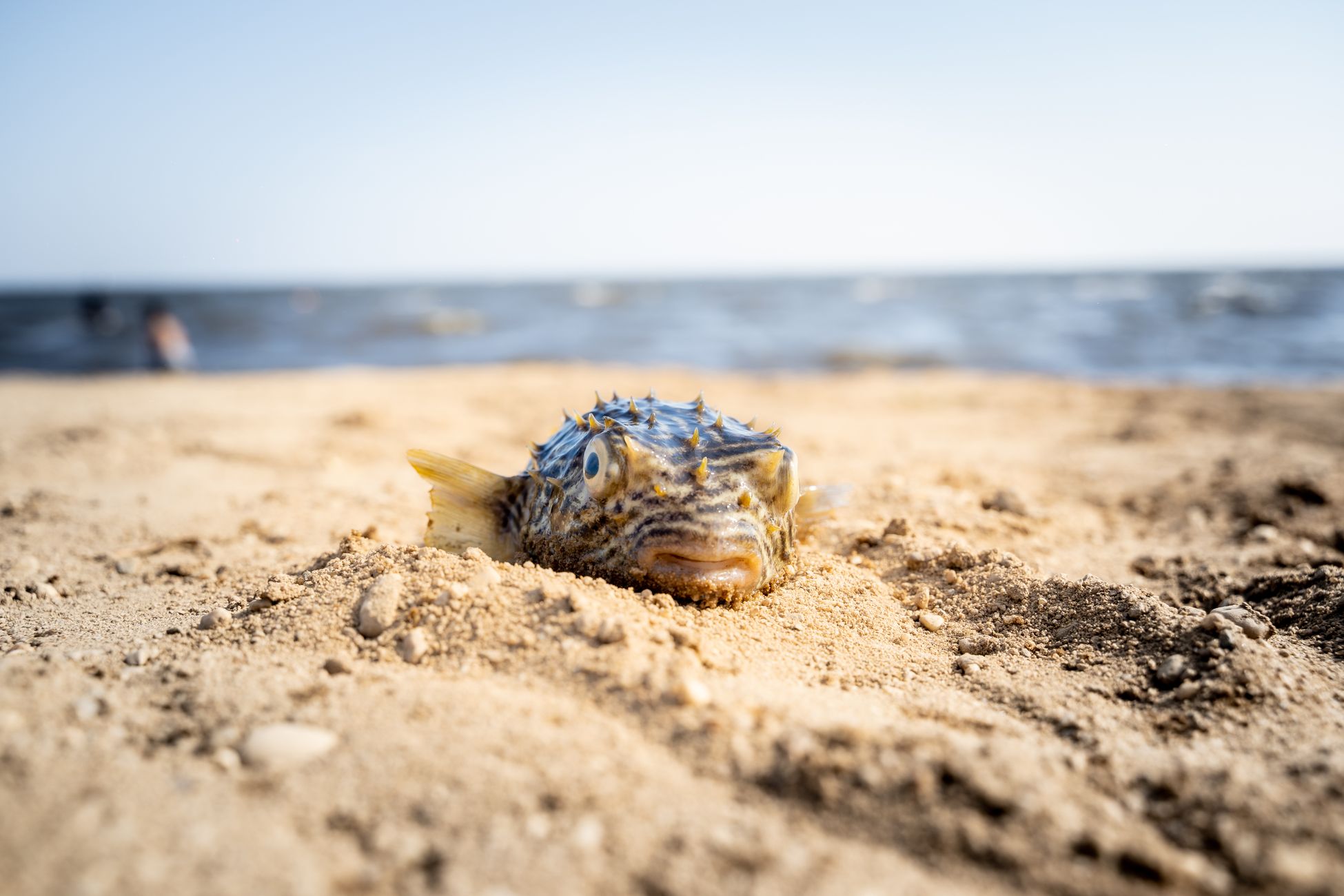
How a 12-centimetre fish builds a two-metre sculpture
The work begins with the male choosing a patch of fine sand and swimming repeatedly through it on his side, dragging his belly and fins. Each pass cuts a shallow radial trough running outward from a central point. He returns to the centre and starts another trough, and another, until the seabed around him resembles a sunburst of grooves separated by neat ridges.
Then he refines. He swims along the ridges and packs them with his fins. He carries individual shell fragments and pieces of coral in his mouth and arranges them along specific peaks, decorating the outer ring like a jeweller setting stones. He fans the central disc smooth with rapid fin beats, leaving a fine layer of the lightest, silkiest sediment in the middle.
The whole project takes roughly a week of nearly continuous labour. The fish barely rests. If a current disturbs a ridge, he rebuilds it. If another male trespasses, he chases the intruder away and resumes work. By the time he is finished, the structure is so symmetrical that researchers initially measured the angular spacing of the radial valleys and found them within a few degrees of perfect.
The point is the centre
The female arrives, swims slowly around the perimeter, then enters the central disc. If she approves, she settles into the smooth centre and lays her eggs there. The male fertilises them on the spot. Then she leaves.
The male stays for a period guarding the eggs in the very centre of the design until they hatch. Once the larvae drift away, he abandons the circle entirely. The ocean currents flatten the ridges within days, and he begins building again somewhere else.
This is a textbook case of sexual selection through extended phenotype — the idea that an animal’s built structures, like a bowerbird’s bower or a beaver’s dam, can become traits that mates evaluate and select for, just as they would select for plumage colour or song. The circle is an advertisement, and the females are picky.
Why the design works
The radial valleys appear to funnel the lightest, finest grains of sand toward the central disc, where the eggs will be laid. The female may be reading the structure as a kind of test: a male who can build a circle that concentrates the softest sediment in the middle is offering a better cradle for her eggs.
The decorations matter too. The little shell fragments arranged along the outer ridges aren’t random. They appear to be chosen for colour and shape, and they may help the ridges hold their form against currents while also signalling effort and attention to detail. Subsequent descriptions of the behaviour have emphasised how much of the construction is fine-grained adjustment rather than bulk excavation.
And the location is strategic. The species builds in spots where the seabed sediment is the right grade and where ambient currents will sweep the lightest grains into the trap of the radial design. The fish is exploiting the physics of the ocean floor to assemble, grain by grain, the equivalent of a perfectly graded nursery.
A species named after the structures it builds
When Torquigener albomaculosus was formally described in 2014, the circle-building behaviour was cited as part of what distinguished it from related pufferfishes. The white spots on its flanks, which give the species its name, are the same spots that appear in the photographs of the architect at work in the middle of his unfinished design.
The species is small, drab, and easily overlooked. Without the circles, it would be just another minor pufferfish in a genus full of them. The architecture is what gave it away — and what eventually gave it a name. Documentaries have since filmed the entire seven-day cycle in time-lapse, showing a fish that looks too small for the work somehow finishing it anyway.
Architecture as courtship
Animals that build to attract mates are rare enough that each example tends to become famous. Male bowerbirds in Australia and New Guinea construct elaborate avenues of twigs decorated with blue bottle caps and berries. Male pufferfishes do the underwater equivalent, except their medium is sand, their canvas washes away, and their species was unknown to biology until a diver in the 1990s wondered what was making the shapes.
Sexual selection theory predicts exactly this kind of behaviour when females bear most of the cost of reproduction and males compete for their attention. If the female is choosing where to lay eggs that she will not guard, she needs a way to evaluate male quality and habitat quality in one glance. A two-metre sand mandala built by a 12-centimetre fish does both. It demonstrates stamina, motor control, attention to symmetry, and an ability to read the local currents.
The bizarre tasks animals can be coaxed into performing — fish navigating wheeled vehicles, chimps doing arithmetic — show how much cognitive capacity exists in brains we tend to dismiss. The pufferfish isn’t being trained by anyone. It has carried this routine through generations on its own, hard-wired and refined into a sequence of behaviours that humans only managed to film a decade and a half ago.
A vanishing gallery
The circles do not last. Within a week or two of being abandoned, the ridges erode, the decorations scatter, and the seabed smooths over. The fact that they were ever found at all is partly an accident of dive tourism around Amami Oshima, where divers happened to descend onto patches of seafloor that just happened to be carrying a recently completed sculpture.
The world’s oceans are full of structures and behaviours nobody has yet witnessed. Vast expanses of the deep ocean floor remain unobserved by human eyes. The pufferfish circles were spotted only because they happened to lie within recreational diving range. How many other small architects are working at deeper depths, building and rebuilding structures that flatten before anyone arrives to see them, is a question with no current answer.
For now, the white-spotted pufferfish keeps building. Somewhere off Amami Oshima tonight, a male barely the length of a smartphone is ploughing his hundredth radial valley of the week, dragging a shell fragment into position on a ridge, fanning fine sand toward the centre of a circle wider than he will ever swim across in a single pass. In a few days the female will arrive, inspect the work, and decide whether the architect deserves the eggs. Then the currents will erase the design, and he will start the next one.
