
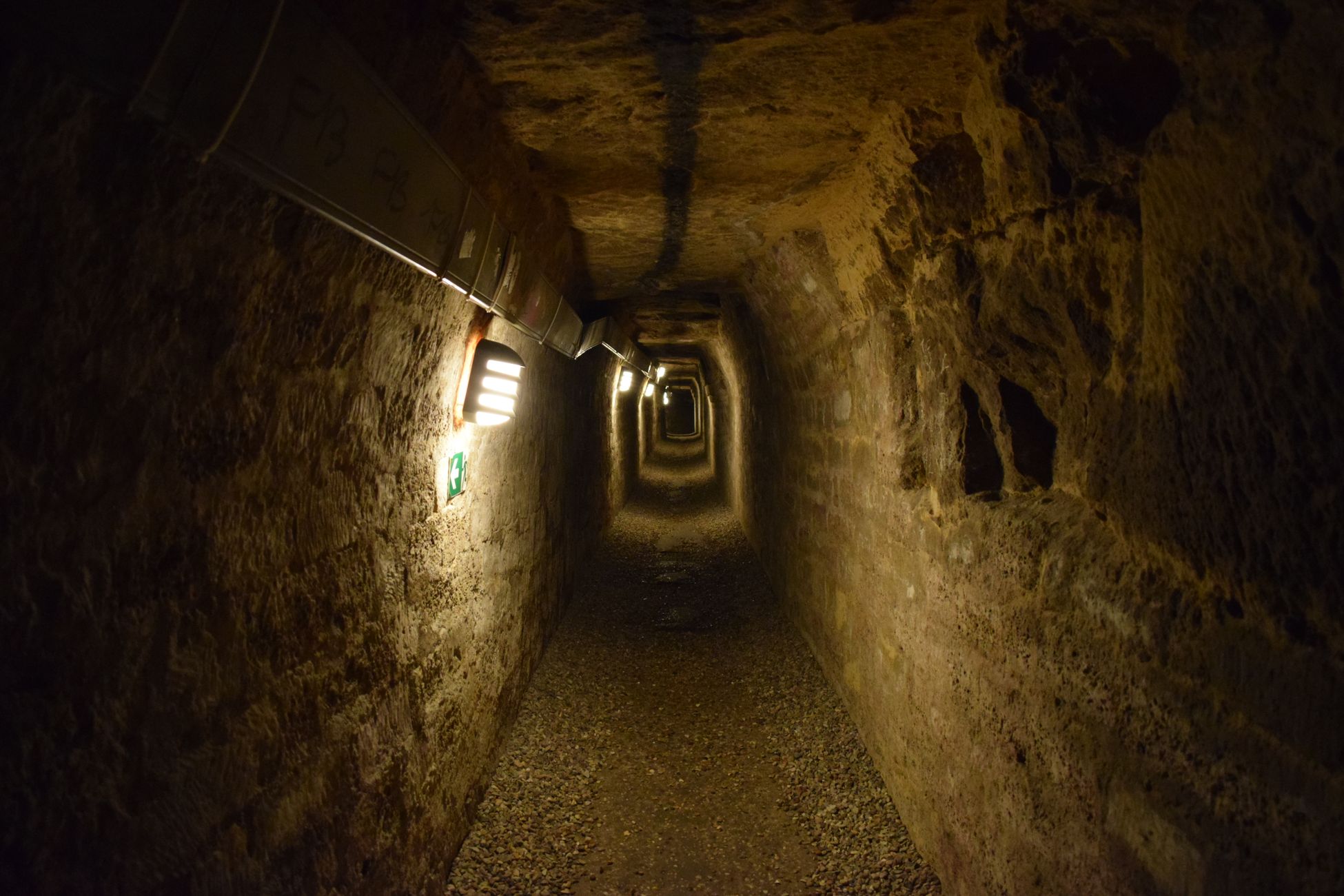
Forty meters below the cobblestones of Via Toledo, in a chamber the Neapolitans call the Bourbon Tunnel, the air still smells faintly of damp tuff and rust. Mattresses from 1943 lie where families left them. A child’s shoe, a rosary, the rusted handlebars of a Vespa abandoned by a fleeing owner — all of it sits in the same yellow volcanic rock that Greek colonists began hollowing out in the 5th century BCE to quarry stone for the walls of Neapolis. The hollows they left behind became cisterns under the Romans, escape passages for the Bourbon kings, and, during the Allied bombing campaign of World War II, bomb shelters for tens of thousands of Neapolitans crowded into a labyrinth their ancestors had inherited from antiquity.
The city above is loud, chaotic, sun-bleached. The city below is silent, climate-controlled by geology, and almost continuously inhabited for millennia.
A city built by removing itself
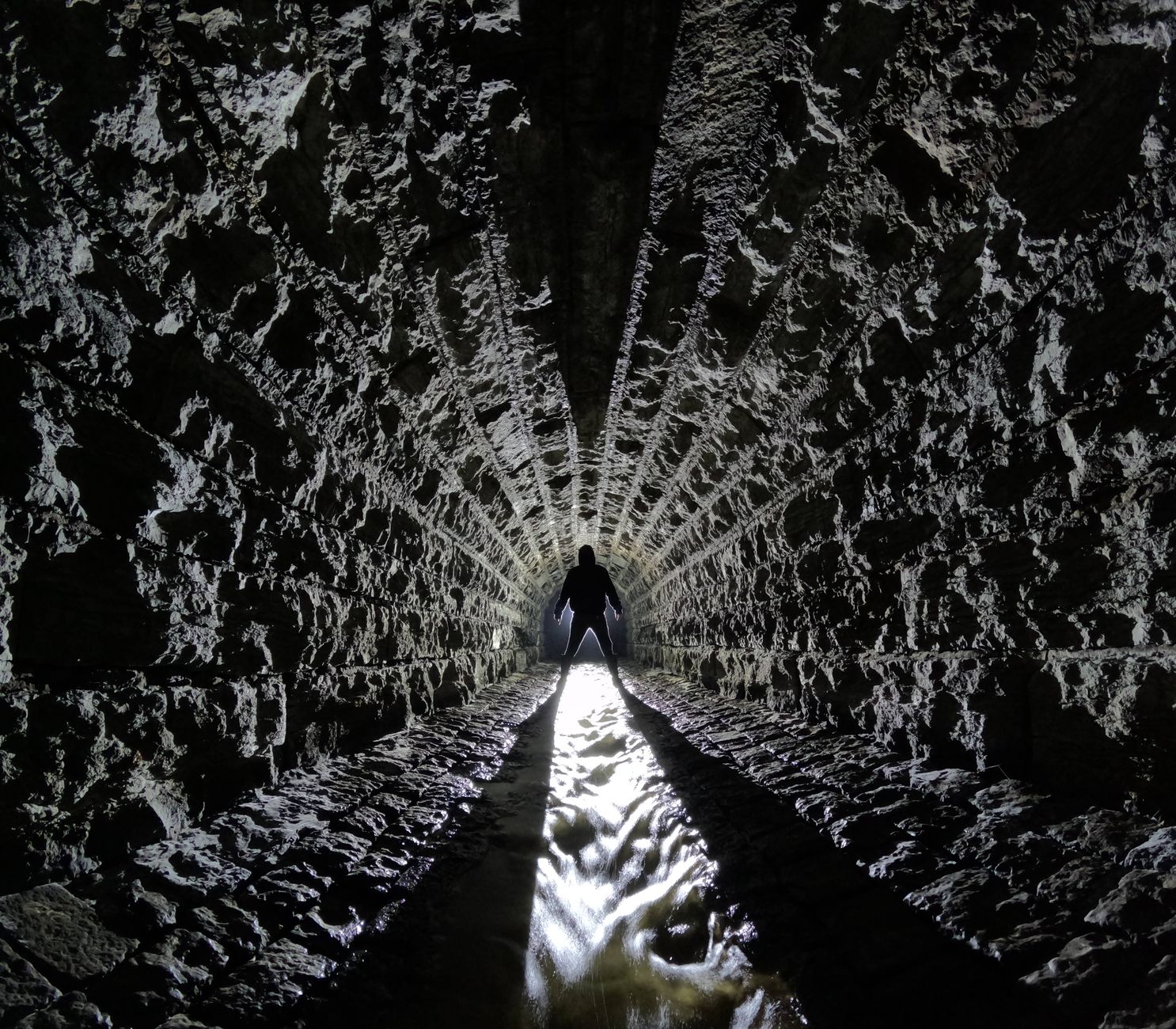
Naples sits on the Campanian Ignimbrite, a sheet of soft yellow tuff laid down by a supervolcanic eruption in the Phlegraean Fields just west of the modern city. The rock is soft enough to cut with a hand pick and strong enough, once exposed to air, to hold up a five-story palazzo. Greek settlers figured this out almost immediately. Rather than haul stone in from quarries elsewhere, they cut blocks directly from beneath the plots where they intended to build, lifting the tuff up through a shaft and assembling the house on top of the void they had just created.
Every palazzo in the historic center is, in effect, made of the hole beneath it. The cellars in Spaccanapoli and the Sanità district are not really cellars. They are quarries that ran out when the builders decided the house above was tall enough.
The Romans turned the holes into plumbing
By the 1st century BCE, the Greek quarries had been connected into something far more ambitious. Roman engineers extended the Aqua Augusta aqueduct into the existing voids beneath Neapolis and lined them with waterproof opus signinum, a concrete made with crushed terracotta. The quarries became cisterns. Each palazzo had its own private well shaft dropping straight down into a chamber that held tens of thousands of liters of drinking water.
Households drew water by lowering a bucket through a narrow shaft in the courtyard. A class of workers called pozzari — well-men — climbed down the shafts to clean the cisterns and repair the linings. They worked in the humid chambers until the late 19th century.
What ended the water system
Cholera ended it. An outbreak in 1884 killed thousands of Neapolitans, and investigators traced the contamination to the cistern network, where centuries of seepage from cesspits and graveyards had finally caught up with the city. The government commissioned a new aqueduct, sealed off the wellheads, and walled up the cistern chambers. The pozzari were out of work. The underground city, after more than two millennia of continuous use, went dark and silent.
It stayed that way for decades. Long enough that most Neapolitans forgot the chambers were there at all. Long enough that, when the air-raid sirens began in 1940, the city’s civil defense planners had to send teams down the old well shafts with kerosene lamps to find out what was still intact.
1940 to 1943: the chambers reopen
Naples was one of the most heavily bombed cities in Italy during the Second World War. Allied aircraft flew hundreds of raids against the port and rail yards, killing tens of thousands of civilians. The Fascist government, slow to build proper concrete bunkers, ordered the old cisterns reopened. Workers knocked through the 19th-century brick seals, cut connecting passages between chambers that had been separate cisterns for centuries, and installed wooden bunks, latrines, infirmaries, and electric lights powered by hand-cranked generators.
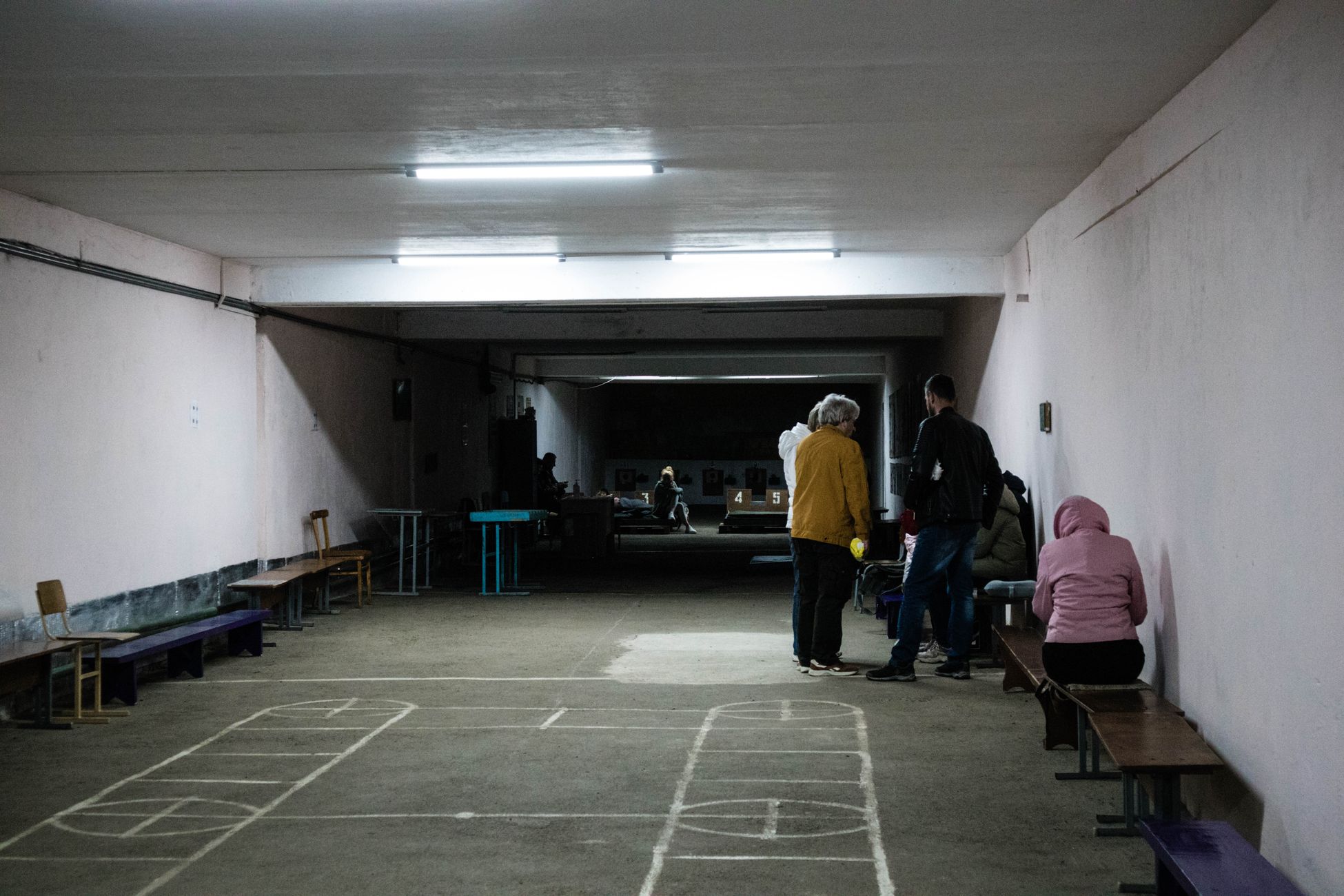
By 1942, signs reading Ricovero — shelter — hung above stairways tucked into the side streets of every quarter. A single chamber under the Pallonetto di Santa Lucia could hold thousands of people. The Bourbon Tunnel network beneath the royal palace took in thousands every night at the height of the raids.
What it was like down there
Survivors who gave testimony decades later described a city that had folded into itself. Families brought their best furniture down, fearing the house above would be flattened. They scratched their names and the dates of raids onto the tuff walls in pencil and charcoal, and the graffiti is still legible because the rock does not weather underground. There are tally marks counting how many nights a family had slept in the chamber. There are drawings of Allied bombers. There is one inscription, in the Bourbon Tunnel, that simply reads Mamma ho paura — Mama, I’m scared — in a child’s hand.
Disease moved through the chambers easily. Tuberculosis, lice, scabies. Pregnant women gave birth on the tuff floor with midwives working by candlelight. The chambers held a constant cool temperature year-round, the natural temperature of the rock, which meant the shelters were warmer than apartments above in winter and brutally damp in summer.
What survivors said decades later, in oral histories collected by local cultural associations and by the volunteers who eventually reopened the chambers, was that certain reactions never left them. An uneasiness around sirens. A wariness about basements and enclosed spaces. An aversion to sleeping in the dark. Some described their adult children carrying a version of the same — a discomfort with cellars and tunnels they couldn’t quite account for, never having been below ground themselves.
After the war, another vanishing
When Naples fell to the Allies in 1943, the shelters emptied within weeks. Families went back up to whatever was left of their apartments. The municipal authorities, with no further use for the chambers, sealed them again — this time with rubble. The chambers became dumping grounds. Through the 1950s and 1960s, the city quietly used the old cisterns to dispose of bombed-out cars, motorcycles, statues damaged by the raids, and household debris that nobody wanted to haul to the surface. The Bourbon Tunnel alone holds dozens of Fiat Topolinos, Lancias, and Vespas from the postwar years, perfectly preserved in the dry tuff, their tires still inflated.
Rediscovery
Speleological groups began clearing chambers in the late 20th century. The Bourbon Tunnel was reopened to visitors after years of hauling out the debris by hand. Today a portion of the underground city is mapped and accessible — a fraction of what’s actually there. New chambers turn up routinely when a building collapses, or when sinkholes open in the street, which they do, alarmingly often, in a city built on its own hollows. Sinkholes in recent years have swallowed sections of road and revealed previously unrecorded Greek-Roman cisterns still holding water.
The chambers have become a key part of Naples’ tourism economy. The population’s sense of identity is built partly on shared physical inheritance — the literal rock their ancestors quarried, sheltered in, and bequeathed. The historic center of Naples, including the subterranean network, has been a UNESCO World Heritage site since 1995. Some of the cleared chambers now host candlelit classical concerts — Galleria Borbonica’s Concerto al buio, performed in the dark, is the best known — alongside art installations and a small underground garden that takes advantage of the constant cool temperature.
The same rock, four civilizations deep
Stand in a chamber under the Sanità district and look at the walls. The lower courses, cut at clean angles with bronze tools, are Greek. Above them, the irregular Roman patches where the cistern was deepened. Higher up, Bourbon-era brick from the 1850s expansion. And near the ceiling, a hand-painted arrow and the word USCITA — exit — stenciled in 1942 to guide families toward a stairway leading up to a courtyard that had been shaking, that night, with bombs.
Naples is a city that has been bombed, plague-stricken, erupted on, and earthquake-shaken — the kind of seismic instability that periodically reminds southern Italy of its tectonic situation — and through all of it the chambers have held. The tuff is patient. It was laid down by a volcano millennia ago, hollowed out by the Greeks centuries before Christ, plumbed by the Romans 2,000 years ago, drained by cholera in the 19th century, repopulated by air raids in the 1940s, and rediscovered last week, somewhere, by a homeowner who noticed that the floor of their cellar sounded hollow.
Above the chambers, the espresso bars open at six. Below them, the child’s shoe is still where it was left in 1943, in a room cut from rock that was already old when Augustus was born.
