
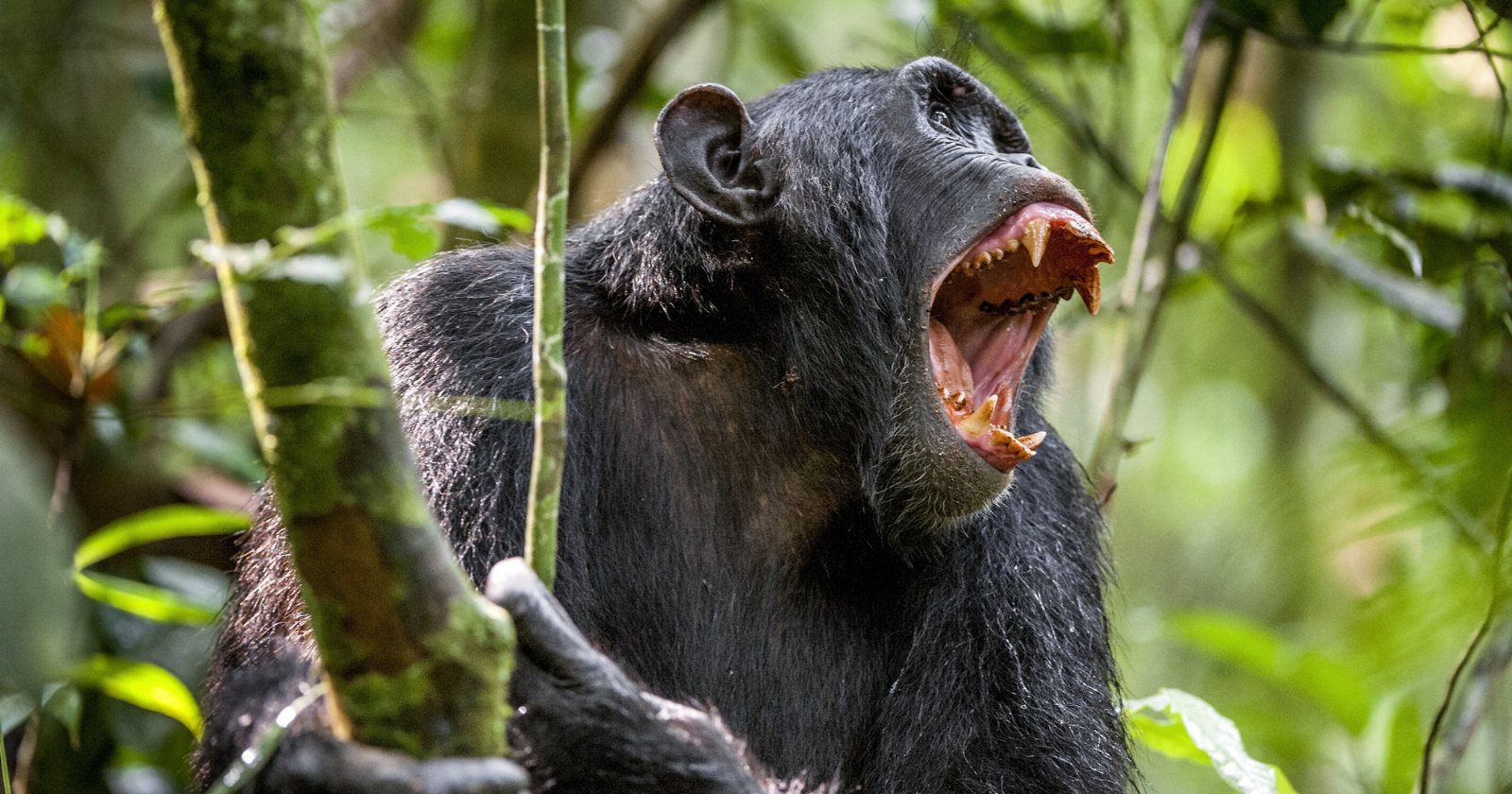
The Ngogo chimpanzees of Kibale National Park in western Uganda have been continuously studied by primatologists for thirty years. The Ngogo Chimpanzee Project was co-founded in 1995 by John Mitani of the University of Michigan and David Watts of Yale University, and is now co-directed by Aaron Sandel of the University of Texas at Austin. The project has documented approximately 200 individual chimpanzees through their full life cycles, recorded their grooming networks, hunting parties, dominance hierarchies, and reproductive patterns, and produced one of the most detailed long-term datasets on chimpanzee social behaviour ever assembled.
The size of the community was, until quite recently, its most distinctive feature. Most wild chimpanzee communities contain approximately 50 individuals. The Ngogo community at its peak contained approximately 200, including more than 30 adult males, all of whom lived within a shared territory, recognised each other by sight and call, groomed each other, formed alliances and rivalries, mated across the community, and patrolled the boundaries of their shared range together against neighbouring groups.
The community was, on the available evidence, an exceptionally well-functioning chimpanzee society.
It is now in the middle of the second documented chimpanzee civil war in scientific history.
The day the split began
The collapse of the Ngogo community had a precise starting moment, which the long-term observation project happened to have a researcher on hand to witness. On the morning of 24 June 2015, Aaron Sandel was following a sub-group of Ngogo chimpanzees through the forest when the animals fell silent. Several of them began to grimace, a facial expression that in chimpanzees indicates nervousness or threat. Others began touching each other in patterns the researchers recognised as reassurance behaviour. In the distance, more chimpanzees could be heard approaching.
The normal pattern of Ngogo social life would have been for the two sub-groups to merge with each other, exchange the loud screaming, back-patting, and hand-holding greetings that chimpanzees use to reaffirm community membership, and then mingle freely for hours or days before separating again. This was the pattern Mitani and his colleagues had observed thousands of times across thirty years of fieldwork.
The pattern did not hold on the morning of 24 June 2015. As the approaching sub-group came into earshot, the chimpanzees with Sandel ran in the opposite direction. The approaching sub-group did not pursue them as a threat. The two sub-groups had, on the available behavioural evidence, simply decided not to meet.
From that morning, the social cohesion of the Ngogo community began to fray in measurable ways. Researchers tracked the network of grooming and association patterns and watched as individuals shifted into one of two emerging clusters, which the team came to call the Western and the Central groups. By 2017, the two groups had stopped using overlapping territory. By 2018, the deaths had begun.
The first killing
In January 2018, adult males from the Western group attacked and killed an adolescent male from the Central group named Errol. Sandel had watched Errol grow up. The pattern of the attack, in which five to ten adult males held the victim down while others bit, beat, and dragged him, was familiar to the researchers from previous documented cases of inter-community chimpanzee violence, in which Ngogo and other groups had attacked chimpanzees from rival neighbouring communities.
What was different about the killing of Errol was that the victim was not from a rival neighbouring community. He was from the same community that the attackers had been part of two and a half years earlier. The males who killed him had, in some cases, groomed his mother. They had patrolled the Ngogo territorial boundaries with him as members of the same hunting party. They had, on the long-term observational record, treated him as kin until the morning of 24 June 2015.
The killing of Errol established the pattern that has continued since. The 2026 paper in Science by Sandel and colleagues, titled “Lethal conflict after group fission in wild chimpanzees,” documents the period from 2018 to 2024, during which the Western group attacked and killed at least seven adult or adolescent males and seventeen infants from the Central group. An additional 14 Central males disappeared during the same period and were never recovered, although the team notes that some may have died from causes other than direct attack. The total number of killings since the data analysis ended in 2024 has continued to rise, with further attacks documented in 2025 and 2026.
All attacks since 2018 have been by the Western group against the Central group. The Central group, despite having been the larger of the two factions at the time of the split, has not retaliated in any documented case. The Western group, which started with 76 members, has grown to 108. The Central group is in stepwise decline.
Why this kind of event almost never happens
Inter-community violence between separate chimpanzee groups is well-documented in primatology. The Ngogo community itself has been one of the more aggressive communities ever studied, with documented attacks on chimpanzees from neighbouring communities going back to 1999. What is genuinely rare, and what makes the 2026 Sandel paper a significant scientific event, is for a single chimpanzee community to split into two factions and for those factions to then begin killing each other.
The Sandel team estimates, based on the rate at which such splits have been documented across all wild chimpanzee research sites combined, that a community fission of this kind occurs approximately once every 500 years per chimpanzee community. The team’s estimate is based on the only previous documented case, which is the chimpanzee war that Jane Goodall observed at Gombe Stream National Park in Tanzania between 1974 and 1978. In that case, the Kasakela community split into two factions, called Kasakela and Kahama, and over four years the Kasakela males systematically killed every adult male in the Kahama splinter group, eliminating it entirely as a community.
The Gombe War was, at the time, the most contested observation in primatology. Critics noted that Goodall had been provisioning the chimps with bananas at the research site since the 1960s, and argued that the artificial food supply had created unnatural competition that produced the violence. The Gombe War, on this critique, was an artefact of human interference rather than a natural feature of chimpanzee behaviour.
The Ngogo civil war substantially weakens this critique. The Ngogo Chimpanzee Project has never provisioned the chimps with food, and the violence has unfolded entirely without human food interference, as the University of Michigan press release accompanying the Science paper notes. The behaviour Sandel and his colleagues have documented is, on the strongest current reading of the evidence, a natural feature of chimpanzee social biology that emerges under specific conditions, not an artefact of human intervention.
Why did they turn on each other
The 2026 Sandel paper does not identify a single cause for the Ngogo split. The team examined several factors that may have contributed, all of which appear to have operated in combination rather than individually.
The first was the unusual size of the Ngogo community. At approximately 200 individuals and more than 30 adult males, the group was approximately four times the size of a typical wild chimpanzee community. Chimpanzee social cohesion is maintained by individual relationships of grooming, alliance, and recognition, and there appear to be limits to how many such relationships any one chimpanzee can sustain. The Ngogo community had, on the available behavioural evidence, grown beyond the size at which its members could maintain personal bonds with every other member, and had been operating for at least a decade with internal sub-structures that the researchers called clusters.
The second was the deaths of several well-connected adult males in the years immediately before the 2015 split. The Sandel team identifies five adult males who had served as social bridges between the Western and Central clusters and who died of natural causes between approximately 2010 and 2014. The loss of these individuals appears to have weakened the connections that held the two emerging factions together.
The third was a change in the dominance hierarchy. A new alpha male emerged in 2015, an event that in chimpanzee communities typically occurs every six to eight years and produces measurable increases in aggression and social tension during the transition period.
The fourth was a respiratory epidemic in 2017, traced to a human-origin pathogen, which killed approximately 25 Ngogo chimpanzees and removed additional social links between the two emerging clusters.
None of these factors, individually, would have been sufficient to fracture a chimpanzee community. The Sandel team’s central interpretation is that the combination of large group size, the loss of social bridge individuals, the alpha male transition, and the epidemic produced a network of social relationships that became too thin to hold the two clusters together. When the relationships broke down, the underlying behavioural capacity for inter-community violence, which Ngogo chimpanzees had previously directed against rival neighbouring groups, was redirected inward against former members of their own community.
The honest limitations
Several caveats apply to the interpretation above.
The first is that the Ngogo civil war is still in progress. The 2026 Science paper covers data through 2024, but additional killings have been documented in 2025 and 2026, and the long-term outcome of the conflict is not yet settled. The Central group may eventually be eliminated, as the Kahama group was at Gombe, or it may stabilise as a smaller community, or it may recover and re-establish itself. The current trajectory points toward continued decline, but the time horizon is genuinely uncertain.
The second is that the proposed causes of the split are, at this stage, contributing factors rather than established triggers. The Sandel team has documented the conditions under which the split occurred, but the specific reason that the community fractured rather than continuing in its previous arrangement is not yet known. Multiple chimpanzee communities have grown to large sizes, lost social bridge individuals, transitioned to new alpha males, and survived epidemics, without fracturing in this way. What made Ngogo different is genuinely an open scientific question.
The third is that the implications for human conflict, which several commentators on the 2026 paper have drawn, should be treated with caution. Chimpanzees and humans share a common ancestor approximately six million years in the past, and there are clear evolutionary continuities in patterns of aggression, alliance, and intergroup conflict. The specific dynamics of human civil wars, which involve ideology, ethnic identity, political institutions, and material resources at scales that have no chimpanzee equivalent, are not directly modelled by the Ngogo conflict.
What it means
Several things follow from the Ngogo civil war evidence that are worth saying clearly.
The first is that the behavioural capacity for what humans call civil war, in which a previously unified social group fractures into factions that then attempt to destroy each other, is not, on the available evidence, unique to humans. It has now been documented twice in chimpanzees, in two separate national parks, in two separate countries, separated by four decades and the entire breadth of the African continent. The behaviour is rare but it is reliably reproducible under the right conditions, and those conditions appear to be specific features of chimpanzee social biology rather than anything imposed by human contact.
The second is that the underlying mechanism, on the strongest current reading of the evidence, is the breakdown of personal relationships within a social group that has grown beyond the scale at which such relationships can be maintained. The Ngogo community was at approximately four times the size of a typical chimpanzee community. The relationships that held it together were stretched thin even before the deaths and the epidemic that further weakened them. The split occurred along the fault line of the two pre-existing clusters within the community, which had been visible to researchers as internal structures for at least a decade before the rupture.
The third is that the violence, once the social break occurred, was directed by Ngogo chimpanzees against animals they had previously treated as kin. The Western males who killed Errol in January 2018 had groomed his mother. They had patrolled the Ngogo territorial boundaries with him as members of the same hunting party. They had, by every available behavioural measure, considered him a member of their own community until the morning of 24 June 2015. The behavioural capacity to redefine former community members as legitimate targets of lethal aggression appears, on the available chimpanzee evidence, to be substantially older than the evolution of language, ideology, or the human capacity for ethnic identity formation.
The fourth, on the strongest current reading of the peer-reviewed evidence, is that the question Aaron Sandel has been asking since the morning of 24 June 2015, which is what makes a stable social group come apart and what makes its former members turn on each other, is not just a question about chimpanzees.
The Ngogo community had been stable for thirty years.
It came apart on a single morning, in a way that no one was expecting, and the killings began three years later.
The chimpanzees are still attacking each other.
