
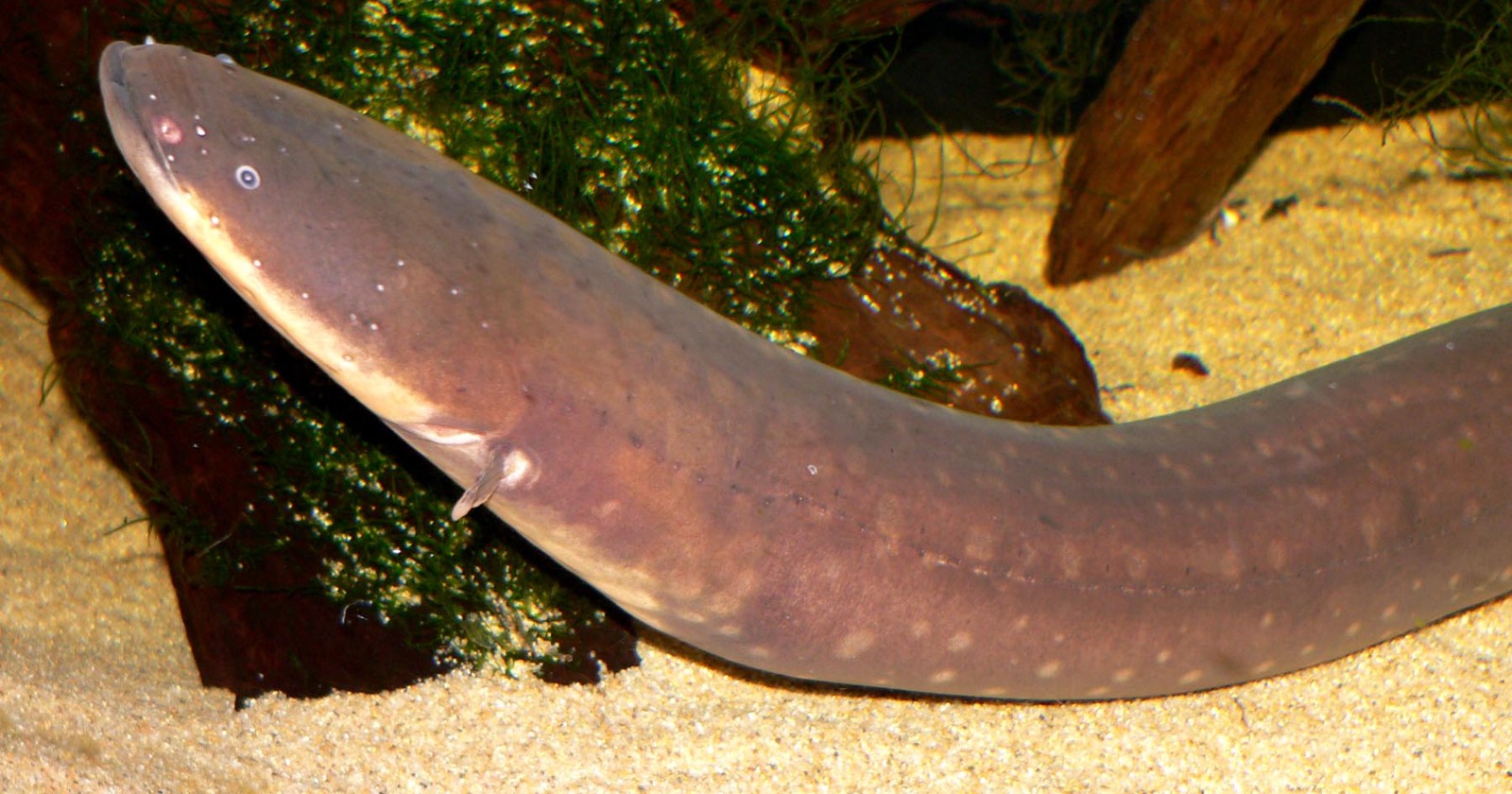
For 250 years, the electric eel was a settled question. Ever since Linnaeus catalogued it in the eighteenth century, science recognized exactly one species, Electrophorus electricus, famous for delivering a jolt strong enough to knock down a horse. In 2019, a team led by the biologist C. David de Santana took that settled question apart.
Working through 107 eel specimens collected across what the researchers call Greater Amazonia, the team found that the familiar electric eel is not one animal but three distinct species, two of them new to science. And when they measured the electric output of one of those new species in the field, they recorded a discharge of 860 volts. That is well above the roughly 650 volts that had previously been the highest figure cited for an electric eel, and it makes the animal the strongest living generator of electricity known to science.
How one animal became three
The clue that something was being missed was hiding in plain sight. Electric eels are enormous, sometimes more than two meters long, and they live across a huge swath of South America. It would be easy to assume that such a conspicuous, well-studied creature had no secrets left. The 2019 study, published in the journal Nature Communications, shows how wrong that assumption can be.
By comparing genetics, body shape, and ecology across their specimens, the researchers identified three lineages that had split apart millions of years ago, during the Miocene and Pliocene. Two earned recognition as new species. One, named Electrophorus varii, lives in the slow, murky lowland floodplains of the Amazon basin. The other, named Electrophorus voltai, lives in the faster, clearer highland waters that drain the ancient rock of the Brazilian Shield.
The name is not an accident. Voltai honors Alessandro Volta, the Italian physicist who built the first true battery in 1800. Volta’s “pile” of stacked metal discs was inspired in part by the electric organs of fish like the eel, and the study’s authors note that electric eels helped inspire the design of his battery. Two centuries later, the strongest known electric fish carries his name.
What drove the three lineages apart was the slow rearrangement of a continent. The researchers link the split to the history of the Amazon itself, which once flowed west and reversed to its modern eastward course over the late Miocene and Pliocene. As the river carved its present floodplain across the middle of the continent, it raised a barrier of warm, mineral-rich lowland water. That barrier divided the cooler highlands of the Guiana Shield to the north from the Brazilian Shield to the south. Eel populations on either side were cut off and drifted apart, until the highland E. voltai and the lowland E. varii were no longer the same animal. The team dates the separation of E. voltai from its northern relative to roughly 3.6 million years ago.
A body built like a battery
An electric eel is, in a sense, a swimming battery. Most of its long body is given over to electric organs packed with thousands of disc-shaped cells called electrocytes, stacked in series the way Volta stacked his metal plates. Each cell produces only a small voltage. Lined up by the thousand and fired at once, they add up.
That is how an eel turns a faint biological signal into a discharge that can stun prey or repel a predator. The animal uses weaker pulses to navigate and to sense the world around it, much as a bat uses sound, and reserves the high-voltage blast for hunting and defense.
The 860-volt measurement came from an E. voltai individual a little over 1.2 meters long. The researchers also suggested a reason the highland species might pack a stronger punch. Its clear, mineral-poor mountain waters conduct electricity poorly, and the team has proposed that a higher voltage could help a shock travel through water that resists it. That part remains a hypothesis rather than a proven fact, but the habitat difference itself is well documented: the highland shield streams E. voltai calls home are markedly lower in conductivity than the lowland rivers of its cousin.
Why the number matters, and why it does not
It is worth slowing down on that headline figure, because a single dramatic number is exactly the kind of thing that gets stretched in the retelling.
The 860 volts is real and it is a record, but it is one measurement from one fish. In the language of the paper, the sample size for that reading was a single individual. Voltage in electric eels rises with body size and varies with the animal’s condition and the circumstances of the discharge. So 860 volts is best understood as the highest value yet recorded, not as a fixed rating that every member of the species hits on demand. The honest claim, and the one the researchers make, is that this is the strongest discharge ever measured from a living organism, comfortably above the previous figure.
It is also worth knowing where the old number came from. The roughly 650 volts that stood as the benchmark for generations traces back to much older sources, the kind of figure repeated in encyclopedias and histories of electric fishes rather than freshly measured in the wild. Part of what the 2019 team did was simply go back to living animals, in their own rivers, with modern instruments, and check. The record fell not because the eels changed but because someone finally looked again.
Voltage is also only half of what makes a shock dangerous. What actually disrupts a muscle or a nerve is current, the flow of charge, delivered in a rapid train of pulses. An electric eel does not electrocute a person the way a downed power line would. Serious injuries to humans are rare, and the real danger in deep water is usually that a startled, shocked swimmer can lose coordination and drown, rather than that the voltage itself proves fatal. The eel’s weaponry is formidable, but it is tuned for stunning fish in shallow Amazon waters, not for killing large mammals.
Hidden in a famous animal
The deeper lesson of the study is not really about voltage at all. It is about how much remains unknown even in the parts of nature we think we have fully described.
The electric eel is one of the most recognizable animals on Earth, studied for centuries, kept in aquariums, name-checked in physics classes. And yet a careful look at enough specimens revealed that biologists had been lumping three separate species under one name, and that one of them was quietly setting a record no one had measured. The team examined animals from museum collections and from fresh field expeditions across rivers, floodplains, and remote shield highlands to assemble the picture.
If a creature this large and this familiar could hide a new species and a record-breaking discharge, it is a fair guess that the rivers of the Amazon still hold a great deal that no one has looked at closely enough. The strongest battery in the animal kingdom spent two and a half centuries in plain sight before anyone thought to check.
