
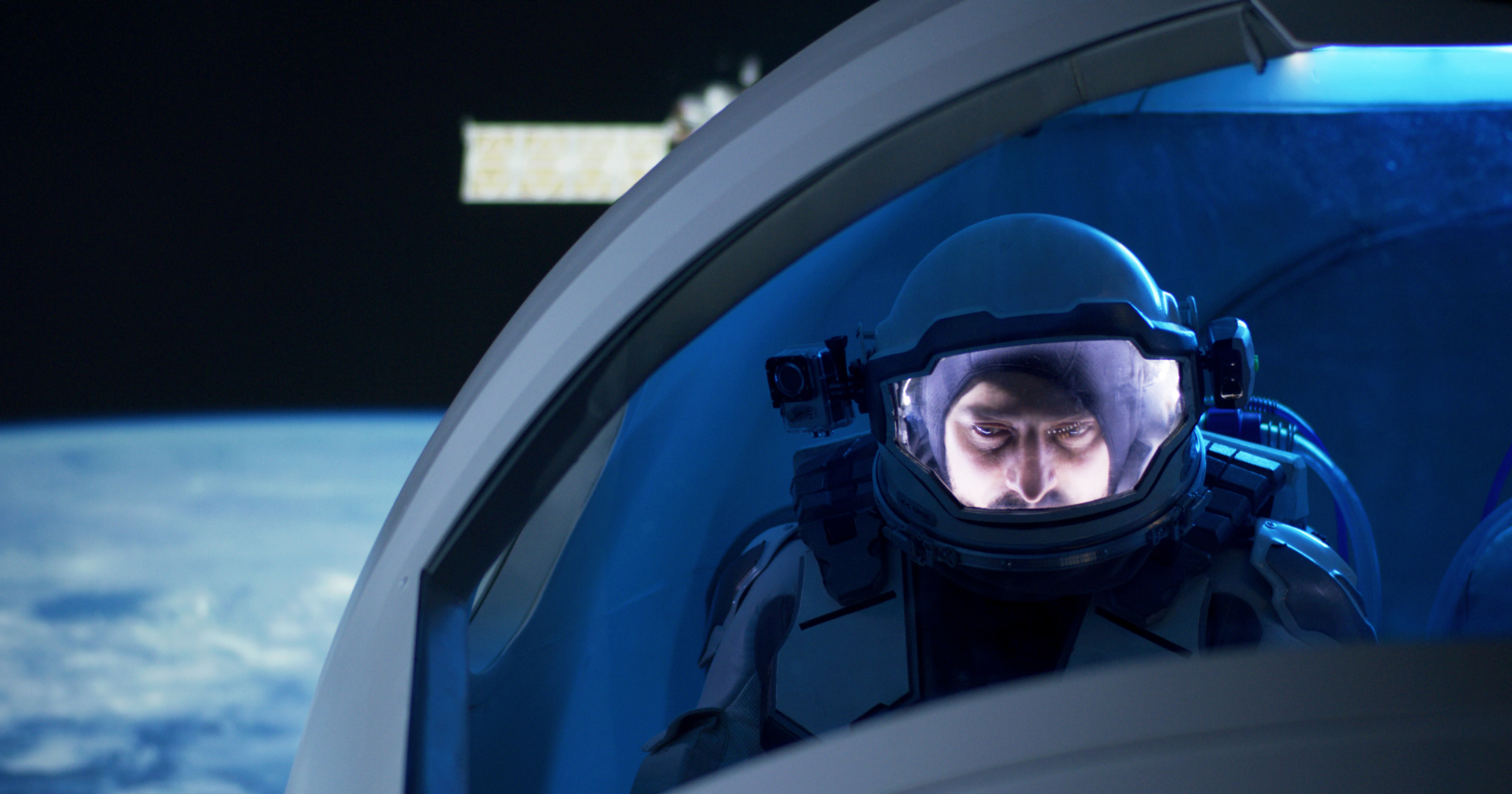
Apollo astronauts trying to rest on the way to the Moon kept noticing the same thing in the dark. With the cabin lights down and their eyes adjusted, they saw brief flashes and streaks of light, dots and lines that no one else could see and that were not there in any ordinary sense. The cause, worked out over the missions that followed, was cosmic rays from deep space passing through the visual system. The broad cause is now well supported, even if the exact biophysics of how a passing particle turns into a flash of light is still not fully pinned down.
The flashes are an example of a phosphene, a sensation of light produced by something other than light entering the eye.
In this case, the something was radiation.
What the astronauts saw
The reports began on Apollo 11. After a period of dark adaptation, with eyes open or closed, crew members saw flashes they described as pinpoints, thin streaks, or small clouds of light. They were almost always colourless. They came at a rate of roughly one-half to two a minute, often enough to be a distraction when someone was trying to sleep.
This was not confined to one crew or one flight. Flashes were reported across the Apollo missions, and later by astronauts on Skylab, on Mir, and on the International Space Station. The phenomenon even had a kind of forecast. As early as 1952, the biophysicist Cornelius Tobias had suggested that people exposed to cosmic radiation in space might see exactly this sort of thing, and the team that investigated the Apollo reports traced them back to that idea.
How they tied it to cosmic rays
Suspecting a cause and demonstrating it are different tasks. To test whether the flashes really were caused by particles passing through the head, the Apollo 16 and 17 crews carried a device called the Apollo Light Flash Moving Emulsion Detector, worn on the head during the coast to and from the Moon. It used stacked photographic emulsion to record the tracks of charged particles, so that the path of a particle could be matched against the moment an astronaut reported a flash.
The numbers were small but telling. The detector was worn for about an hour on each of the last two Apollo missions. On Apollo 17, seventeen flashes were reported during the session, and two of them were matched to heavy cosmic-ray nuclei passing through an eye. Combined with the geometry of the eye and statistical modelling, that was enough for the investigators to attribute the flashes to cosmic rays. Ground experiments pointed the same way: when volunteers had their dark-adapted eyes exposed to beams of heavy ions, they saw comparable flashes.
What is still uncertain
The confirmed part is that cosmic rays cause the flashes. The unconfirmed part is the step in between, the biophysics of how a single fast particle produces a perceived point of light. Several mechanisms have been proposed, and more than one may contribute.
The leading idea is that the particle ionises tissue directly in the retina, stimulating the light-sensing cells or the neurons behind them as it passes through. This fits the ground experiments, where heavy ions produced flashes at intensities too low for any light to have been generated. A second idea is Cherenkov radiation: a particle moving through the clear jelly of the eye faster than light moves through that medium emits a faint glow, real photons generated inside the eye itself. The trouble is that Cherenkov light should look bluish and diffuse, and most astronauts described sharp white dots and streaks, which do not match. A third possibility is that some flashes come from particles striking the optic nerve or the visual centres of the brain, bypassing the eye altogether.
Decades on, reviews of the phenomenon still describe the specific mechanism as undefined, and note that the effects on the different parts of the visual system have not been fully separated.
The cause is well established; the wiring is not.
Why it still matters
On Earth’s surface, we are mostly shielded from this by the atmosphere and the magnetic field. In low Earth orbit the shielding is reduced but not gone, which is why astronauts on stations such as Mir and the ISS have also reported the effect. The Apollo crews saw the flashes more strongly still because they left that protection behind, travelling beyond the magnetosphere. The flashes were, in effect, the radiation environment of deep space made briefly visible inside a human head.
That is why they are treated as more than a curiosity. They are a perceptible sign that high-energy particles are passing through the body, the brain included, and the same radiation is a serious concern for long missions beyond Earth. On the International Space Station, experiments have used the visual system as a way to study how cosmic radiation affects the central nervous system. For a crew bound for Mars, who would spend months outside the magnetosphere, the dose to the brain over that time is one of the open problems of the trip.
What to watch
The people who travel back to lunar distance under Artemis and later missions will almost certainly see the flashes again. They will also carry better instruments and a sharper reason to use them. Pinning down how the flashes are produced would be a small result. Understanding what months of that radiation does to the brain behind the eye is the one that matters.
