
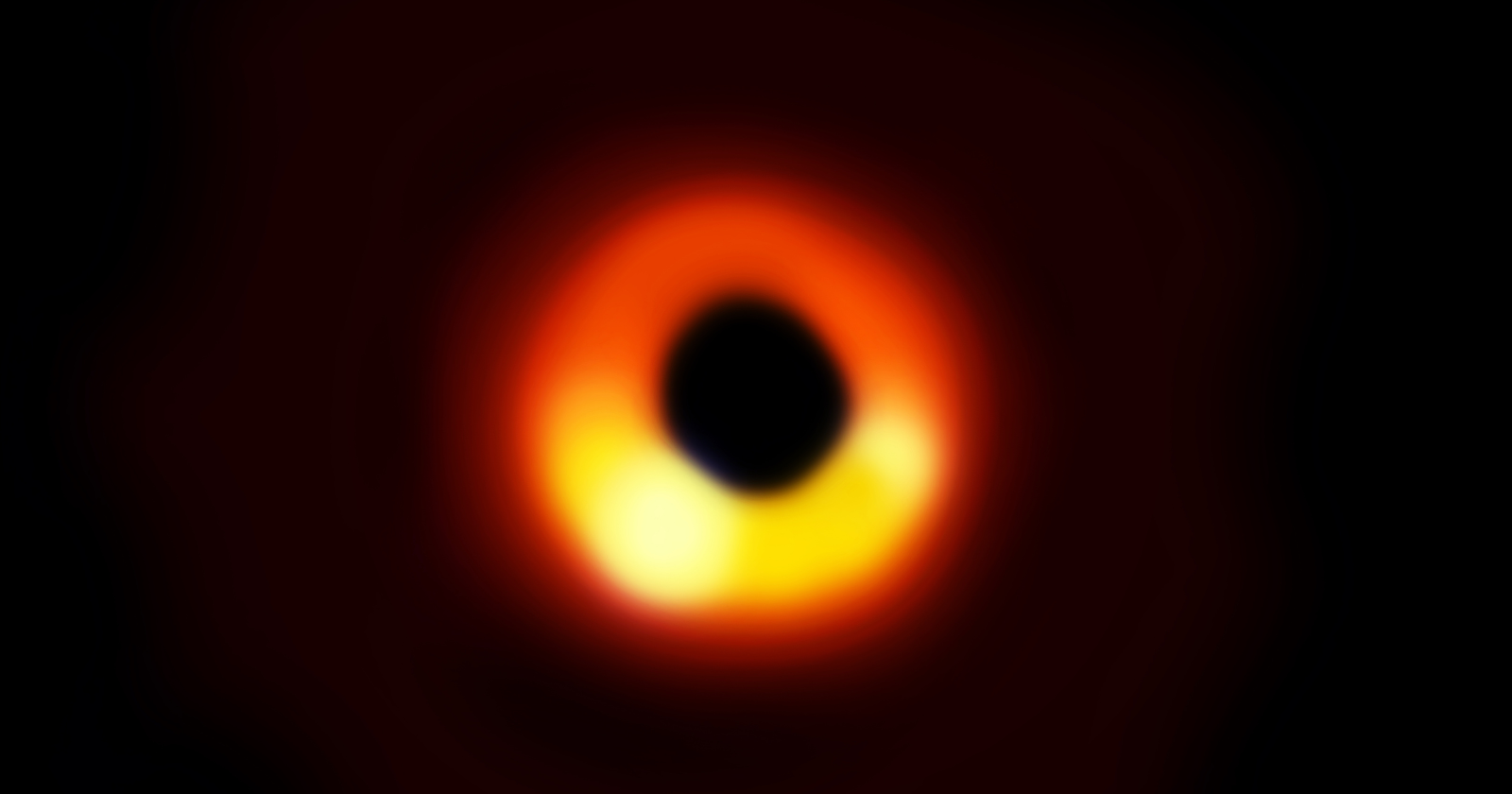
On 12 May 2022 the Event Horizon Telescope Collaboration unveiled the first image of Sagittarius A*, the supermassive black hole at the centre of the Milky Way. It’s a bright, slightly lumpy ring of light wrapped around a dark centre. The dark patch is the shadow cast by an object about 4 million times the mass of the Sun, sitting roughly 27,000 light-years away, and it had been there the whole time, quietly, while the picture took five years to make.
The light in the picture is old in two senses. The photons left the galactic centre tens of thousands of years ago, and the data behind the image was recorded in April 2017. The Event Horizon Telescope is not a single dish. Eight radio observatories were linked across the planet into one Earth-sized virtual telescope, each recording its slice of the same source, the slices later stitched together into a single resolving instrument.
Stitching is the slow part. More than 300 researchers at 80 institutes spent about five years turning the raw signals into the ring, including building a large library of simulated black holes to compare the data against.
The obvious expectation is that the nearest supermassive black hole would be the easiest to photograph, and it was not. The collaboration had already imaged M87*, a black hole of about 6.5 billion solar masses, in 2019. M87* sits far further away but is vastly larger, giving it a much slower-changing appearance. In this case, stability mattered as much as closeness.
Because Sgr A* is so much smaller, gas whips around it far faster. As EHT scientist Chi-kwan Chan put it, “where gas takes days to weeks to orbit the larger M87*, in the much smaller Sgr A* it completes an orbit in mere minutes.” The innermost orbit takes roughly 30 minutes for Sgr A* against about 30 days for M87*. The source flickers and rearranges itself even as the telescopes are watching it.
That motion broke the usual assumption that the thing being imaged holds still during an exposure. As MIT Haystack’s Vincent Fish described it, “Sgr A* is changing over minutes, so the data is jumping all over the place.” Anyone who has tried to photograph a fidgeting child in low light knows the shape of the problem, scaled up by orders of magnitude. The team had to average over many possible images and reformulate the methods built for the steadier M87*.
The ring matched the prediction. EHT Project Scientist Geoffrey Bower said, “We were stunned by how well the size of the ring agreed with predictions from Einstein’s Theory of General Relativity.” The measured diameter of the bright emission ring came in at about 51.8 microarcseconds, close to the size general relativity expects given the mass-to-distance ratio already pinned down by tracking stars that orbit the centre.
Having two black holes of wildly different size that both fit the same theory is the useful part. Sera Markoff, co-chair of the EHT Science Council, said, “This tells us that General Relativity governs these objects up close, and any differences we see further away must be due to differences in the material that surrounds the black holes.” Two objects consistent with general relativity is not the same as the theory being settled in every regime, but it narrows where any deviation could be hiding.
Not everything is closed. An independent reanalysis by Miyoshi and colleagues questioned the ring, and the collaboration has defended its methods, arguing the ring with a central depression remains the most likely model fitting the data. The variability that made Sgr A* hard to image also makes it a sharper test: Harvard-Smithsonian’s Michael Johnson had noted in 2019 that “For Sgr A*, there’s almost no wiggle room.” General relativity seems to have passed this test.
What changes with the image’s existence is concrete. Researchers now have a resolved, nearby target whose appearance shifts on a timescale of minutes, which means the next step is movies rather than stills, tracking the plasma as it moves. EHT scientist Keiichi Asada said the team can now “go a lot further in testing how gravity behaves in these extreme environments than ever before.” Until 2022, no one had a picture of the centre of our own galaxy to hold up against general relativity’s prediction; that picture now exists.
