
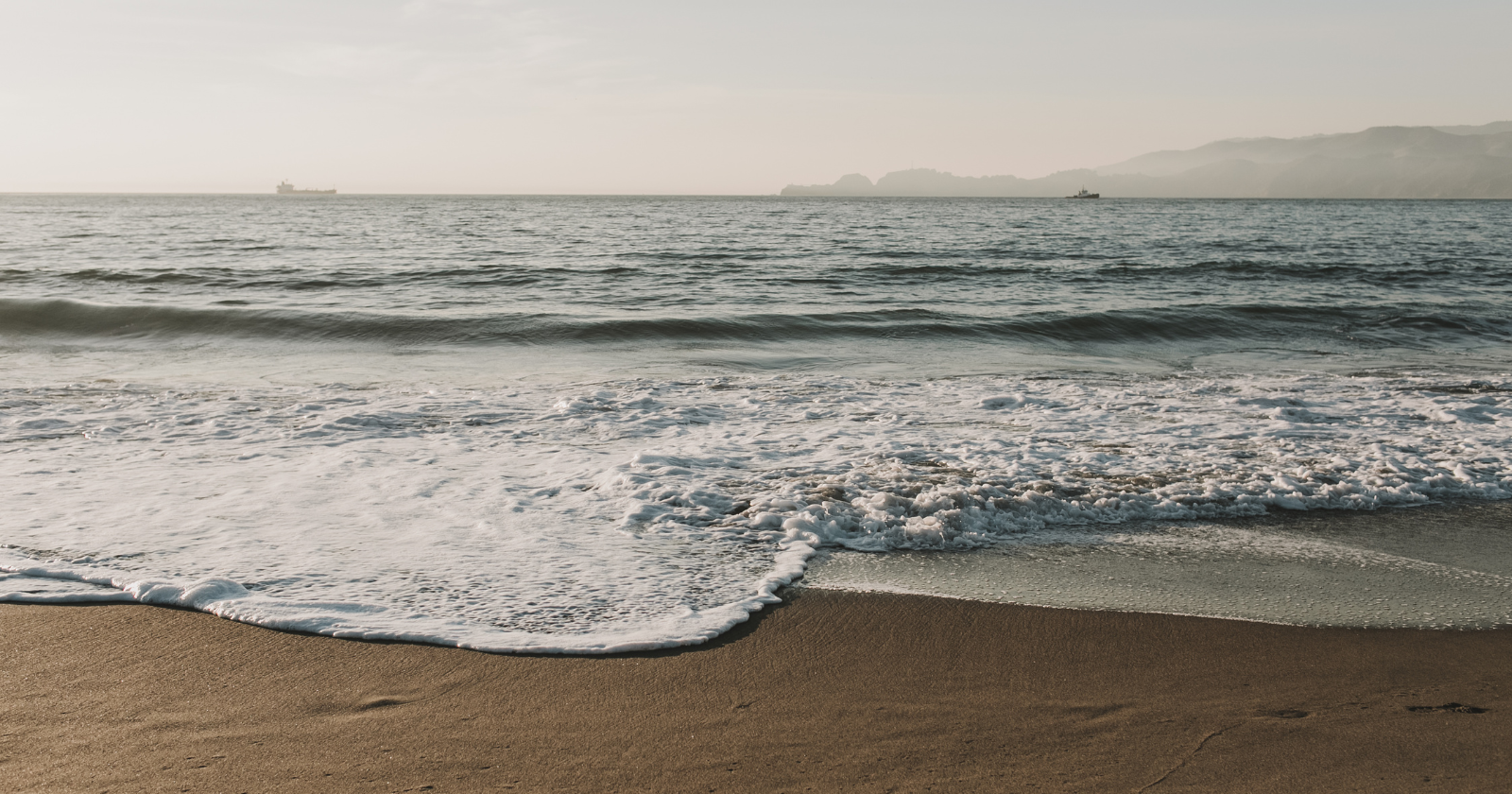
Stand at the edge of the ocean for a few seconds. A wave comes in. It curls, it crashes, it pushes a sheet of water across the sand and then retreats. You think nothing of it. You watch the next one come in behind it. What just happened, in technical terms, is that the population of life on Earth briefly rearranged itself at your feet. Every cubic centimetre of the water that just touched your toes contains more living organisms than the entire population of a small city. Every cubic metre contains more than the human population of the planet. The single wave that just broke on the shore contained, by conservative estimates, several hundred trillion microscopic organisms — viruses, bacteria, single-celled algae, protozoa, the larvae of crabs and fish, copepods, dinoflagellates, and dozens of other categories of marine life that have no common names because they are too small to ever have been noticed by the people walking past them. And then the wave retreated, and the same thing happened with the next wave behind it, and the one behind that.
According to the Woods Hole Oceanographic Institution’s reference on microbial life in seawater, the sunlit surface waters of the ocean contain approximately one million microscopic organisms in every drop. The Catalina Island Marine Institute’s somewhat more granular breakdown, drawing on data from the Australian Department of Environment and Energy, gives a typical litre of seawater as containing approximately one billion bacteria, four billion viruses, one million phytoplankton, and half a million zooplankton — for a total of slightly over five billion living organisms per litre, or roughly five million per millilitre. The exact figures vary by location, depth, season, and method of measurement. Coastal waters generally contain more life per unit volume than open-ocean waters. Surface waters generally contain more than deep waters. Nutrient-rich upwelling zones contain more than nutrient-poor gyres. But across nearly all of the world’s ocean surface, every millilitre of water you might happen to scoop up contains millions of independently living things.
What’s actually in there
The numerical dominance belongs to viruses. According to a 2023 PLOS Biology review of marine viral abundance, the early 1990s quantifications based on DNA staining of viral particles found concentrations of up to ten million viruses in a single drop of seawater, and subsequent studies have confirmed that marine viruses are the most abundant biological entity in the ocean. The total population of viruses across all of the world’s oceans is estimated at approximately 10³⁰ individual viral particles — a number with thirty zeros, larger than the estimated number of stars in the observable universe. Most of these are bacteriophages, viruses that infect marine bacteria and archaea. They do not infect humans. They are not visible to the naked eye, do not noticeably affect the taste or appearance of the seawater they inhabit, and would be entirely invisible to the average swimmer were it not for the slight luminescence that some of their phytoplankton hosts produce when disturbed.
Beneath the viruses, in numerical terms, sit the bacteria — approximately one million per millilitre of typical seawater, with some coastal locations containing several times that figure. The bacteria perform an enormous range of chemical work in the ocean: photosynthesis (by the cyanobacterial genera Prochlorococcus and Synechococcus, which together produce a substantial fraction of all the oxygen on Earth), nitrogen fixation, carbon cycling, and the basic decomposition that returns dead organic matter to the dissolved nutrient pool. Beneath the bacteria sit the phytoplankton — single-celled photosynthetic organisms larger than bacteria but still microscopic, present at roughly a thousand per millilitre and responsible for approximately half of all global primary production. Beneath them sit the zooplankton — the small drifting animals that eat the phytoplankton, including the immature larval stages of many of the larger marine animals that humans eat. And alongside all of these, throughout the water column, are bits of organic detritus, copepods, free-swimming fish larvae, crab and starfish larvae, dinoflagellates, ciliates, foraminifera, and many other categories of life that are present in lower numerical abundance but together fill in the rest of the picture.
The arithmetic of the wave
A typical breaking wave at a sandy beach contains somewhere between 50 and 100 cubic metres of water — call it 50 million to 100 million millilitres. Multiply that volume by the conservative estimate of approximately 11 million microscopic organisms per millilitre, and a single beach wave contains, in total, somewhere between 500 trillion and 1 quadrillion individual living organisms. According to the Population Reference Bureau’s standard estimate of the cumulative human population of Earth across all of history, approximately 117 billion modern humans have ever been born since Homo sapiens emerged approximately 200,000 years ago. The ratio between the two figures is approximately five thousand to one. A single wave, breaking on a single beach, in a single second, contains roughly five thousand times as many living organisms as the entire cumulative birth history of the human species.
The ratio is, depending on how you feel about microscopic life, either deeply humbling or deeply boring. Most of the trillions of organisms in any given wave are smaller than a human cell, will live for hours to days, are largely indistinguishable from one another to the unaided human eye, and contribute almost nothing to your direct experience of the beach. They are also responsible for approximately half of the planet’s oxygen production, the regulation of much of its climate, and the cycling of carbon, nitrogen, phosphorus, and sulfur through the global biosphere on timescales that ultimately determine whether the surface of the Earth remains habitable for larger organisms like humans. The wave is doing a lot more than just wetting your ankles.
Why this matters for the planet
The role of marine microbes in the global system is much larger than their physical size suggests. According to a foundational 2007 review in Nature Reviews Microbiology by the marine virologist Curtis Suttle, marine viruses alone kill approximately 20 percent of the ocean’s microbial biomass every day, releasing the contents of those dead cells back into the dissolved organic matter pool and driving an enormous flux of carbon, nutrients, and genetic material through the surface ocean. The Suttle paper also estimated that if all the viruses in the world’s oceans were stretched end to end, they would extend farther than the distance to the 60 nearest galaxies. Every second, approximately 10²³ viral infections occur somewhere in the ocean — a rate that exceeds the total number of human-to-human contacts that have occurred across the entire history of our species by many orders of magnitude per second.
The implications for global biogeochemistry are substantial. The viral lysis of bacteria in the surface ocean (“the viral shunt,” in the technical literature) keeps a large fraction of marine carbon in the dissolved phase rather than allowing it to sink to the deep ocean as particulate matter. The result is that the ocean’s surface layer is, in a meaningful sense, an enormous open-air bioreactor, continuously processing and recycling the chemical building blocks of life at scales that dwarf any process occurring on dry land. The bacteria and phytoplankton that the viruses kill are continuously replaced by new bacteria and phytoplankton; the next generation infects, lyses, and gets replaced again. The whole cycle happens, in any given parcel of seawater, on timescales of hours to days.
What the next wave contains
The wave that just broke on the beach as you read this paragraph contained, depending on its size, somewhere between several hundred trillion and a quadrillion individual living things. The vast majority were viruses, mostly bacteriophages, mostly unidentified by science, mostly too small for any visual technology smaller than an electron microscope to resolve. A smaller but still enormous number were bacteria, photosynthesising and respiring and dividing on the same timescale on which the wave was forming and breaking. A still smaller number were the phytoplankton that produce, collectively across the global ocean, roughly half of the oxygen in the air you are breathing. A still smaller number were the zooplankton, copepods, and larvae of larger marine animals.
The wave itself, viewed as an object, has no particular significance. Waves break on beaches continuously, all over the world, in numbers no person could plausibly count. What the wave contains, however, briefly outnumbers the entire cumulative population of the human species by a factor of several thousand. The next wave behind it does the same thing. The wave after that does the same thing. The ocean, taken as a whole, has been doing this every second of every day for approximately 3.8 billion years, and will continue to do it for as long as there is enough liquid water on Earth to support the microbial communities that constitute, in number if not in mass, the dominant form of life on the planet. The human population is a rounding error in this larger accounting. The cumulative birth count of every human who has ever lived fits, with room to spare, inside the volume of water that breaks on a single beach in the time it takes to read this sentence.
