
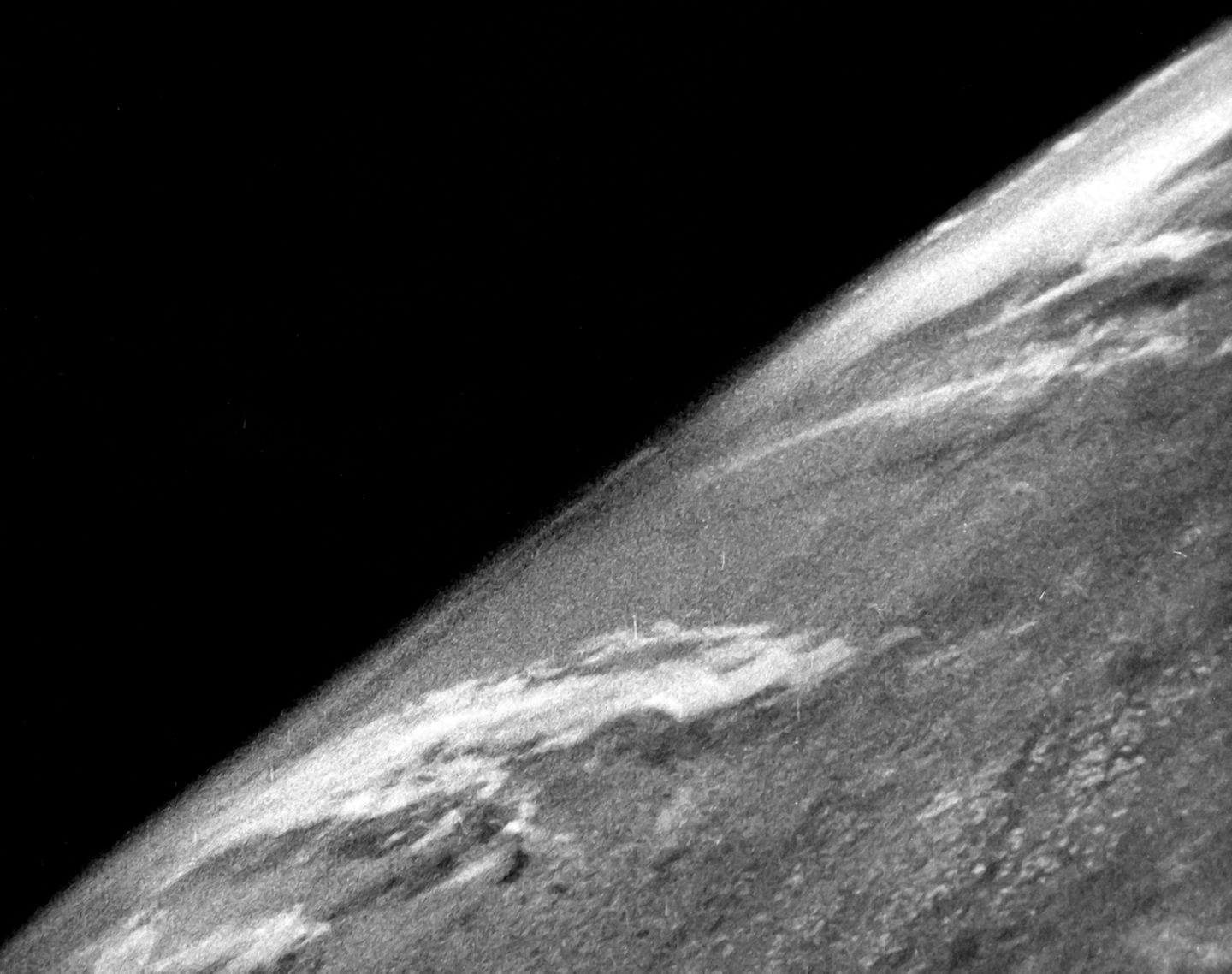
Every photograph of Earth ever taken from space, from Apollo 8’s Earthrise to Apollo 17’s Blue Marble to Voyager 1’s Pale Blue Dot, descends from a strip of 35-millimetre film pulled from the wreckage of a captured German V-2 rocket in the New Mexico desert in October 1946.
The camera that exposed it was a DeVry motion-picture camera modified by Clyde Holliday at the Johns Hopkins Applied Physics Laboratory. It was not launched on a spacecraft, because no spacecraft existed. It was bolted into a weapon.
On October 24, 1946, V-2 No. 13 rose from White Sands Proving Ground carrying Holliday’s camera above the line now commonly treated as the edge of space. At about 105 kilometres up, it photographed Earth as a curved surface against black sky, one frame every second and a half.
The rocket did not land gently. It came back down on the desert range and was destroyed on impact, but the film cassette survived. When the frames were recovered and developed, the result was the first successful photograph of Earth taken from space.
The date matters because it is often blurred with the better-known V-2 camera flights that followed in 1947 and 1948. The first successful sequence came on October 24, 1946, more than a decade before Sputnik, and long before any human being had seen Earth from orbit.
A weapon repurposed as a camera platform
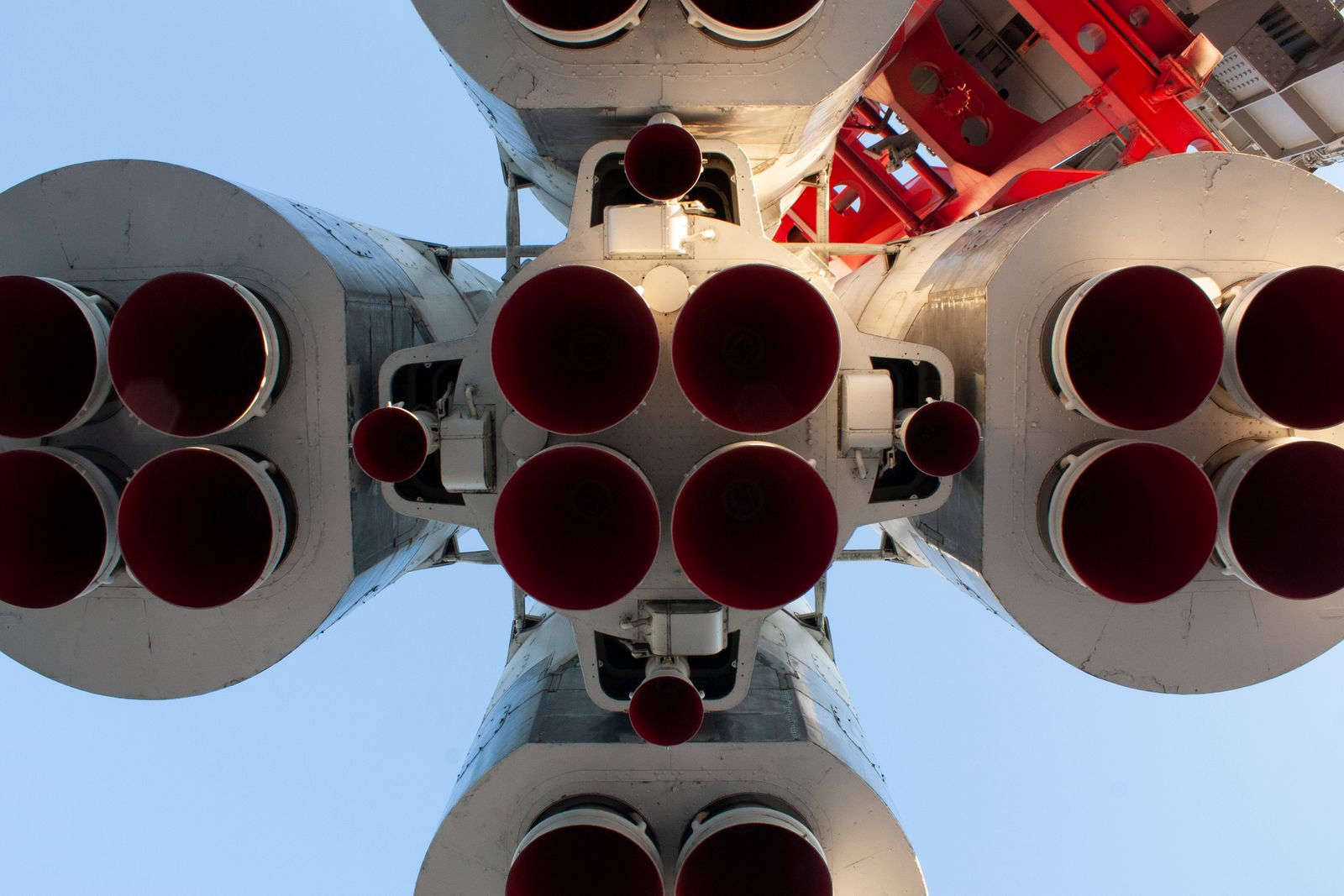
The V-2 was designed to kill. Wernher von Braun’s team at Peenemünde built it as a long-range ballistic missile, and the Smithsonian National Air and Space Museum describes the weapon as having a range of about 320 kilometres and a one-ton warhead.
More than 3,000 V-2s were fired at Allied targets during the war. The program also consumed forced labour on a horrific scale, with the Smithsonian’s Air and Space Museum noting that at least 10,000 people died in the Mittelwerk production system, more than were killed by the weapon’s deployment.
After Germany’s defeat, American forces shipped captured V-2 parts to New Mexico. White Sands became one of the places where the United States learned how high-altitude rockets behaved, how instruments survived launch, and how useful the upper atmosphere could be as a laboratory.
The U.S. Army’s own history of White Sands places the range at the centre of early American rocket testing, beginning with captured German V-2 technology in 1946. That same test culture opened the nose cones to scientists from the Naval Research Laboratory, the Applied Physics Laboratory, the University of Michigan and other institutions.
Most instruments were there to measure radiation, cosmic rays, solar ultraviolet light or the upper atmosphere. Holliday’s camera did something simpler and stranger. It turned the rocket around, in effect, and made Earth itself the subject.
The camera rode above the Kármán line
The October 24 flight carried a 35-millimetre DeVry cine camera, set to expose one frame every 1.5 seconds. Contemporary accounts identify the launch as V-2 No. 13, fired from White Sands and reaching about 104.6 to 105 kilometres above the desert.
That altitude put the camera just above the 100-kilometre Kármán line, the conventional boundary often used to mark the start of space. Balloons had photographed curvature from high altitude before. Holliday’s camera crossed into a different category.
The flight itself was rough. After engine cutoff, the rocket tumbled, and its spent body eventually struck the range downrange from the launch site. One detailed reconstruction places the impact speed at about 150 metres per second, far below the 500 to 800 metres per second sometimes repeated in loose retellings.
The camera was not simply vaporised. Accounts of the recovery describe Holliday’s camera as found in usable condition except for damage such as the missing lens, while the film cassette preserved the exposed frames. The rocket was gone; the pictures remained.
What the first frames showed
The images were grainy and severe. They showed a bright, curved horizon, black sky above it, and the American Southwest flattened into pale geometry below.
Nothing in the frame looks like the blue planet photographs that later became famous. There are no oceans shining blue, no cloud swirls at global scale, no Moon in the foreground. The power of the image is that it is barely an image at all, just enough evidence to prove that Earth could be photographed from outside itself.
Smithsonian’s account of the flight notes that Holliday stitched the movie frames together into broader views, and that the V-2 photographs revealed the planet against the darkness of space. The Johns Hopkins Applied Physics Laboratory also credits its researchers in 1946 with bolting a 35-millimetre motion-picture camera onto a captured German V-2 and taking the first pictures of Earth’s curvature from space.
Holliday understood the shift almost immediately. In a 1950 National Geographic article, he wrote that the V-2 photographs showed “how our Earth would look to visitors from another planet coming in on a space ship.”
The view before Sputnik
That sentence was written seven years before Sputnik, twelve years before John Glenn orbited Earth, and eighteen years before Apollo 8 carried human eyes around the Moon. The idea of Earth as a planet among planets was already present in a strip of film recovered from military wreckage.
The camera program did not stop with one rocket. Holliday and other teams refined the mounts, lenses and recovery systems, and later V-2 flights produced clearer panoramic images from still higher altitudes, including views that covered enormous stretches of the southwestern United States and northern Mexico.
Those flights helped teach engineers how to design instruments for violent ascent, cold upper air, vibration, spin and impact. The information flowed into the wider American sounding-rocket program, including Aerobee, a smaller and cheaper research rocket that APL developed when V-2s became scarce.
The line from V-2 photography to later space images is not only emotional. It is technical. The recovery procedures, camera housings, telemetry habits and high-altitude test culture belonged to the same early chain that eventually led from sounding rockets to satellites, crewed capsules and planetary probes.
The photographs that followed
A little more than two decades later, Apollo 8 astronaut Bill Anders photographed Earthrise from lunar orbit. In 1972, the Apollo 17 crew took The Blue Marble while travelling toward the Moon.
In 1990, Voyager 1 turned back toward home and made Pale Blue Dot, photographing Earth from about 6 billion kilometres away. Space Daily has covered that image separately in its account of Carl Sagan’s long push for Voyager’s final look back.
Every one of those later images is more beautiful than Holliday’s first frames. They are richer, cleaner, more legible and more famous. But none of them came first.
The first view was black and white, scratched by motion, recovered after impact, and born from a rocket designed for war. Somewhere in that damaged sequence, the desert falls away and Earth curves into darkness for the first time a camera ever proved it could.
