
In September 1994, a New South Wales National Parks ranger named David Noble lowered himself on a rope into a narrow sandstone gorge inside Wollemi National Park, about 150 kilometres northwest of Sydney, and walked through a stand of trees whose ancestors had shed pollen over the heads of dinosaurs. The trees were tall, knobbly-barked, fern-like in the canopy. Noble snapped off a small branch, took it home, and a few weeks later botanists at the Royal Botanic Gardens confirmed what he had found: a living member of a conifer lineage known almost entirely from fossils, presumed to have died out long ago.
The species was named Wollemia nobilis — Wollemi for the park, nobilis for the ranger.
Fewer than 100 mature wild trees are known to exist. They all grow in a single canyon system whose precise location Australian authorities keep secret, partly to keep collectors out and partly to keep their boots, and the fungal spores on them, away from the roots.
A tree that was supposed to be a fossil
Botanists had seen the Wollemi pine before 1994 — just not alive. Its distinctive pollen and leaf imprints had been catalogued from rocks across what was once the supercontinent Gondwana, in sediments reaching back more than 90 million years to the Cretaceous. The lineage did not vanish with the dinosaurs. Its pollen kept appearing in the record for tens of millions of years after the asteroid impact, thinning out only in the last several million years. The youngest known fossils are about two million years old. After that the record goes silent — and that silence was why everyone assumed the tree was gone.
Then a park ranger abseiled into a slot canyon on a long weekend.
The closest living relatives of the Wollemi pine sit in the family Araucariaceae — the same group that contains the monkey puzzle tree of Chile and the Norfolk Island pine that turns up in shopping-centre planters. Genetic work has since placed Wollemia on its own branch, the surviving twig of a lineage that scientists describe as the botanical equivalent of finding a small dinosaur still alive in a paddock.
Carrick Chambers, then director of the Royal Botanic Gardens in Sydney, called it the botanical find of the century. He was not exaggerating for the press.
What the grove actually looks like
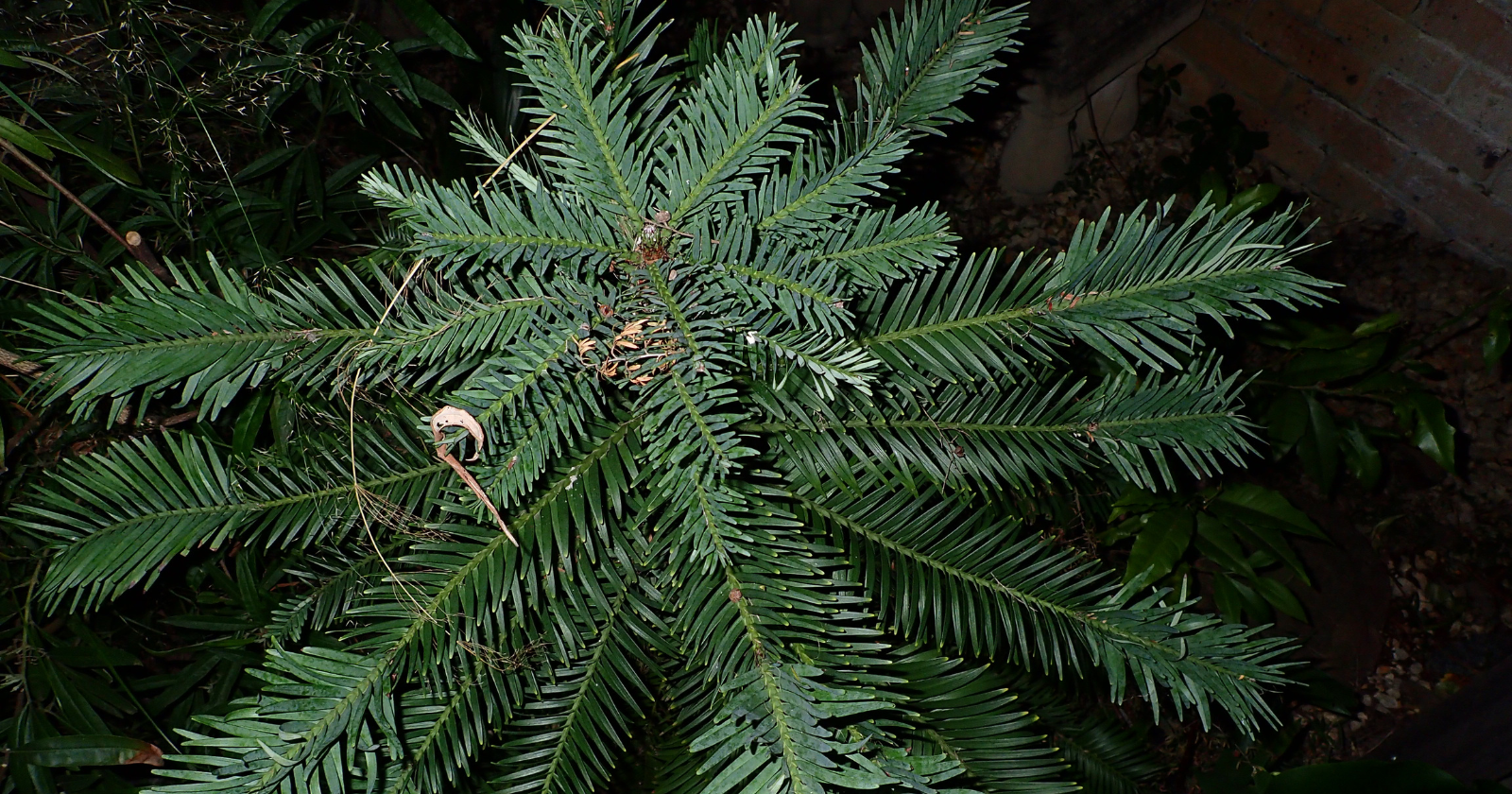
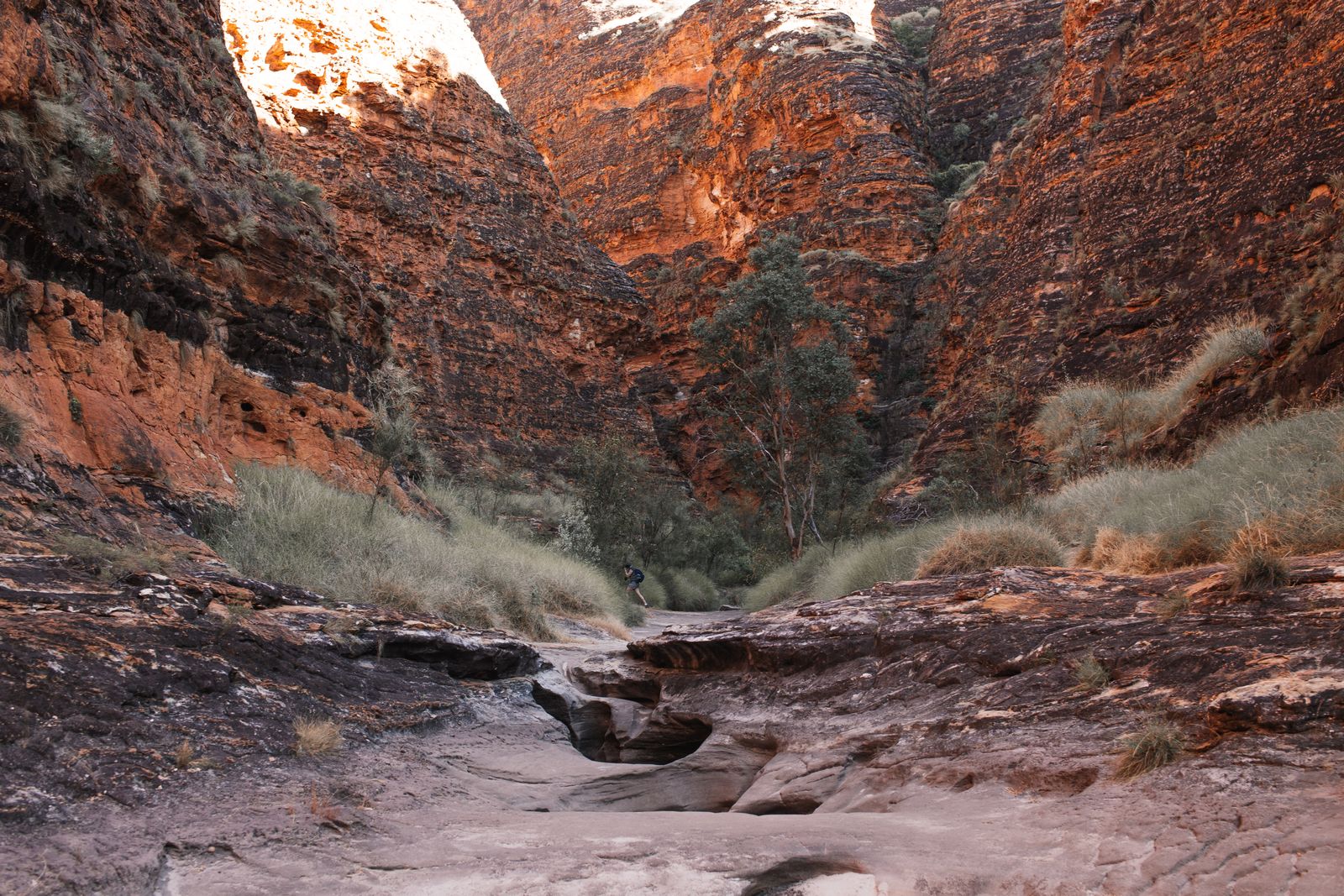
The canyon is narrow, deep, and damp. Sandstone walls funnel cool air and trap moisture, creating a microclimate that has barely changed since the last glacial maximum. Inside, the pines grow up to about 40 metres, roughly the height of a 12-storey building. The bark is dark and bubbled, often described as looking like Coco Pops welded together. The branches sweep down, then up, in a candelabra shape.
The adult trees produce two kinds of cone — male and female — on the same individual, but the species mostly reproduces by coppicing: sending up multiple trunks from a single root system. Many of the trees in the grove are not separate individuals at all. They are stems sharing one ancient genetic identity, replaying itself for tens of thousands of years.
That sameness is part of what makes the population so fragile. Genetic surveys of the wild stand have repeatedly found almost no variation between individuals. When researchers decoded the species’ genome — work published in a 2023 study — they confirmed extremely low genetic diversity, the mark of a population squeezed through a severe bottleneck and reduced to something close to a stand of clones. A single pathogen tuned to that genotype could take all of them.
Those clonal roots may be wired together below ground. Forest ecologist Suzanne Simard at the University of British Columbia has spent decades documenting how trees are linked by mycorrhizal fungi — threadlike networks that shuttle carbon, nitrogen and water between individuals. In one mapped stand, every tree in a 30-by-30-metre plot was connected to every other, with an estimated 250 to 300 individuals sharing a single network. Australian soils are far poorer in nutrients than the North American forests where most of that work was done, and researchers including Ian Anderson at Western Sydney University suspect such networks matter even more here. Beneath a grove of near-identical clonal pines, the fungal web may have been continuous for as long as the trees themselves.
The pathogen problem
The pathogen everyone worries about is Phytophthora cinnamomi, a water mould that attacks plant roots and is already widespread in Australian bushland. It travels in mud, on boots, on tyres, in the runoff after rain. Wollemi pines in cultivation have shown they are vulnerable to it. If it reaches the wild grove, the species in the wild could be functionally over within a generation.
This is the practical reason the coordinates are guarded. Park rangers and approved researchers visit on tightly controlled trips, decontaminating gear before entry. Bushwalkers who stumble across the area are asked to leave without photographing landmarks. In 2005, a group of unauthorised visitors was found to have entered the canyon; the response from New South Wales authorities was closer to that of a counter-intelligence service than a parks department.
The 2019–2020 Australian bushfires came within metres of the grove. A specialist firefighting operation, kept quiet until after the season, used helicopters to water-bomb the canyon rim and lowered crews in to set up irrigation lines. Most of the wild trees survived. A few were scorched. None of the adults were lost.
How a tree drops out of the record
The honest answer to how it persisted is that nobody knows exactly. The leading explanation is that the Wollemi canyon is what ecologists call a refugium — a pocket of stable conditions that survived while the climate around it changed beyond recognition. When Australia drifted north and dried out, when the inland seas retreated, when fire regimes shifted, the canyon held on to its cool, wet, sheltered microclimate. Generation after generation of pines coppiced from the same roots.
Related living fossils have similar stories. The dawn redwood, Metasequoia glyptostroboides, was known from fossils across the Northern Hemisphere before living trees were found in a remote valley in China in the 1940s — the same shape of story, a deep refuge and a stable climate sheltering a remnant population small enough to escape notice but large enough to keep reproducing.
The fossil record, in this sense, is a measurement instrument with limited resolution. A few hundred trees in one canyon, shedding pollen that does not travel far, will barely register. The Wollemi pine was there all along. The record simply stopped picking it up.
From a slot canyon to a million backyards
Once the species was confirmed, the Royal Botanic Gardens in Sydney began propagating cuttings. The decision was strategic: the more Wollemi pines existed outside the wild grove, the harder it would be for any single event to eliminate the species. Seedlings were distributed to botanic gardens around the world — Kew in London, the Australian National Arboretum in Canberra, and, more recently, gardens across the United Kingdom, Ireland, Europe and the United States.
Then the cultivated trees reached the public. The first were sold at auction through Sotheby’s in 2005, with commercial release following in 2006. A tree that science had known only from fossils could now be ordered with a credit card.
Hundreds of thousands of Wollemi pines now exist in cultivation, on six continents, descended from a few cuttings taken from a canyon almost nobody has been allowed to visit.
In strict botanical terms, the species is no longer at risk of disappearing entirely. In the wild, it remains critically endangered.
Why the discovery still matters
The Wollemi pine sits in a small category of finds that should temper how confidently extinction is ever declared. A bdelloid rotifer thawed from Siberian permafrost after 24,000 years and resumed eating and reproducing, as covered in an earlier Space Daily piece on suspended animation. The coelacanth, last recorded in the fossil record around 66 million years ago, turned up in a South African fishing net in 1938. Each case points the same way: the fossil record samples the past, it does not catalogue it.
What the Wollemi pine adds is a sense of how contingent that survival can be. It can hinge on something as small as a single canyon staying wet through an ice age, or a ranger choosing one weekend to rappel into one specific gorge instead of the next one over.
The grove sits roughly 150 kilometres from a city of more than five million people. Commercial flights cross above it every few minutes. The trees inside it belong to a lineage older than Tyrannosaurus rex, and they have spent the entire span of human history quietly coppicing from the same root systems, in a canyon whose coordinates almost nobody is allowed to write down.
On any given afternoon, the only sound in there is wind moving through needles that look almost exactly like the imprints in 90-million-year-old rock.
