
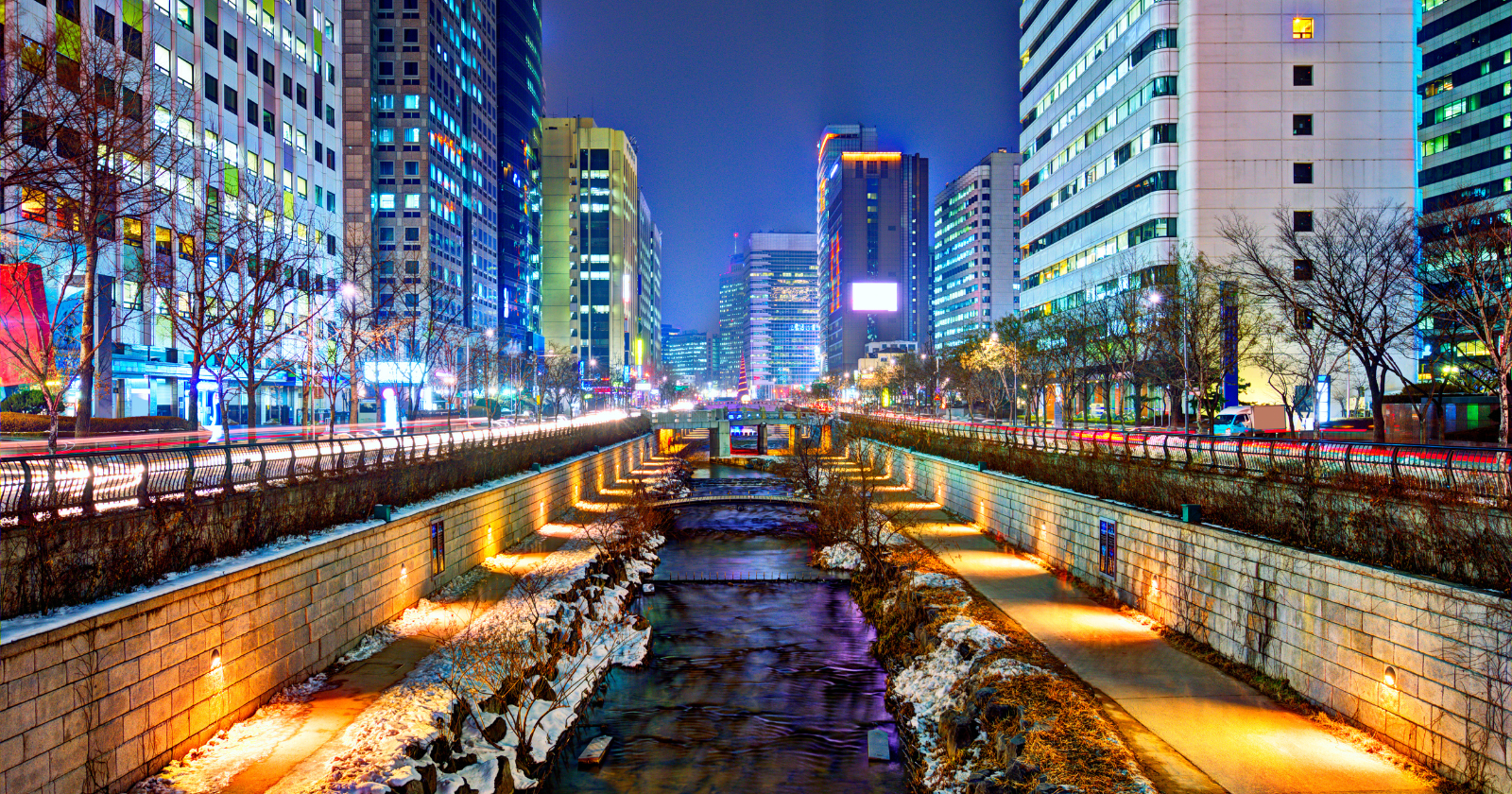
The stream is called Cheonggyecheon. It runs approximately 10.8 kilometres west to east through the centre of Seoul, beginning in the hills north of the city and emptying into the Han River that bisects the Korean capital. For most of the twentieth century, the people of Seoul could not see it. The stream had been buried beneath concrete in the 1950s, partly as a flood-control measure, partly as sanitation, and partly because the rapid post-war reconstruction of Seoul considered the open stream an obstacle to development. In 1976, a six-lane elevated expressway was built on top of the concrete covering, carrying approximately 168,000 vehicles per day through the heart of the city. By the late 1990s, the structure was beginning to fail, and the stream beneath it had not been seen by daylight in more than forty years.
In July 2003, the Seoul Metropolitan Government, under Mayor Lee Myung-bak, began the project to tear all of it down.
What was buried
The original Cheonggyecheon stream, in its pre-modern form, had been one of the central geographic features of Seoul since the city was founded as the capital of the Joseon dynasty in 1394. It flowed through the old city and was crossed by stone bridges, several of which were architectural landmarks. The Joseon kings had it dredged repeatedly to prevent flooding. The stream banks were where laundry was washed, where markets were held, and where the most densely-populated parts of the pre-industrial capital had grown up.
The decision to bury the stream came in the 1950s, when post-war Seoul was overwhelmed by refugees, informal settlements lined the banks, and the stream itself had become heavily polluted with sewage. The covering project, completed in 1958, was considered a triumph of post-war modernisation. The covering was followed in the 1960s and 1970s by the construction of the elevated expressway above it, which was opened in 1976 and considered, at the time, a symbol of Korean industrial progress.
By 2000, the expressway was deteriorating. Engineering surveys indicated it would require approximately 100 billion Korean won (around 90 million US dollars) and three years of repairs to make safe. The covered stream beneath had become a sewer in all but name. The neighbourhoods on either side had declined economically and were known primarily for flea markets, secondhand shops, and the heavy traffic.
This video explains more:
The decision
Lee Myung-bak, a former construction-company executive who had been elected Mayor of Seoul in 2002, ran his campaign in part on the proposal to tear down the elevated expressway and restore the stream. The proposal was controversial. Many business owners along the route opposed it. The Seoul Metropolitan Government held more than 4,200 public consultation meetings with affected stakeholders before construction began.
The lead transportation planner for the project was Dr Kee Yeon Hwang, then director of the urban transportation department at the Seoul Development Institute, who later became President of the Korea Transport Institute. Hwang had been brought into the planning early to model what would happen to traffic if the expressway were removed. His simulations, run repeatedly over several months, showed that downtown traffic would worsen slightly immediately after construction, but overall traffic across Seoul would improve. Hwang’s findings were initially met with significant skepticism from his peers in the transportation profession, on the grounds that removing a major arterial road carrying 168,000 vehicles a day could not, by intuition, produce a net traffic improvement.
The peer-reviewed evidence has since shown that Hwang was right, but in a more interesting way than the popular framing of the story suggests.
What actually happened to traffic
In 2012, Chung, Hwang, and Bae published a peer-reviewed study of the long-term traffic outcomes in the journal Transport Policy. They had monitored vehicle volumes and travel speeds across Seoul before, during, and after the construction, then continued monitoring for several years afterwards. Their finding was that the immediate effect of removing the expressway was indeed a decrease in travel speed and an increase in vehicle congestion on the remaining surface roads. The popular framing of the story, which has the highway removal magically improving traffic from day one, is incorrect.
What happened instead was a slower behavioural shift. Over the months and years following the removal, the team measured a continuous increase in subway ridership, a continuous increase in bus ridership, and a continuous decrease in private car trips into downtown Seoul. The roughly 168,000 vehicles per day that had been using the expressway did not, in aggregate, transfer onto the surrounding surface roads. Instead, the drivers slowly changed their behaviour. Many of them switched to public transport. Others changed where they were going, or when they travelled, or whether they made the trip at all. The Chung team called this phenomenon “self-compliance”, meaning that travellers adjusted their patterns to the new road capacity rather than insisting on the old patterns despite the changed infrastructure.
By the end of 2008, bus ridership in Seoul had increased by 15.1 per cent and subway ridership by 3.3 per cent, while overall car traffic in downtown Seoul had decreased by 2.3 per cent. The expressway that had been removed was no longer needed because the demand for it had migrated elsewhere.
The Cheonggyecheon project is now one of the most widely cited real-world examples of what economists call the Braess paradox, the counter-intuitive finding that adding road capacity to a congested network can sometimes worsen overall travel times, and removing capacity can sometimes improve them. The Chung team’s evidence suggests that the paradox operated in Seoul not through magic but through gradual behavioural adjustment.
What returned to the stream
The ecological recovery, documented by researchers at the University of Southern California for the Landscape Performance Series and based on Seoul Development Institute monitoring, was significantly faster than the traffic adjustment. Within months of the water returning to the stream, fish appeared. Within the first year, migratory birds had begun using the corridor as a stopover during their movements between Northern Asia and Southeast Asia. Within three years, the documented biodiversity in the restored stream corridor had increased by 639 per cent compared to the pre-restoration baseline.
The specific species counts were striking. Plant species rose from 62 to 308. Fish species rose from 4 to 25. Bird species rose from 6 to 36. Aquatic invertebrate species rose from 5 to 53. Insect species rose from 15 to 192. Mammal species rose from 2 to 4. Amphibian species rose from 4 to 8.
The species that returned to the stream were not, for the most part, deliberately reintroduced. They came back on their own.
The restored corridor became habitat for native fish including the Korean spotted barbel and Korean splendid dace, neither of which had been seen in downtown Seoul in living memory. Mallard ducks, herons, and several species of kingfisher established breeding populations in the corridor. The Cheonggyecheon Restoration Project’s design team had constructed native willow swamps, shallows, and marshes at 29 different locations along the stream, providing physical habitat for fish, amphibians, and insects, but the underlying ecological recovery was driven by the simple fact that the water had returned and the sunlight had reached it.
What it did to the city
The environmental effects extended well beyond the species that returned. Air pollution along the corridor dropped substantially. Small-particle air pollution, measured as PM-10, fell by approximately 35 per cent in the surrounding area, from 74 micrograms per cubic metre before the restoration to 48 after. Before the restoration, residents of the neighbourhoods along the covered stream had been more than twice as likely to suffer from respiratory disease as residents of other parts of Seoul.
The urban heat island effect was reduced. Temperatures measured along the restored stream were between 3.3 and 5.9 degrees Celsius cooler than temperatures measured on parallel roads four to seven blocks away. The cooling effect was partly due to the water itself, partly to the increased vegetation along the corridor, partly to the removal of the heat-absorbing concrete expressway, and partly to a measurable 2.2 to 7.8 per cent increase in wind speeds through the corridor, now that the elevated highway no longer blocked airflow through the city centre.
The economic effects were also measurable. Land values within 50 metres of the restored stream rose by between 30 and 50 per cent in the years following completion, which was double the rate of increase elsewhere in Seoul. The number of businesses in the Cheonggyecheon area grew by 3.5 per cent during the 2002-2003 period, while business growth in downtown Seoul as a whole was approximately half that rate. The local working population grew by 0.8 per cent at a time when downtown Seoul as a whole was losing workers, at a rate of 2.6 per cent. The restored corridor now attracts approximately 64,000 visitors per day, of whom roughly 1,400 are international tourists.
The honest limitations
Several things are worth saying clearly about what the Cheonggyecheon project does and does not represent.
The restored stream is not a fully natural river. The original Cheonggyecheon was an intermittent stream that ran dry for much of the year except during the summer monsoon. The restoration project addressed this by pumping 120,000 tons of water per day from the Han River and from several subway pump stations, treating the water, and releasing it at the head of the stream. The current of the restored stream is, in this sense, artificial. The fish and birds that have colonised it do not know this, but it is true.
The project was also expensive. The total cost was approximately 386.7 billion Korean won, or around 281 million US dollars at the time of construction. Adjusted for inflation and including subsequent investment, the figure is now estimated at closer to 900 million US dollars. The restoration was not, by any reasonable measure, a cheap alternative to repairing the expressway.
There were also social costs the project did not fully address. Some of the small businesses and street vendors that had operated under the elevated highway were displaced by the construction and never returned to the area. The Seoul Metropolitan Government’s stakeholder consultation, while extensive, did not prevent all the negative effects of the redevelopment, including subsequent gentrification that pushed lower-income residents out of the surrounding neighbourhoods. Several peer-reviewed studies have analysed these distributional outcomes critically.
The project is not, in other words, a story of pure positive transformation. It is a story of trade-offs that, on the available evidence, came out substantially in favour of the restoration.
What it taught
The Cheonggyecheon project has now been studied by urban planners, transport economists, ecologists, and policy researchers around the world for two decades. The Harvard Graduate School of Design awarded it the Veronica Rudge Green Prize in Urban Design in 2010, and its findings have informed similar highway-removal projects in Madrid, San Francisco, Milwaukee, Portland, and Seoul itself, which has subsequently removed several other elevated roadways in the city.
The single most important finding, on the strongest peer-reviewed reading of the evidence, is that the assumed relationship between road capacity and travel demand is not straightforward. The traffic engineering profession in the 1960s and 1970s, when most of the world’s urban expressways were built, operated on the assumption that travel demand was relatively fixed and that road infrastructure had to be built to accommodate it. The Cheonggyecheon evidence, alongside similar findings from other highway-removal projects, suggests that travel demand is in fact substantially shaped by the available infrastructure. Build more roads and people drive more. Remove roads and, given enough time, people drive less.
The ecological evidence points in a similar direction. The 639 per cent biodiversity increase did not require active rewilding. It required only the removal of the structure that had been blocking the recovery. The fish came back because the water came back. The birds came back because the fish and insects did. The plants colonised the restored banks because the sunlight had returned. The ecosystem that had existed before the burial of the stream had not been destroyed but suppressed, and the suppression had been removed.
The Cheonggyecheon project is, on the best available evidence, the most rigorously documented example of what happens when a major city removes a major piece of infrastructure that had been built on the assumption that nature needed to be displaced for the city to function.
The displacement turned out to be unnecessary.
The city has functioned better since.
