
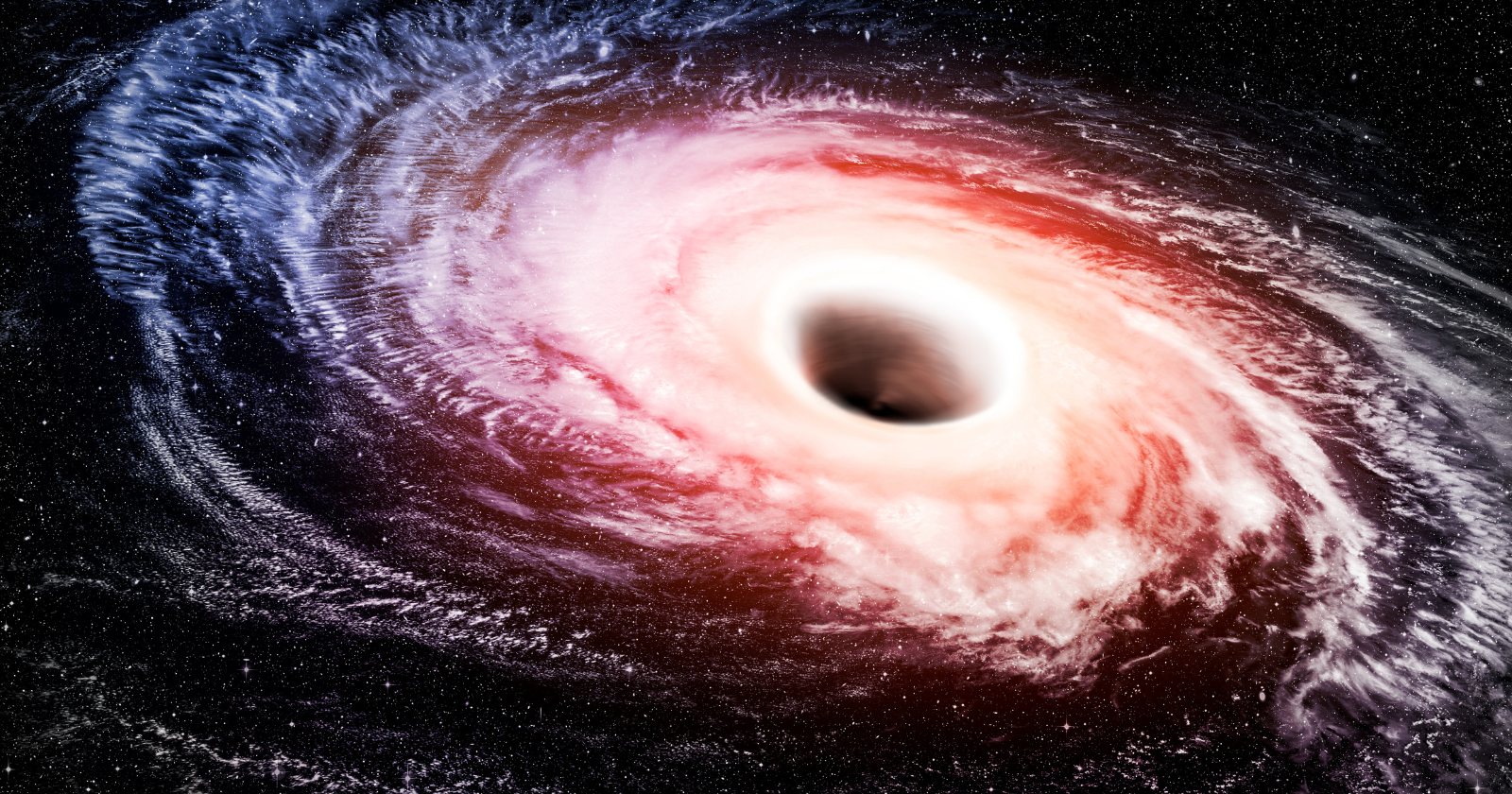
If you point a powerful telescope at the right patch of sky on the border between the constellations Canes Venatici and Coma Berenices, just below the handle of the Big Dipper, you can pick up a small bluish-white dot of light. The dot is not a star. It is the visible glow of an enormous accretion disc surrounding a supermassive black hole approximately 10.8 billion light-years from Earth. The light you see has been travelling toward Earth for more than three-quarters of the age of the universe. By the time it left its source, the Earth did not yet exist; the Sun was not yet born; the Milky Way had only recently coalesced into its modern spiral shape. The quasar’s name is TON 618, short for Tonantzintla 618, after the Mexican observatory where it was first catalogued in 1957.
According to the Wikipedia reference on TON 618, the central black hole that powers the quasar is one of the most massive ever measured. The most widely-cited estimate, derived from a 2004 analysis by Ohad Shemmer and colleagues based on the width of the Hβ emission line in the quasar’s spectrum, places the mass at approximately 66 billion times the mass of the Sun. A more recent 2019 analysis by Ge and colleagues, using improved methods, has revised this figure downward to approximately 40.7 billion solar masses. The two estimates differ substantially, reflecting the inherent uncertainty in deriving black hole masses from emission-line widths in distant quasars. Either figure places TON 618 in a category that some astronomers have proposed should be called “ultramassive” — distinct from the merely “supermassive” black holes that sit at the centres of most large galaxies, including the Milky Way’s Sagittarius A* at approximately 4 million solar masses.
What 66 billion solar masses looks like
The Milky Way galaxy, as a whole, contains approximately 200 to 400 billion stars with a total stellar mass estimated at approximately 64 billion solar masses. The 66-billion-solar-mass figure for TON 618, if it is correct, makes the single black hole at the heart of one distant galaxy more massive than the combined mass of every star in our entire galaxy. The revised 40.7-billion-solar-mass figure puts the black hole at roughly two-thirds the stellar mass of the Milky Way — still spectacular, but no longer exceeding the entire galaxy’s stellar content. In either case, the gravitational influence of the black hole on its host galaxy and its surroundings is among the largest currently known to astronomy.
The Schwarzschild radius of a black hole — the distance from the centre to the event horizon, the boundary beyond which no light can escape — scales linearly with mass. For a black hole of one solar mass, the Schwarzschild radius is approximately 3 kilometres. For Sagittarius A*, at 4 million solar masses, the radius is approximately 12 million kilometres, about 17 percent of Mercury’s orbit. For TON 618 at 66 billion solar masses, the Schwarzschild radius reaches approximately 1,300 astronomical units (AU), where one AU is the Earth-Sun distance. The event horizon’s diameter is therefore approximately 2,600 AU, or roughly 390 billion kilometres. According to the Guinness World Records reference on TON 618 as the most massive black hole ever observed, this means the black hole could swallow our entire solar system more than 40 times over without filling its event horizon. Even at the revised 40.7-billion-solar-mass figure, the event horizon still spans approximately 1,600 AU in diameter — substantially larger than the orbit of any planet around our Sun, and many times larger than the entire planetary region of the solar system.
How it was found
TON 618 was first observed not as a black hole but as a faint blue star. According to NASA Goddard’s reference on TON 618 as part of an animation comparing the universe’s biggest black holes, the object was catalogued by the Mexican astronomers Braulio Iriarte and Enrique Chavira at the Tonantzintla Observatory in 1957, in a survey of faint blue stars far from the plane of the Milky Way. The astronomers assumed they were looking at a white dwarf, a kind of dead stellar remnant common in the halo of the Galaxy. The actual nature of quasars — distant active galactic nuclei powered by supermassive black holes — was not understood until 1963. The intervening six years left TON 618 sitting in the Tonantzintla catalogue as a misidentified white dwarf, its true nature unrecognised.
In 1970, radio surveys of the same patch of sky picked up unexpectedly strong emissions from the same coordinates, suggesting that the bluish-white dot was something other than a small dead star. Optical spectroscopy by Marie-Helene Ulrich at the McDonald Observatory in Texas later in the 1970s confirmed the identification: the object showed the characteristic broad emission lines and high redshift of a quasar. The redshift indicated that the light had been stretched by cosmic expansion to the extent expected for an object more than 10 billion light-years from Earth, making TON 618 one of the most luminous quasars then known. Its absolute brightness — approximately 140 trillion times that of the Sun — meant it could be seen from such enormous distances despite being a single point of light at the centre of a galaxy whose own stellar light is so completely outshone by the quasar that the host galaxy itself remains invisible from Earth.
The mass measurement problem
The mass of a black hole as distant as TON 618 cannot be measured directly. The black hole itself emits no light. What astronomers can observe is the surrounding accretion disc — the swirling region of intensely hot gas and matter that is being pulled into the black hole — and the broad-line region beyond it, where cooler gas glows with the characteristic emission lines of ionised hydrogen and other elements. The widths of these emission lines indicate how fast the surrounding gas is moving, which in turn indicates how strong the gravitational field is, which in turn indicates the mass of the central black hole. The technique is called virial mass measurement, and it is the standard method for estimating supermassive black hole masses across cosmological distances.
The technique has substantial inherent uncertainties. The relationship between emission-line width and black hole mass requires assumptions about the geometry of the broad-line region, the orientation of the system relative to Earth, and the specific emission lines being measured. Different choices of method and emission line can produce mass estimates that vary by a factor of two or more for the same object. This is why the TON 618 mass estimate has shifted from 66 billion solar masses (Shemmer et al. 2004, based on the Hβ line) to 40.7 billion solar masses (Ge et al. 2019, based on revised analysis methods). The lower figure is now considered more likely by some astronomers, while the higher figure remains widely cited in popular references. The actual mass is probably somewhere between the two, and a definitive answer will require either a substantially better method or direct measurement techniques that do not yet exist for objects at such cosmological distances.
The upper limit on black hole mass
According to a BBC Science Focus analysis of ultramassive black holes, the existence of TON 618 has prompted theoretical work on whether there is an upper limit to how massive a black hole can grow. The British astrophysicist Andrew King has argued that non-spinning black holes face a theoretical maximum mass of approximately 50 billion solar masses, beyond which the inner edge of the accretion disc moves so far out that the disc becomes self-gravitating and the black hole stops growing. Most black holes are spinning, which raises this theoretical ceiling somewhat, but the basic principle suggests that even the largest known black holes may be approaching the upper limits of what is physically possible.
If TON 618 really is at 66 billion solar masses, it sits above King’s non-spinning maximum and at or near the spinning maximum, suggesting it may have stopped growing or be on the verge of doing so. If it is at the lower 40.7 billion figure, it sits below the theoretical ceiling and may still be growing. Either way, the object represents a population of ultramassive black holes that are near the upper edge of the mass distribution observed anywhere in the universe. The light that reveals TON 618’s existence to us is more than 10 billion years old. The black hole itself has had 10 billion years since then to grow further, or to slow to a stop, or — in principle — to begin to gradually evaporate through Hawking radiation. None of this is visible from Earth. The image is fixed at a moment more than three-quarters of the universe’s age in the past, showing us only what TON 618 was, not what it has become.
