
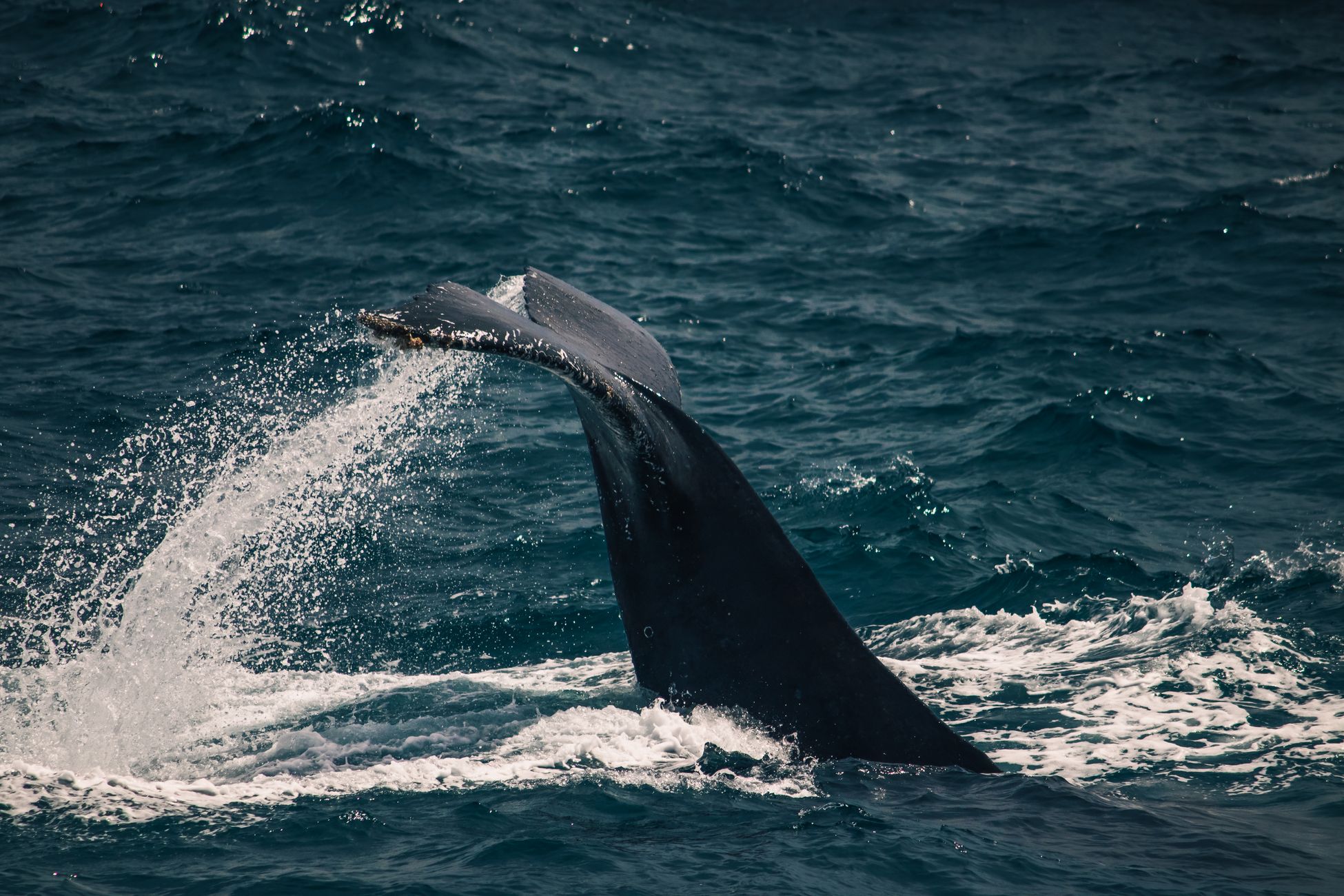
A sperm whale cruising the deep Atlantic can fire off a single click that researchers have measured at 230 decibels underwater, a pressure pulse so violent that biologists who study them suspect a close-range burst could stun a squid, rattle a diver’s chest cavity, or in theory kill smaller prey outright. The sound comes from a single animal, in a single moment, aimed like a flashlight beam through a forehead the size of a small car. Nothing else on Earth is louder.
The number is real, and it is staggering once you translate it. A jet engine at takeoff, heard from the tarmac, registers around 140 decibels in air. A rifle shot near the ear is about 165. Sperm whale clicks, converted to the equivalent in air, would sit somewhere around 170 to 180 decibels — comparable to standing inside the muzzle blast of a large-caliber gun. Underwater, the figure climbs because the reference pressure is different, but the energy is genuine. These are the loudest biological sounds ever recorded.
A nose built like a cannon
The sperm whale (Physeter macrocephalus) carries the largest nose in the animal kingdom, and almost everything about that nose has been retooled for sound. Roughly a third of the animal’s body is head, and most of that head is a pair of oil-filled chambers — the spermaceti organ and the junk — stacked above the upper jaw. Air gets pushed through a structure called the museau de singe (“monkey lips”) at the front of the skull, snapping shut with enough force to generate a pulse that then bounces between two air sacs at either end of the nose.
Each bounce sends a fraction of the energy out through the front of the head as a click. The rest keeps reverberating, which is why a single click recorded on a hydrophone often shows up as a series of decaying pulses spaced milliseconds apart. The whole apparatus is, functionally, a biological air horn the size of a Volkswagen.
The clicks are not random. Sperm whales use them to hunt at great depths, where sunlight does not reach and the only way to find a fast-moving squid is to ping the darkness and listen for the echo. Their preferred meal, the deep-sea squid, can grow to massive sizes.
What 230 decibels actually does
Underwater sound carries energy differently than sound in air. Water is denser, so a pressure wave moves through it with much more force per square centimeter. At 230 decibels at one meter from the source, the sound pressure is high enough to cause measurable physical effects on tissue. The Smithsonian’s reporting on the species describes the working hypothesis that the clicks may do more than locate prey — they may briefly debilitate it.
The idea was first floated in the 1980s by biologist Kenneth Norris, who noticed that sperm whale stomachs often contained squid with no visible bite marks and no apparent struggle. He proposed that the whale’s loudest clicks, focused forward through the spermaceti organ, could act as an acoustic weapon — stunning squid the way a flashbang stuns a person in a hallway. The theory has never been definitively proven in the wild, mostly because nobody has watched a sperm whale hunt at depth with a camera close enough to confirm it. But the physics support it, and the absence of squid teeth marks on the predator remains suggestive.
For human divers, the practical guidance is simple: do not get in front of a clicking sperm whale at close range. Free divers who have swum with the animals describe a sensation of being thumped in the sternum from across a swimming pool, even when the whale is many body lengths away. At close enough range, the pressure wave could rupture small air-filled cavities — sinuses, the middle ear, the gut.
The click as a fingerprint
The same anatomy that makes sperm whales the loudest animals on Earth also makes them among the most acoustically distinctive. Each whale produces a pattern of clicks called a coda, and codas vary by family group, by ocean basin, and by individual. Researchers working with Project CETI, a collaboration of biologists, linguists, and machine-learning specialists, have spent years recording sperm whale clans in the eastern Caribbean and pulling apart the structure of their communication.
In April 2026, researchers reported that sperm whale codas contain features analogous to human vowels — consistent spectral patterns that the whales modulate independently of rhythm and tempo. In other words, the clicks are not just Morse code. They carry a second layer of information riding on top of the timing, much the way a human “ah” and “ee” carry meaning separate from the rhythm of a sentence.
The same animal that can produce the loudest sound on the planet is also, apparently, holding nuanced conversations with its relatives across miles of open ocean.
How loud is loud
The decibel scale is logarithmic, which means the difference between numbers is not what it looks like. A 200-decibel sound is not 10 percent louder than a 180-decibel sound — it carries roughly 100 times the energy. The jump from 200 to 230 is another factor of about 1,000. By the time a click leaves the front of a sperm whale’s head, it carries energy on the order of millions of times what a human shout produces.
For comparison, the next loudest contenders in the animal kingdom are nowhere close. Snapping shrimp generate cavitation bubbles that collapse at around 200 decibels underwater, which is impressive for an animal the size of a paperclip but still well below the sperm whale. Blue whales sing at roughly 188 decibels. Howler monkeys, the loudest land animal most people can name, peak around 140 in air — about the level of a chainsaw at three feet. The sperm whale operates in a category by itself.
Why evolution built a 230-decibel animal
The pressure that drove the design is hunger. Sperm whales eat enormous quantities of squid, and the squid live in cold, dark water where vision is useless. Echolocation is the only way to find them, and the deeper you go, the more useful it is to have a loud signal that returns a strong echo from far away.
A louder click sees farther. A focused click sees with more precision. The spermaceti organ functions as an acoustic lens that aims and tunes the pulse. Eighteenth-century whalers harvested that wax by the barrel and used it to make smokeless candles and machine lubricant, never suspecting they were rendering down what amounts to a deep-sea sonar array.
The animal’s brain — the largest of any creature that has ever lived — sits behind the sound-producing apparatus, processing returning echoes with a resolution biologists are still working to characterize. A sperm whale can probably distinguish a squid from a fish from a rock at hundreds of meters, in total darkness, from the shape of the echo alone.
The diver’s perspective
People who have been in the water with sperm whales describe the clicks as something felt before heard. The pulses travel through the body, through the bones of the skull, through the diaphragm. Underwater photographer videos from the Azores and Dominica often capture divers reflexively flinching when a nearby whale fires off a sequence. The sound is not painful at typical encounter distances of 10 or 20 meters, but it is impossible to ignore.
Closer than that, the rules change. Marine mammal researchers generally treat the area within a few body lengths of an actively echolocating sperm whale as off-limits, partly out of respect for the animal and partly because the acoustic intensity at close range has never been formally tested on human subjects, for obvious reasons. The working assumption is that a direct, focused click at point-blank range could disorient or injure a person. The animal almost certainly has no intention of harming anyone, but the click does not know that.
Listening to the loudest voice in the ocean
For most of human history, sperm whales were silent. Nobody on a 19th-century whaling ship ever heard one click — the sounds traveled through water, not air, and the technology to capture them did not yet exist. The first hydrophone recordings of sperm whale clicks were made in the 1950s, and even then the recordings were treated mostly as curiosities. The realization that these were structured, intentional signals took decades more, and the realization that they might constitute something language-like is happening in real time, in papers being published now.
Other cetacean studies continue to fill in the picture of how acoustic specialization shapes the lives of these animals.
Somewhere in the Atlantic tonight, a sperm whale is a thousand meters down, hanging head-down in the black water, ticking out a slow series of clicks at a volume that would tear apart a human ear. Each pulse leaves the front of its enormous head, races outward at nearly a mile a second, hits a squid, and returns. The whale listens. Then it clicks again. The loudest sound on Earth is being made, right now, by an animal nobody can see.
