
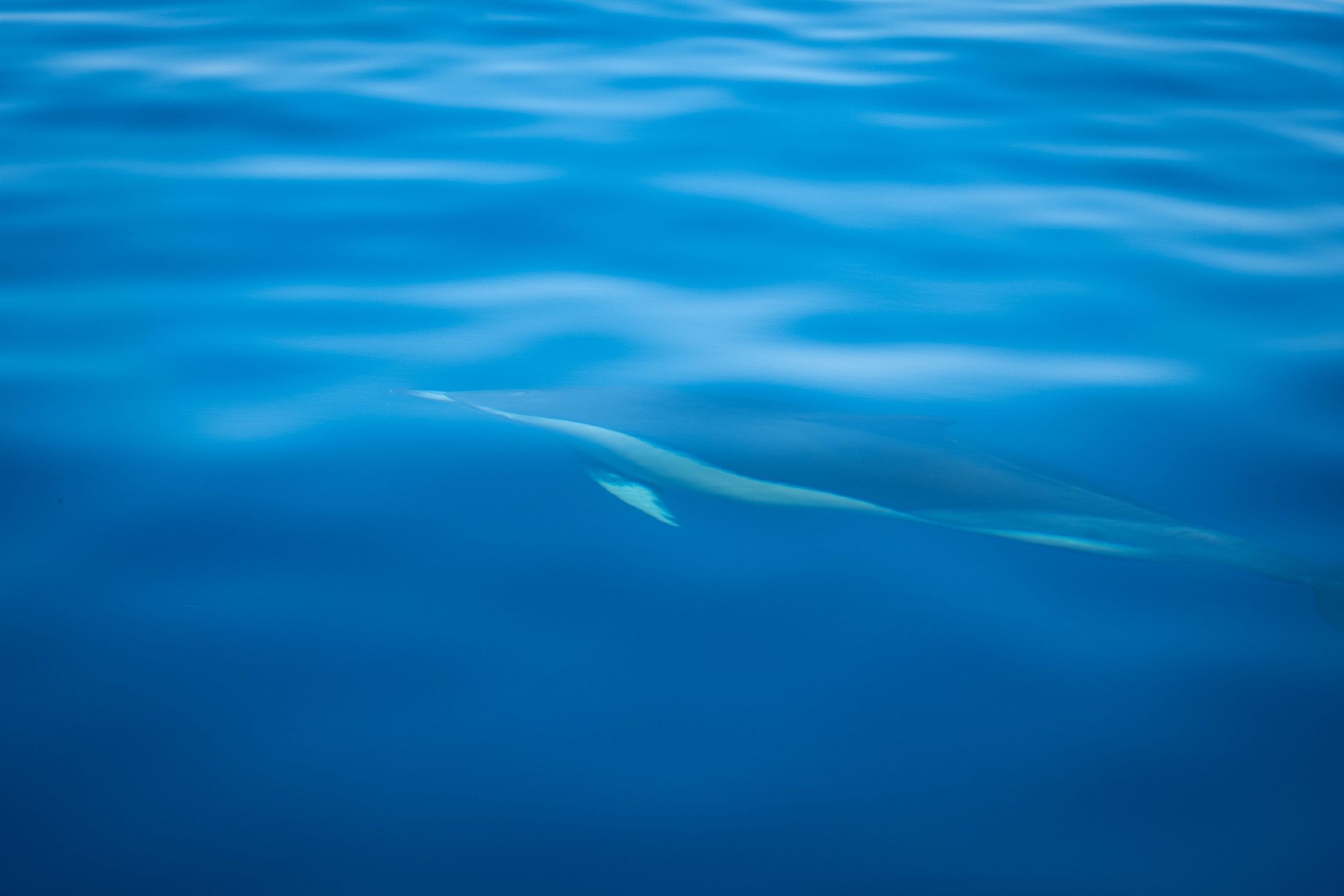
In the cold green water off Tremblay Sound in Nunavut, a male narwhal lifts a two-meter ivory spike out of the slush, swings it sideways, and cracks down on an Arctic cod with a precise tap that leaves the fish drifting motionless. A few seconds later the whale circles back and inhales the stunned cod through its nearly toothless mouth. The footage, captured by drone by researchers from Fisheries and Oceans Canada and the World Wildlife Fund, was the first clear visual evidence that the legendary narwhal tusk is not just an ornament. It is a hunting tool.
And the tool itself is one of the strangest objects grown by any mammal on Earth.
An inside-out tooth that grew the wrong way
The narwhal (Monodon monoceros) has only two teeth, both buried in its upper jaw. In males, the left one keeps growing. It punches straight through the upper lip and spirals outward in a left-handed helix until it can reach almost three meters in length, sometimes longer than the whale is tall.
What makes it strange is the architecture. In every other mammal tooth on the planet, the hard enamel sits on the outside and the sensitive pulp and nerves stay safely inside. The narwhal tusk is inverted. The soft, porous, nerve-rich dentin sits on the outside surface, exposed directly to the freezing seawater of the High Arctic.
Tiny nerve channels thread through that outer layer and connect to the pulp, giving the tusk a sensitivity that would be closer to a bare finger than a tooth. The tusk has been described as a sensory organ that happens to be shaped like a sword.
The Tremblay Sound footage
For centuries, naturalists guessed at what the tusk was for. Mating display. Ice-breaking. Jousting. Acoustic antenna. Walking stick. None of those guesses came with film.
That changed when WWF-Canada and DFO biologists flew drones over narwhals feeding in the shallows of Tremblay Sound on Baffin Island. The drones recorded males using the tusks in short, deliberate downward and sideways strikes against individual Arctic cod, the small silvery fish that dominates the Arctic food web. After a strike, the fish would freeze or convulse, and the narwhal would maneuver its blunt head into position to suck it in.
The behavior had never been documented before. The strikes appeared precise rather than thrashing, more like a measured slap than a swing. The clips, later discussed on Science Friday, show the whales doing it repeatedly and with apparent skill.
Why stunning matters for a whale with no real teeth
Adult narwhals have no functional teeth in their mouths. They feed by suction, opening the jaw quickly and pulling prey in with a rush of water. That works well for slow squid and bottom-hugging halibut. It works less well for Arctic cod, which are fast, slippery, and inclined to dart sideways at the first hint of a shadow overhead.
A stunned fish is an easier fish. The downward strike with the tusk solves a mechanical problem that the narwhal’s mouth alone cannot. As NPR reported on the field studies, the strikes also seem to act as a kind of corral, breaking up tight schools so individual cod can be picked off one by one.
Other toothed whales do something similar with sound, using bursts of clicks to disorient prey. The narwhal appears to do it with physical contact.
The nerve count and what it might feel
The narwhal tusk contains a remarkable density of nerve endings across its surface, putting it in the same neurological league as the most touch-sensitive organs in the animal kingdom.
Laboratory experiments have shown that the tusk responds to changes in salinity. When the exposed dentin is bathed in saltier or fresher water, the whale’s heart rate changes. That suggests the tusk can taste, in a sense, the water around it, which would be useful for tracking the boundary between sea ice meltwater and open ocean where prey concentrates.
Pressure, temperature, and possibly particle motion may all register through the same surface. A narwhal swimming through the dark of the polar winter, under meters of ice, is effectively reading the ocean with its face.
Only the males, mostly
The strangeness deepens with sex. Almost all narwhal tusks belong to males. Females usually never erupt one, and they appear to live full lives, find food, and raise calves without it. Some males grow two tusks, both spiraling left.
That asymmetry has long argued against the tusk being purely a feeding tool. If catching cod required a tusk, female narwhals and juvenile males would starve. They don’t. So the hunting use captured in the Tremblay Sound drones is probably a bonus skill layered on top of the tusk’s older roles, which almost certainly include male-male competition and mate assessment.
Males have been observed “tusking,” gently crossing and rubbing their tusks at the surface. The behavior may be a way to compare size and condition without injury, the cetacean version of a handshake that doubles as a measurement.
A unicorn horn in the Renaissance treasury
For most of European history, no one in the south had any idea what a narwhal looked like. The tusks did the traveling. Inuit and Norse traders brought them down through Greenland and Iceland into medieval Europe, where they were sold as unicorn horns and ground into powder said to cure poison, plague, and impotence.
Queen Elizabeth I reportedly owned one valued at the price of a castle. The Throne Chair of Denmark, built in the 1660s, is constructed almost entirely from narwhal ivory under the belief that a throne of unicorn would protect the monarch from treachery. It still stands at Rosenborg Castle in Copenhagen.
The deception was profitable enough that the source was kept secret for centuries. As a recent exhibition at the Peabody Essex Museum in Salem laid out, the unicorn myth and the Arctic whale were not separated in the European imagination until well into the Enlightenment.
The animal behind the spike
Strip away the tusk and the narwhal is still a remarkable animal. It can dive to great depths, hunting Greenland halibut in near-total darkness. It spends its entire life north of the Arctic Circle. It does not migrate to warm water to give birth, the way most whales do. Its summer range is the fjords of Nunavut and northwest Greenland. Its winter range is the pack ice of Baffin Bay, where it surfaces through cracks barely wide enough to fit a head.
Narwhals live in matrilineal pods, sometimes hundreds strong, and they communicate with clicks and whistles distinct enough that researchers can identify individual populations by accent. They are remarkably long-lived animals.
What the strikes still don’t explain
The Tremblay Sound footage answered one old question and opened several new ones. Do females, lacking a tusk, suffer lower foraging success on Arctic cod? Or do they specialize in deeper prey where the tusk would be useless anyway? When males strike a cod, are they killing it outright or only briefly stunning it through a shock wave through the water?
And how does an animal with a tooth full of exposed nerve endings cope with slamming it against a fish? The dentin tubules close to the tip may be more robust, or the nerve density may taper along the length. The mechanics of a tusk strike, in cold salt water against a small fish, have not yet been measured directly.
X-ray studies of how predators handle prey, like the recent work on frog feeding mechanics at Brown University, hint at how much remains hidden inside the mouths of animals that simply swallow things. A narwhal eating a cod underwater, eight meters down, behind a curtain of broken ice, is still mostly a guess.
A tooth that points outward
The simplest way to picture the narwhal tusk is to imagine taking a human canine, turning it inside out so the pulp faces the world, stretching it to nine feet, twisting it into a left-handed spiral, and wiring it directly to the brain. Then giving it to a whale that lives under ice for ten months of the year and uses it to slap fish.
Off Tremblay Sound, in the brief Arctic summer when the drones can fly, the strikes go on. A cod drifts. A narwhal turns. The tusk that medieval Europeans believed could detect poison turns out to detect Arctic cod, and to deliver, with a small precise crack, the blow that ends the chase.
