
Plants do not usually live longer because their conditions are worse. Yet the Great Basin bristlecone pine, Pinus longaeva, complicates that rule. In its case, hardship is not just something to survive; it is part of the machinery that makes extreme age possible.
The most famous individual, a tree named Methuselah, was sampled in 1957 by Edmund Schulman and Tom Harlan and dated at about 4,789 years old; later accounts usually round its age to roughly 4,850 years. A neighbouring unnamed bristlecone in the same grove may have surpassed by another two centuries, according to the National Forest Foundation.
Either way, it would appear both trees likely sprouted before construction began on the Great Pyramid at Giza. The strange part is how they got there: not by escaping the cold, the drought, and the starved soil of a high California ridge, but by living squarely inside all of it.
The tree that survives where others cannot
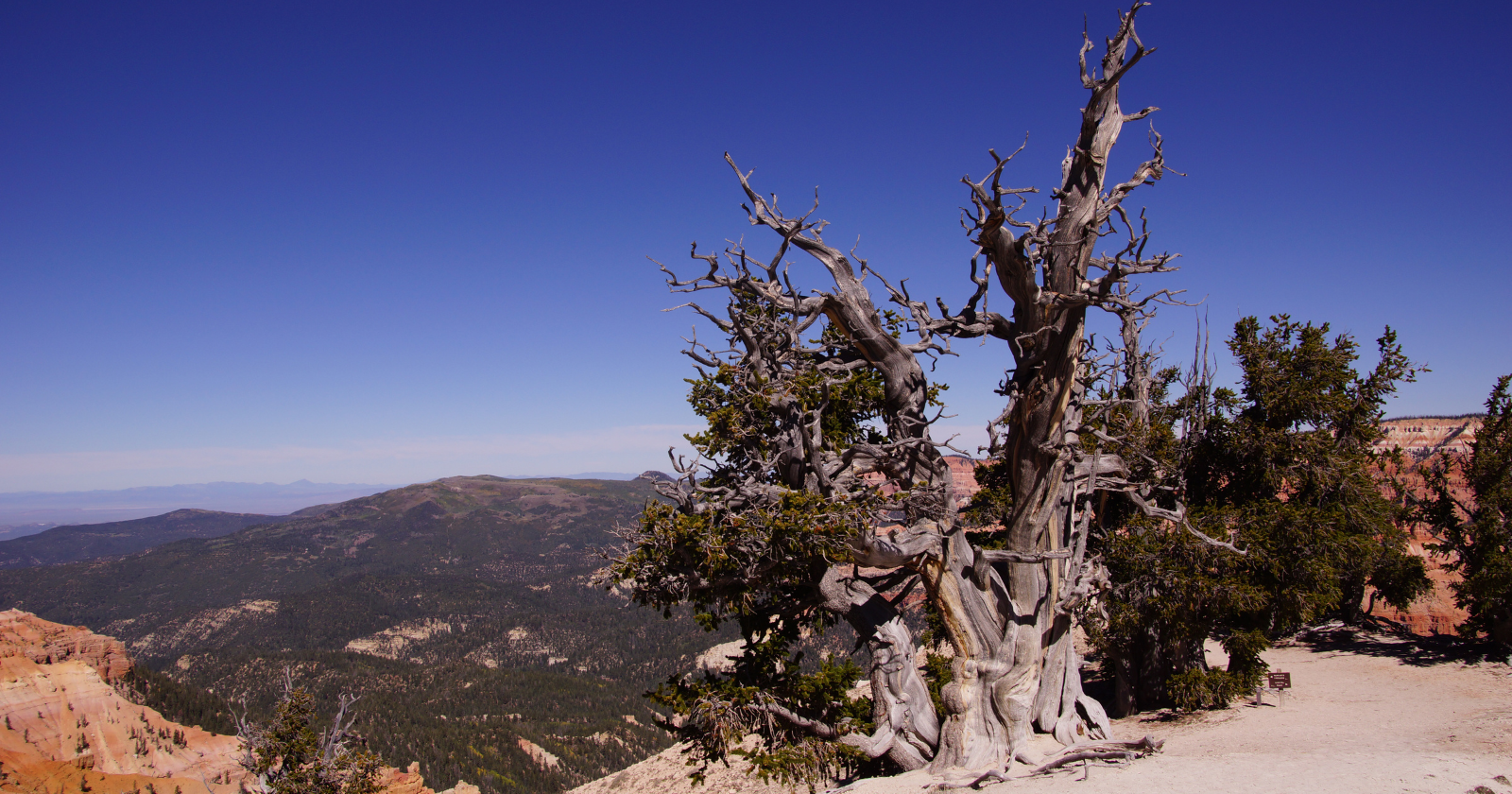
Bristlecones grow where almost nothing else can hold on. They live on harsh, high-elevation sites — around 10,000 feet — where few other plants can establish. The oldest individuals take on a stunted, bonsai-like form, often broader than tall, with multiple twisted stems, a shape produced by millennia spent conserving energy in extreme cold, drought, and wind.
In the bristlecone’s world, comfort can come with trade-offs: faster growth, more competition, more fuel, and more pests. A pine growing in warm, wet, rich soil puts on wood quickly, and quick wood is soft, open, and vulnerable to the fungi and insects that recycle most dead plants within years. The bristlecone takes the opposite path, and it takes it because it has no choice.
What slow growth actually does to wood
On the harshest sites, a bristlecone can often add less than a millimetre of trunk diameter in a year. As noted by EarthDate put the species at roughly one inch of height per century. That pace sounds like a defect, but rings laid down that slowly are packed tight.
The Forest Service makes the link directly: bristlecone wood “is very dense and resinous, and thus resistant to invasion by insects, fungi and other potential pests.” The same traits that make the wood slow to build make it hard to eat and hard to decompose. Compared with many faster-growing trees, bristlecone wood gives insects and fungi less easy purchase.
The needles play their own long game. A bristlecone needle stays on the tree far longer than the two or three years typical of most pines, so the tree spends very little energy replacing them. Everything about its metabolism is tuned to spend slowly.
What 4,850 years of survival looks like
These are not towering trees. Even the larger individuals are modest in size, and the ancient ones are gnarled, half-dead, often little more than a strip of living bark feeding a single surviving limb. Much of the trunk on an old bristlecone is dead wood, and that dead wood is the most telling part of the story. Because the wood is so dense and resinous, exposed bristlecone wood does not rot in the way most timber does; instead, it erodes slowly under wind, rain, and freezing, which sculpts the contorted shapes the trees are known for.
Methuselah’s first season came centuries before construction began on the Great Pyramid. These trees have been growing, as the National Forest Foundation puts it, “since before the pyramids in Egypt were constructed.”
What bristlecone pines have already told science
Working from White Mountains specimens, the dendrochronologist C. W. Ferguson assembled a continuous bristlecone tree-ring chronology, and over a thousand dated decade samples were supplied to radiocarbon laboratories to calibrate the carbon time scale across roughly seven millennia.
That calibration mattered because radiocarbon years are not always the same as calendar years. Atmospheric carbon has varied over time, so a sample’s radiocarbon age has to be checked against material of known calendar age. Bristlecone pine rings helped provide that check.
What keeps the oldest of these trees alive now is the same scarcity that always has: thin soil, few neighbours, cold air, and a slow metabolism that asks very little of a difficult place. The open question is whether those conditions hold. A warming climate pushing other species upslope into the bristlecone’s narrow band would hand it the one thing it has never had to contend with, company, and the competition, pests, and fire that arrive with it.
