

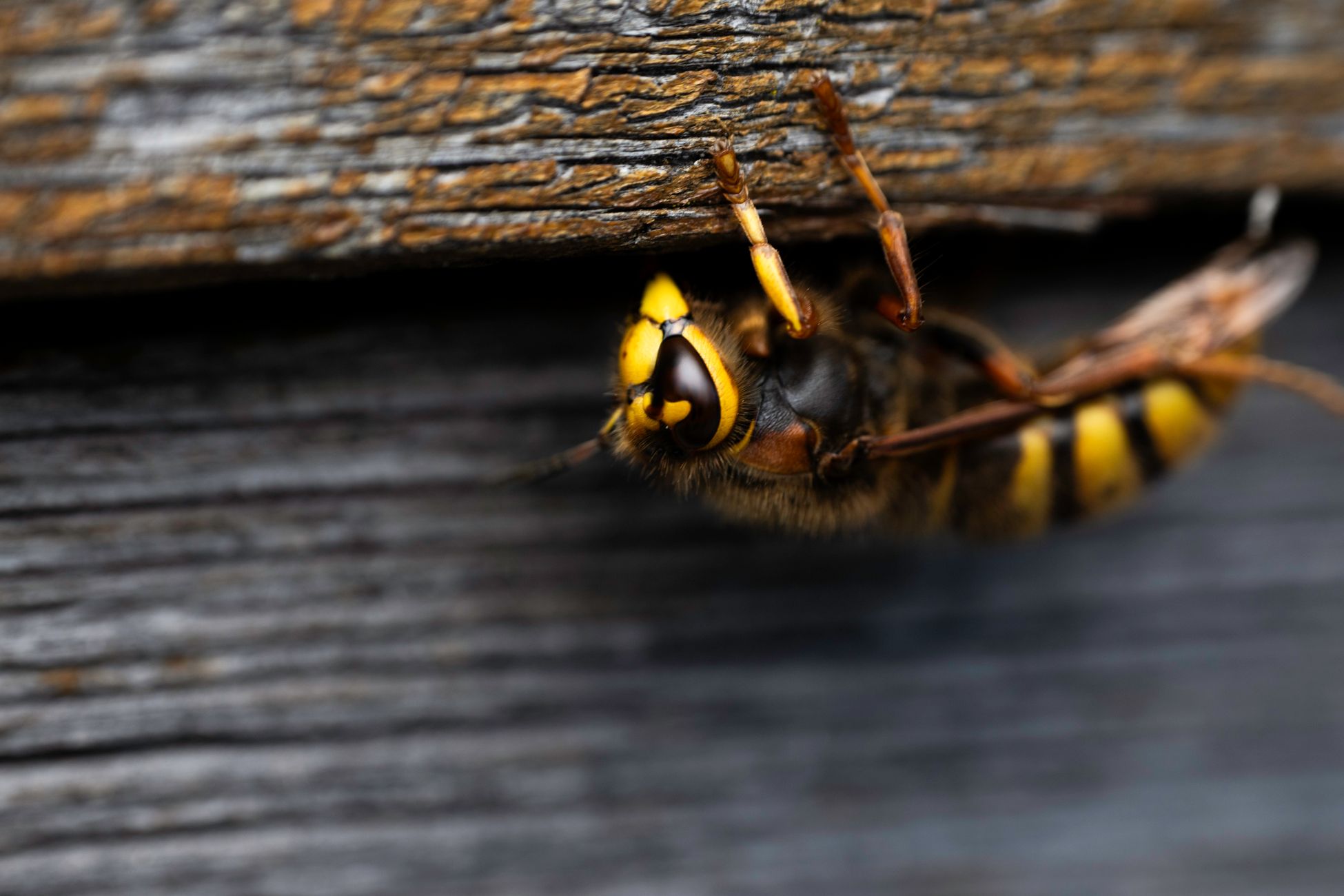
The Asian giant hornet, Vespa mandarinia, arrived in Washington State in December 2019 when a dead specimen turned up in Blaine, near the Canadian border, and within two years Washington State Department of Agriculture crews were vacuuming a nest of nearly 1,500 hornets out of a tree in Whatcom County. The hornet measures up to two inches long, carries a quarter-inch stinger that can punch through a standard beekeeping suit, and kills roughly 50 people in Japan every year through a venom potent enough to dissolve human tissue. A single scouting party of a few dozen hornets can also locate a honeybee hive, mark it with pheromone, and return in force to decapitate 30,000 bees in a matter of hours, hauling the severed thoraxes back to feed their larvae.
The American press christened it the murder hornet. Entomologists winced. The name stuck.
A sting unlike anything else in North America
The venom of Vespa mandarinia contains a cocktail of compounds rare in other stinging insects, including neurotoxins that can paralyze nerve signaling, and high concentrations of cytolytic peptides that rupture cell membranes. The sensation of being stung has been described as feeling like a hot nail driven into the flesh. The pain alone is not what kills. The danger comes from the volume injected and the chemistry of what is injected.
A honeybee sting leaves the stinger embedded. An Asian giant hornet can sting repeatedly, each time pumping a dose several times larger, and the venom carries enzymes that digest tissue around the wound. People who survive describe necrotic black holes left behind in their skin weeks later.
In Japan, where the hornet is native and known as the osuzumebachi, or giant sparrow bee, the annual death toll hovers around 30 to 50 people. Most fatalities come from anaphylactic shock in those stung multiple times, or from kidney failure when the venom load overwhelms the body’s filtration. In October 2025, an American father and son died while ziplining in Laos after being stung more than 100 times each by a swarm of hornets believed to be the same species, a reminder that the insect’s range across Asia overlaps with places Western tourists rarely associate with lethal wildlife.
The slaughter phase
What unnerves beekeepers is not the human risk but the choreography the hornets use against honeybee colonies. The attack proceeds in three stages. First comes the hunting phase, in which individual hornets snatch bees from the air near a hive entrance, chew them into a paste, and carry the protein-rich pellet back to feed their grubs.
Then comes the slaughter phase. A scout marks the hive with a pheromone secreted from a gland on her abdomen, drawing in a few dozen nestmates. The squad lands at the hive entrance and begins methodically biting heads off worker bees with mandibles strong enough to shear chitin. A handful of hornets can dismantle a colony of 30,000 European honeybees in under four hours, leaving the ground in front of the hive carpeted in severed bodies.
The third phase is occupation. The hornets move into the gutted hive, defend it from other scavengers, and spend days carrying brood and honey stores back to their own nest. The thoraxes of decapitated bees, which contain the flight muscles and the most concentrated protein, are chewed into food for hornet larvae. The larvae then secrete a clear liquid that adult hornets drink, a substance that became the basis for an energy drink developed in the 1990s.
Why European honeybees lose
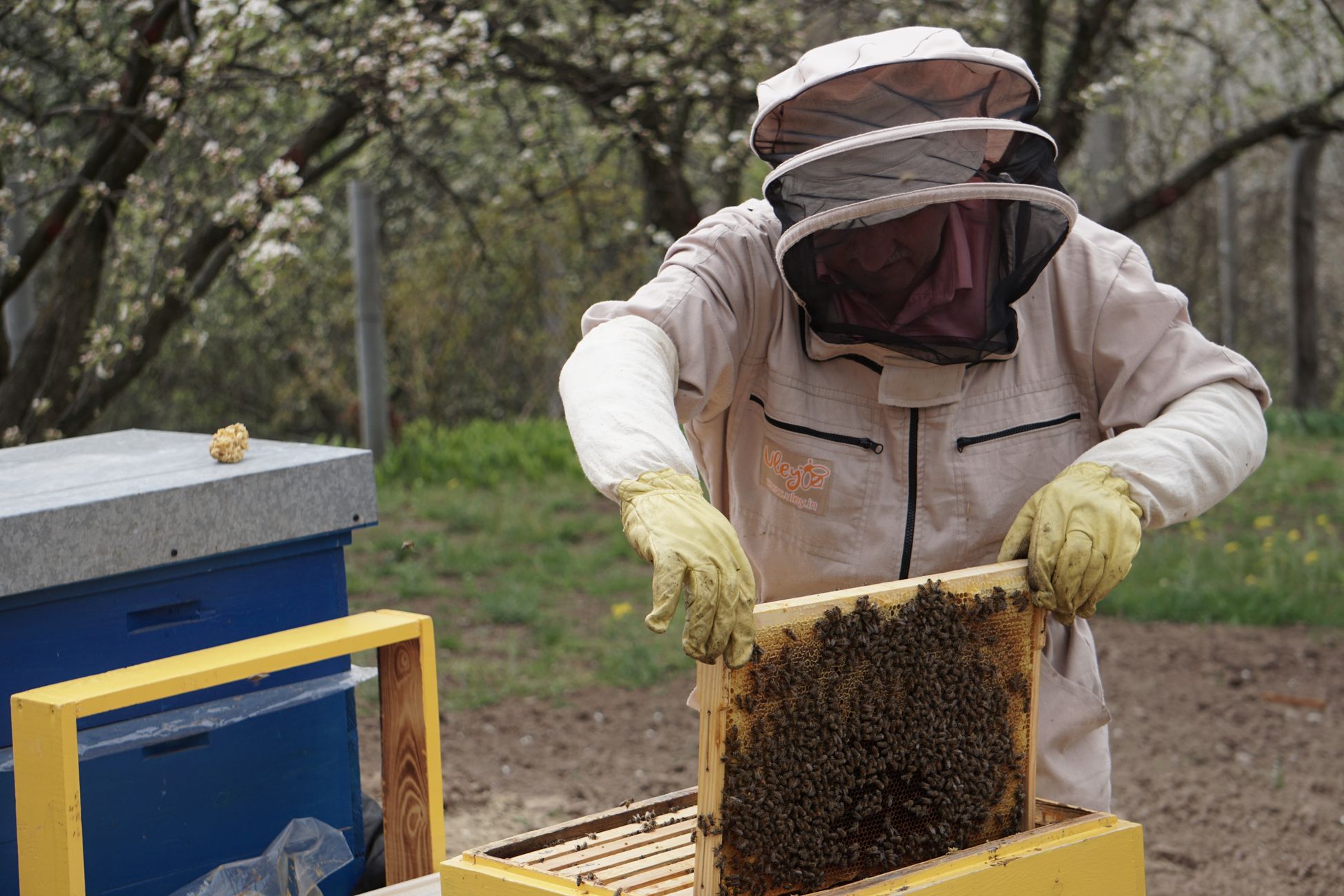
The honeybee Apis mellifera, the species kept by almost every beekeeper in North America and Europe, evolved without any pressure from Vespa mandarinia. When a hornet scout arrives at a European honeybee hive, the bees mount a normal defense, stinging and grappling, which works against most predators and fails utterly against a giant hornet wearing armor a bee sting cannot pierce.
The Japanese honeybee, Apis cerana japonica, evolved a different answer. When a scout enters the hive, hundreds of workers swarm the intruder and form a tight ball around her. The bees vibrate their flight muscles, raising the temperature inside the ball until the hornet dies from overheating while the bees survive.
It is one of the cleanest examples of coevolution in the insect world, and it explains why the arrival of Vespa mandarinia in the Pacific Northwest set off such alarm. The bees Washington beekeepers keep have no such defense in their genetic toolkit. Other species have improvised their own. Vietnamese honeybees smear animal dung around their hive entrances to repel hornet scouts, a behavior that represents one of the few documented examples of tool use by honeybees.
The Blaine specimen and what followed
The first confirmed sighting in the contiguous United States came on December 8, 2019, when a resident of Blaine, Washington, photographed a dead hornet on his porch and reported it to the state agriculture department. The specimen was traced to an Asian population, suggesting it had hitched a ride in international cargo. A separate sighting on Vancouver Island indicated North America had been invaded at least twice, independently.
Through 2020, the Washington State Department of Agriculture rolled out a hornet hunt that combined sap-baited bottle traps, citizen reporting, and infrared cameras. The agency’s first confirmed nest was vacuumed out of a tree by entomologists in white protective suits reinforced with extra layers because standard beekeeping suits had proven insufficient. A second nest, located in August 2021, contained 1,500 hornets at various life stages and was eradicated before any new queens could disperse. The successful early intervention is one of the few invasive-species containment stories that may have actually worked. By late 2024, the hornet was declared eradicated from the United States, although officials cautioned that fresh introductions through Pacific shipping remain plausible.
An unexpected predator
The hornet’s reputation as an apex insect predator took a strange hit in December 2025, when Kobe University ecologist Shinji Sugiura reported that the common Japanese black-spotted pond frog, Pelophylax nigromaculatus, eats Asian giant hornets without apparent harm. Sugiura observed frogs sitting near hornet foraging sites and swallowing the insects whole, stinger and all, then sitting placidly while presumably being stung from inside.
Laboratory trials confirmed the field observations. Frogs offered live hornets ate them, kept them down, and showed no signs of distress. The mechanism is not yet clear, but Sugiura’s team suspects the frogs possess a physiological resistance to the venom rather than simply tough mouthparts. Video of the encounters shows the frog’s throat bulging as a still-stinging hornet works its way down.
What a single nest contains
An Asian giant hornet colony begins in spring with a single overwintered queen, who excavates a chamber underground, usually in an abandoned rodent burrow or a hollow at the base of a tree. She builds the first comb of paper cells herself, lays eggs, and raises the first cohort of workers alone. By midsummer the colony numbers a few hundred. By autumn it can hold hundreds of workers and produce many new queens, each of which will overwinter and start a new colony the following spring.
Each adult worker consumes roughly her own body weight in protein every day, almost all of it sourced from other insects. A late-season colony in full operation strips a wide area of caterpillars, mantises, beetles, and bees. The Whatcom County nest excavated in 2021 was the size of a basketball, lodged inside a tree cavity, and held roughly 1,500 individuals across egg, larval, pupal, and adult stages. State entomologist Sven Spichiger described the operation of removing it as resembling a hostage extraction.
The hornet on quiet ground
Stand in a Japanese cedar forest in late September and the sound a giant hornet makes when she flies past is closer to a hummingbird than to a wasp, a low buzzing thrum at around 100 hertz, audible from several meters away. She cruises at about 25 miles per hour. She can travel more than 50 miles in a day. Her compound eyes detect motion in a 280-degree field. She is a predator with no peer at her size, and a target for a frog that fits in the palm of a hand.
In a Blaine orchard six years after the first specimen turned up on a porch, the traps are mostly empty now. The state still checks them every summer. The queens that founded those first nests are long dead. Somewhere in the holds of a container ship heading east across the Pacific tonight, another one may already be sleeping.
