
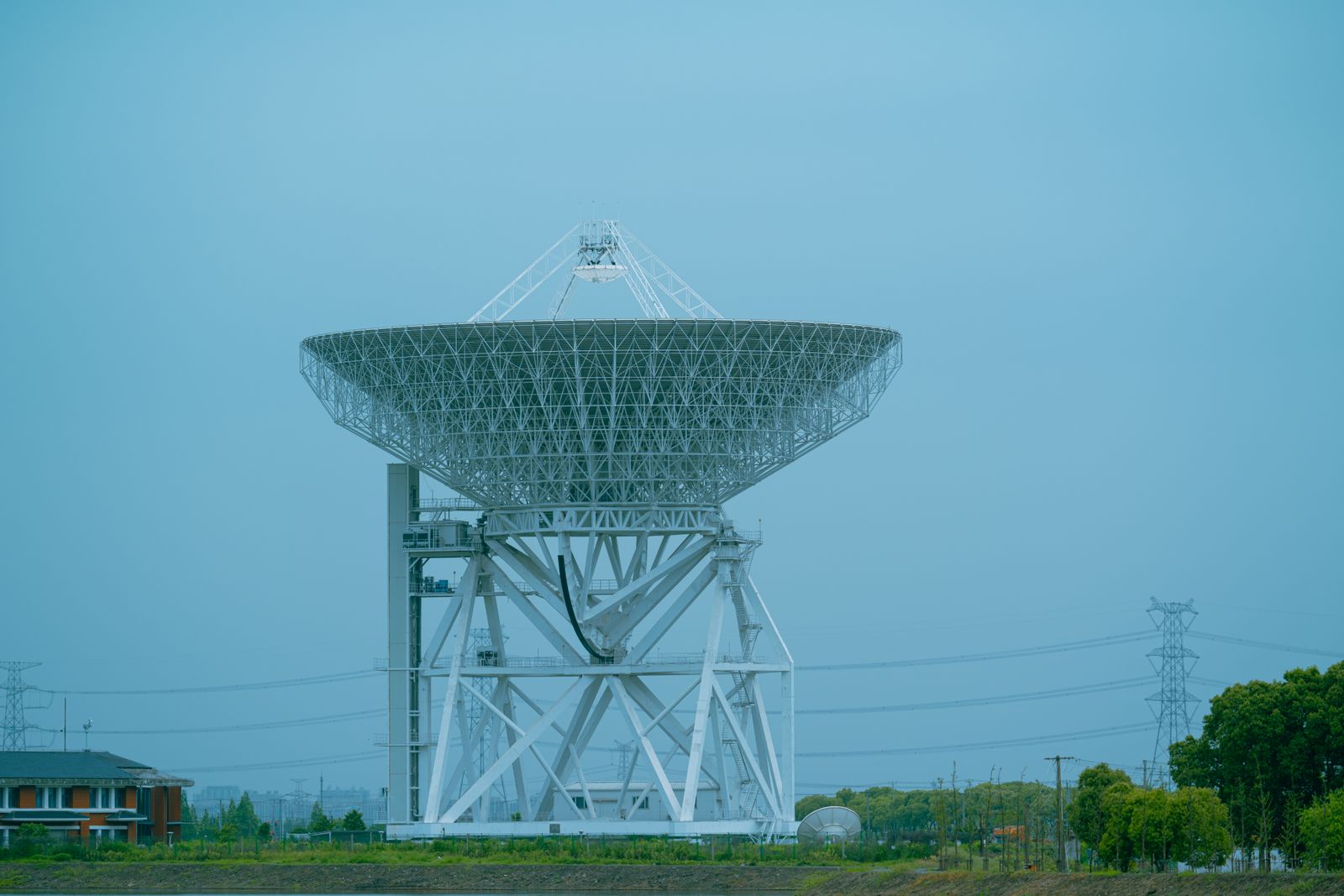
On 23 January 2003, a faint radio whisper reached the Deep Space Network’s 70-metre dish in Madrid from a transmitter NASA engineers had launched when Richard Nixon was still in his first term. The signal had crawled across roughly 12 billion kilometres of vacuum, taking more than eleven hours to arrive. Pioneer 10 was speaking for the last time. Two weeks later, when controllers reached out again, the dish heard nothing but the cold hiss of background noise.
The spacecraft was 30 years and 10 months old. Its plutonium had decayed past the point where it could power even the trickle of watts needed to push a coherent signal home. After that final transmission, Pioneer 10 became what it remains today — a silent, tumbling piece of 1972 aerospace engineering, drifting toward the red giant Aldebaran, on a journey that will take more than two million years.
A 21-month mission that lasted three decades
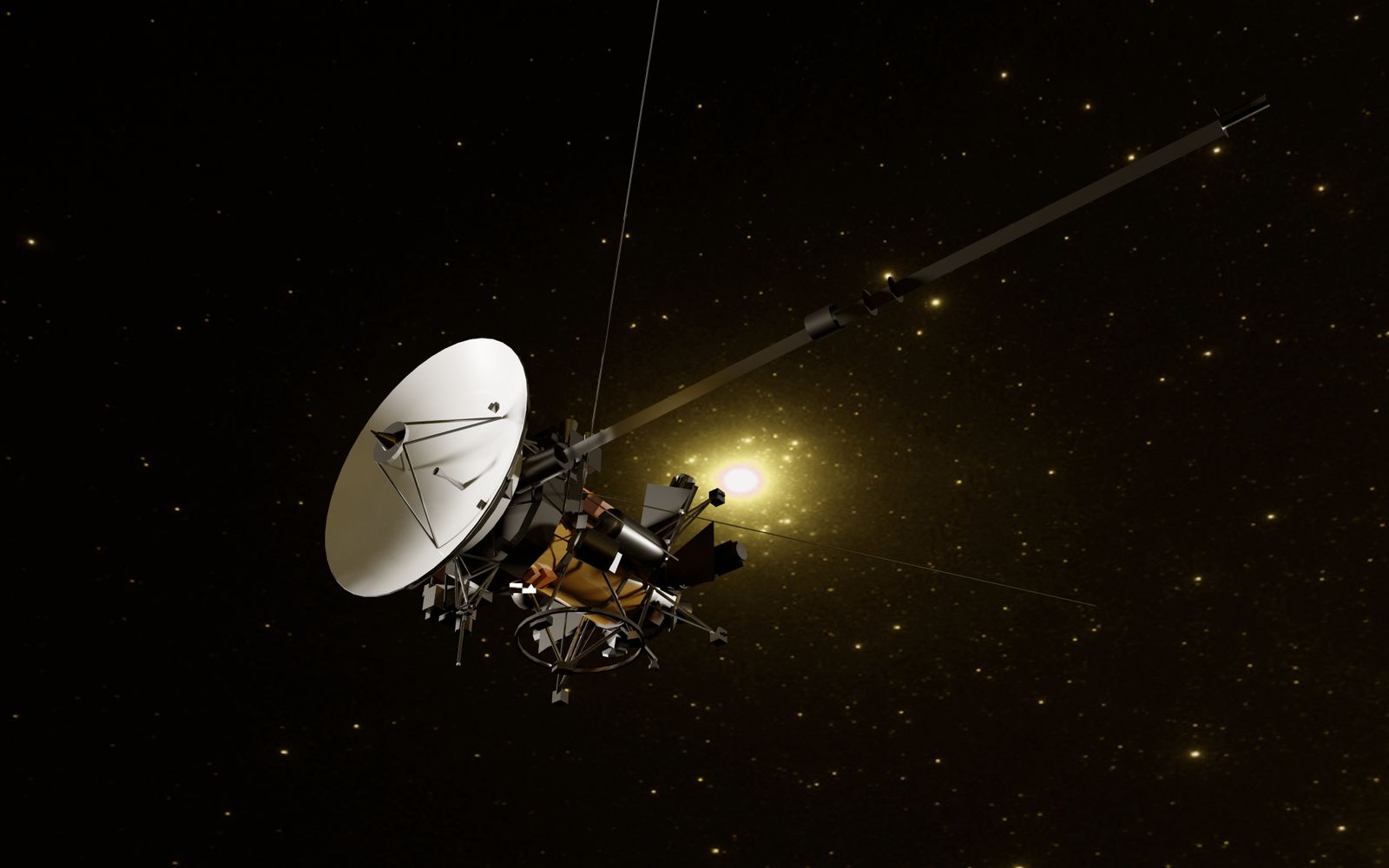
Pioneer 10 launched from Cape Canaveral on 3 March 1972 atop an Atlas-Centaur rocket. The plan was modest by today’s standards: cross the asteroid belt (which many engineers at the time genuinely feared would shred any spacecraft that tried), reach Jupiter, take some pictures, measure the radiation environment, and die.
It did all of that. Then it kept going for another 29 years.
The Jupiter encounter in early December 1973 nearly killed it. Pioneer 10 absorbed about a thousand times the lethal human dose of radiation as it threaded through the Jovian magnetosphere. Its optics darkened. Transistors cooked. False commands began firing inside the craft, and the photopolarimeter succumbed to the radiation before it could capture the planned image of Io. Engineers in California watched the telemetry and waited to see whether anything would still be working on the other side of the planet.
Most of the damage healed. Solar wind and time annealed the silicon. By early 1974, the probe was functional again and on its way out, crossing the orbit of Saturn in 1976, Uranus in 1979, and — on 13 June 1983 — Neptune, becoming the first human-made object to travel beyond the orbits of all the known planets.
The puzzle in the tracking data
Long before the final signal faded, Pioneer 10 and its sister probe Pioneer 11 had been producing one of the strangest puzzles in modern physics. The same Deep Space Network dishes that would eventually strain to hear Pioneer’s last heartbeat were noticing something odd in the routine tracking data: both spacecraft appeared to be decelerating slightly more than Newtonian gravity predicted — by about 8.74 × 10⁻¹⁰ metres per second squared, a vanishingly tiny number that nonetheless refused to disappear.
Some physicists wondered whether this hinted at new physics — a modification of gravity, perhaps, or a clue to dark matter. Others suspected something more mundane. After more than a decade of analysis, a team led by Slava Turyshev at NASA’s Jet Propulsion Laboratory, working with Viktor Toth, concluded in 2012 that the anomaly was caused by anisotropic thermal radiation from the spacecraft itself: heat from the RTGs bouncing unevenly off the back of the high-gain antenna, producing a faint but persistent push in the opposite direction. As we covered when the anomaly was finally resolved, the answer turned out to be the probe’s own waste heat gently pushing it backward at roughly a billionth of Earth’s gravity.
The resolution was almost disappointing — no new physics, just a careful accounting of where the waste heat went. But it was also a reminder that a 1972 spacecraft kept generating worthwhile science questions four decades after launch, by virtue of doing nothing more dramatic than continuing to exist.
The transmitter that wouldn’t quit
Pioneer 10 carried radioisotope thermoelectric generators, or RTGs, packed with plutonium-238. Plutonium-238 has a half-life of 87.7 years, but the thermocouples that convert its heat into electricity degrade much faster than the fuel itself. By the late 1990s, the spacecraft was operating on a power budget thinner than a desk lamp.
By the final transmissions in 2002 and 2003, the available power had fallen to a level too low to run the science instruments at all. The Deep Space Network was listening for a carrier — essentially the radio equivalent of a heartbeat — squeezed out of a transmitter built for a 21-month mission and now in its fourth decade of continuous operation.
The numbers describe an absurd feat of engineering tolerance. The probe was beaming a signal weaker than the bulb inside a household refrigerator across a distance where light itself took nearly half a day to make the trip. The Madrid dish, 70 metres across with its cryogenically cooled low-noise amplifier, had to extract that whisper from a sky full of cosmic background noise, stellar radio sources, and the thermal hum of Earth’s own atmosphere.
By January 2003, Pioneer 10 had long since stopped returning useful science. The last time a Pioneer 10 contact returned telemetry data was 27 April 2002. After that, mission controllers were essentially running engineering tests, confirming the spacecraft was still alive.
The transmission that arrived on 23 January 2003 was, in the language of mission operations, a weak carrier signal — confirmation of life, nothing more. NASA Ames Research Center’s announcement marks the date as the last contact, the moment when a spacecraft that had outlived its design life by a factor of 17 finally fell quiet.
Follow-up attempts in February 2003 returned nothing. A final listening attempt on 3–5 March 2006 also failed. The Deep Space Network stopped trying. The probe was not dead in any mechanical sense — its plumbing of pipes and circuits was probably still intact — but the power had dropped below what was needed to push a detectable signal across the gulf to Earth.
The plaque, and the destination
Bolted to one of Pioneer 10’s antenna support struts is a six-by-nine-inch gold-anodised aluminium plaque designed by Carl Sagan and Frank Drake, with the artwork engraved by Linda Salzman Sagan. It shows a nude man and woman, a diagram of the hydrogen atom, a map of 14 pulsars marking the Sun’s position in the galaxy, and a sketch of the solar system with an arrow pointing outward from the third planet.
The plaque was an afterthought, designed and approved in three weeks before launch. It is also, depending on how you measure it, the longest-lasting human artefact ever made. The spacecraft itself will erode under cosmic ray bombardment over hundreds of millions of years, but the engraved aluminium plaque, shielded from micrometeorites by the structural geometry around it, is expected to remain legible for far longer than the human species has existed.
Pioneer 10 is heading roughly toward Aldebaran, the orange eye of the constellation Taurus, about 68 light-years away. The probe crosses roughly 230 million miles, or 370 million kilometres, every year — more than twice the distance from Earth to the Sun. It will take more than two million years to reach Aldebaran’s neighbourhood. By then, the star itself will have moved on.
As KQED has catalogued in its survey of NASA’s record-holding missions, Pioneer 10 was the trailblazer for everything that came after — the first spacecraft to cross the asteroid belt, the first to reach Jupiter, the first to use a planet’s gravity to reach solar escape velocity. Voyager 1, launched about five and a half years later and travelling faster, overtook it on 17 February 1998, but it followed a trail Pioneer 10 had cut.
The slow fade as an engineering problem
Long-duration spacecraft die in predictable ways. Fuel runs out. Reaction wheels seize. Electronics fail from cumulative radiation damage. Power decays. Of these, the slow plutonium starvation is the most graceful, and the most poignant, because it is the only one that announces itself years in advance. Mission planners can watch the wattage drop and calculate, within months, when the probe will go silent.
The same arithmetic governs the spacecraft still operating today. The Voyagers will eventually lose their last science instruments as their RTGs cross the same threshold Pioneer 10 crossed in 2003. The James Webb Space Telescope faces its own fuel-budget ending, when the thruster propellant that keeps it parked at Lagrange Point 2 finally runs out. The mechanism differs. The ending is the same. A piece of human-built hardware, still functional, becomes uncontactable because the energy to speak has gone.
Pioneer 10’s final years offered NASA a long, unsentimental rehearsal of that ending. Engineers ran experiments on the spacecraft purely to study how deep-space hardware ages — tracking thermal behaviour, transmitter drift, antenna pointing accuracy at extreme range. The probe became, in its last decade, a free orbital laboratory for the discipline of designing the next generation of long-distance missions.
A silent traveller still moving
Right now, as you read this, Pioneer 10 is somewhere past 140 astronomical units from the Sun — more than 20 billion kilometres from Earth. It is still moving outward at roughly 2.5 astronomical units a year. It has been silent for more than 23 years. Its plutonium has continued to decay at its predictable rate, but with nothing to power, that decay produces only heat that radiates uselessly into space.
The gold plaque is still bolted to its antenna strut, still showing the man, the woman, the pulsar map, the arrow pointing back at a small blue planet. The engineers who designed the probe are mostly retired or dead. The Atlas-Centaur rocket family that launched it has been out of service for years. The mission control consoles where Pioneer’s telemetry was once decoded have been scrapped.
The spacecraft itself, though, will outlast all of it. Long after the Sun has expanded into a red giant and swallowed Earth, Pioneer 10 will still be coasting outward in silence — a small, dark shape with a gold plaque catching no light, falling forever toward a star it will never reach. The last thing it ever said to us was a whisper so faint it took eleven hours to arrive and a 70-metre dish to hear, and then it stopped, and the sky where it used to be went quiet.
