
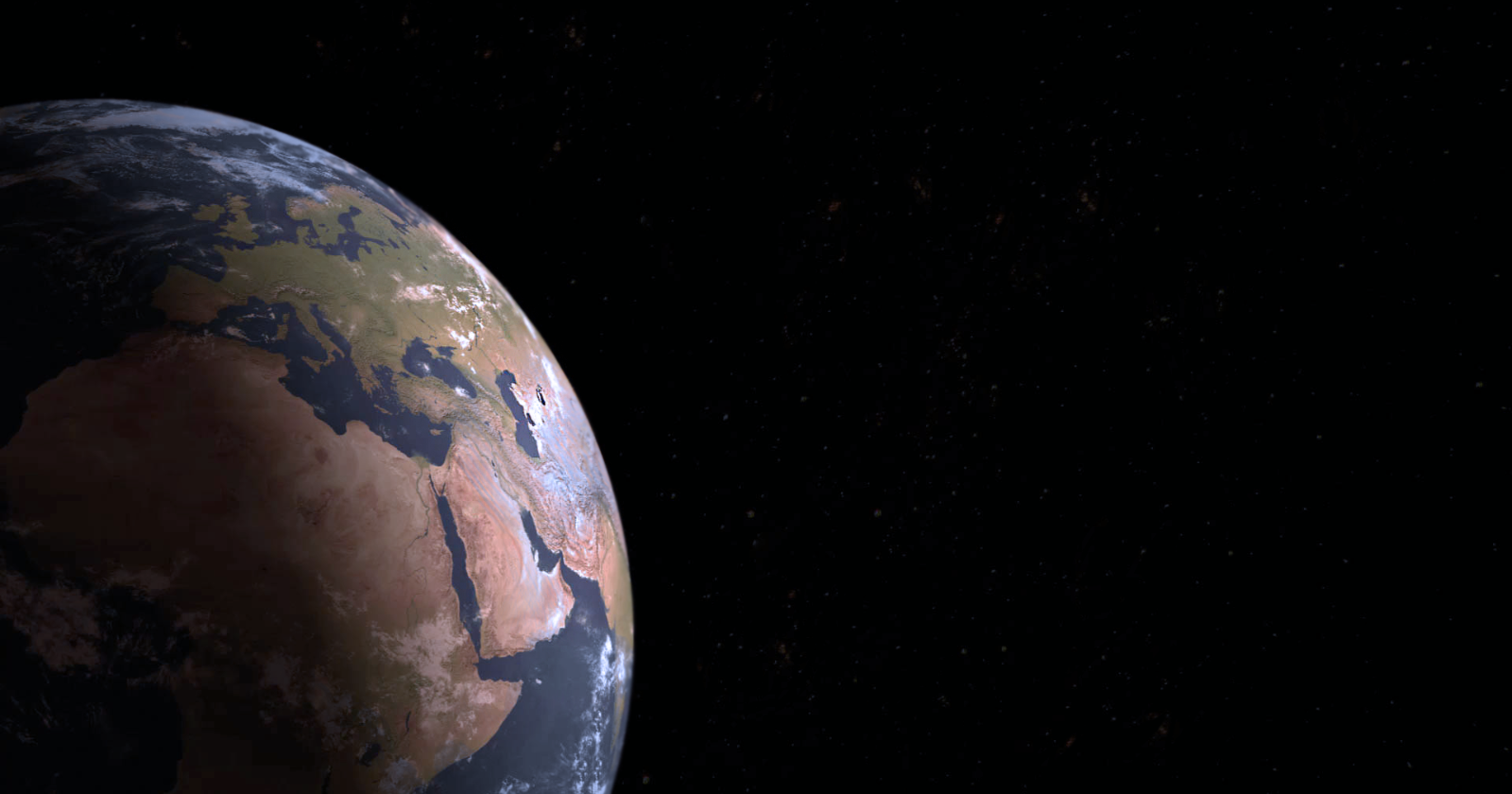
Eratosthenes of Cyrene, born around 276 BCE in what is now Libya and serving from his mid-thirties onward as the third chief librarian of the great Library of Alexandria, performed one of the most consequential calculations in the history of science with a pencil, a stick, and an idea. The idea was that the Earth is spherical, that the Sun is so distant from the Earth that its rays arrive in essentially parallel directions, and that the difference in shadow lengths at two different latitudes at the same moment on the summer solstice could be used, by simple geometry, to deduce the size of the Earth itself. According to the Wikipedia reference on Earth’s circumference, drawing primarily on the surviving ancient source Cleomedes’ On the Circular Motions of the Celestial Bodies, Eratosthenes carried out the calculation in approximately 240 BCE, and arrived at a figure of approximately 250,000 stadia for the Earth’s full circumference.
The stadion was a unit of length used in the ancient Greek world, but it was not a single unit. Different stadia were in use in different regions. The Egyptian stadion was approximately 157.5 metres. The Attic (Athenian) stadion was approximately 185 metres. The Roman stadion was approximately 184.8 metres. Depending on which stadion Eratosthenes was using — a subject of genuine scholarly debate, because none of Eratosthenes’ own writings on the topic have survived intact — his 250,000-stadia figure translates to anywhere from about 39,375 kilometres to about 46,620 kilometres. The modern measured value of the Earth’s circumference is approximately 40,008 kilometres at the poles and 40,075 kilometres at the equator. Eratosthenes’ result was therefore between approximately 1 percent and 16 percent off the modern figure. The lower end of that range is among the closest approximations of a fundamental geophysical quantity ever derived by purely theoretical means from a single set of empirical observations.
How the calculation worked
The geometric reasoning was elegant and required only a small set of observations. According to IFL Science’s review of the calculation, which draws on NASA’s own historical description, Eratosthenes knew of a deep well in Syene, a town in southern Egypt now known as Aswan, where sunlight at noon on the summer solstice was reported to shine all the way to the bottom of the well — meaning that the Sun was directly overhead at that moment. The phenomenon was a well-known local curiosity, recorded in scrolls held in the Library of Alexandria. From this, Eratosthenes inferred that Syene lay on or very close to what we now call the Tropic of Cancer, the latitude at which the Sun is directly overhead at the summer solstice.
At precisely the same moment on the same day — noon on the summer solstice — Eratosthenes measured the shadow cast by a vertical pole in Alexandria, approximately 800 kilometres north of Syene. The shadow was not zero. The pole cast a shadow corresponding to a sun angle of approximately 7.2 degrees from vertical. The reasoning that followed was the part Eratosthenes is remembered for. If the Sun was directly overhead at Syene at the same moment when it was 7.2 degrees off vertical at Alexandria, and if the Earth was spherical with the Sun far enough away to produce parallel rays, then the angular distance from Syene to Alexandria along the surface of the Earth must also be 7.2 degrees. Since 7.2 degrees is one-fiftieth of a full 360-degree circle, the distance from Syene to Alexandria must be one-fiftieth of the Earth’s full circumference. Multiply the Syene-to-Alexandria distance by 50, and you have the circumference of the Earth.
How he measured the distance
Eratosthenes needed only one more piece of information to complete the calculation: the linear distance from Alexandria to Syene. He took this from two sources. According to Encyclopedia.com’s reference on the calculation, one ancient tradition has Eratosthenes hiring professional pacers (called bematists, after the Greek word for “step”) who walked the route between the two cities counting their paces. Another tradition has him estimating the distance from the typical travel time of camel caravans on the route, multiplied by the average daily pace of a camel. The two methods produced converging estimates in the range of 5,000 Greek stadia.
Multiplying 5,000 stadia by 50 gave Eratosthenes a circumference of 250,000 stadia, which he later refined to 252,000 stadia, possibly to make the resulting figure more easily divisible by 60 (a number widely used in ancient calculations because it has many divisors). Regardless of which final figure he used, the result was the first quantitative estimate of the size of the Earth in human history that was within an order of magnitude of the correct answer. Previous estimates, where any had been made at all, had been guesses or vague philosophical statements; Eratosthenes’ figure was a calculation with explicit assumptions and explicit observational inputs, and could be checked against subsequent observations by other astronomers.
The sources of error
Eratosthenes’ figure was not exactly correct, and the sources of error in his calculation have been carefully analysed by subsequent generations. According to ScienceABC’s analysis of the calculation, the most consequential source of error was simply the linear distance from Alexandria to Syene, which Eratosthenes’ pacers had estimated rather than precisely measured. A second source of error was that Alexandria and Syene are not actually on exactly the same meridian — they differ by about 3 degrees of longitude — although this introduces less error than one might expect, because the relevant geometry depends on latitude difference rather than longitude. A third source of error was that Syene is not quite on the Tropic of Cancer. In 240 BCE, the Tropic was approximately 22 arc minutes south of Syene, which means the Sun was not perfectly overhead at Syene on the solstice; a gnomon there would have cast a very small shadow that Eratosthenes either failed to notice or treated as negligible.
Despite these accumulated small errors, the result was extraordinary. Eratosthenes had derived the size of the Earth using only flat geometry, observation of sunlight in two cities, and travel-time-based distance estimation. He had assumed the spherical shape of the Earth — a hypothesis that was already common in educated Greek circles of his era but not universally accepted — and had used the calculation as confirming evidence for that hypothesis. He had used the assumption that the Sun’s rays are parallel, which is approximately true given the actual Sun-Earth distance, and the assumption produced consistent results when applied to the geometry. The internal coherence of the calculation was, in its own time, a strong argument for the correctness of the underlying model.
What this enabled
The Eratosthenes calculation became one of the foundational measurements of ancient astronomy. The size of the Earth, once known, allowed estimates of the size of the Moon (through analysis of lunar eclipse shadows), the distance to the Moon (through parallax measurements), the distance to the Sun (through more complex methods that proved less reliable in antiquity), and the overall scale of the visible universe. Subsequent ancient astronomers including Hipparchus, Ptolemy, and the medieval Islamic scholar Al-Biruni refined the Eratosthenes calculation using improved measurements, with Al-Biruni in around 1000 CE producing a value within about 200 kilometres of the modern figure using a single mountain-height observation in what is now Pakistan.
The calculation also became, in the centuries that followed, an emblem of what could be achieved through observation, geometry, and clear reasoning, without any instrumentation that would not have been available to a literate scholar in 240 BCE. Eratosthenes had no telescope (the first telescope was built around 1608), no marine chronometer (Harrison’s first reliable chronometer was completed in 1759), and no precise mechanical clocks of any kind. He had a stick, the geometry he had learned at Athens, the resources of the Library of Alexandria, and a willingness to combine an observation made in one city with an observation made in another city 800 kilometres south. The astronomer Carl Sagan, in the opening segment of his 1980 television series Cosmos, presented the Eratosthenes calculation as the original example of what science could do: produce reliable knowledge of the world by combining careful observation with clear reasoning, with results that could be checked, refined, and built upon by later generations. The reasoning Eratosthenes used remains, more than 2,200 years later, the standard introductory example of geometric astronomy in physics courses around the world.
