
Mount Everest keeps the title most people mean when they talk about the highest mountain on Earth. Its summit is the highest point above mean sea level, at 8,848.86 metres, according to the height jointly announced by China and Nepal on 8 December 2020.
That is not the only way to measure a mountain.
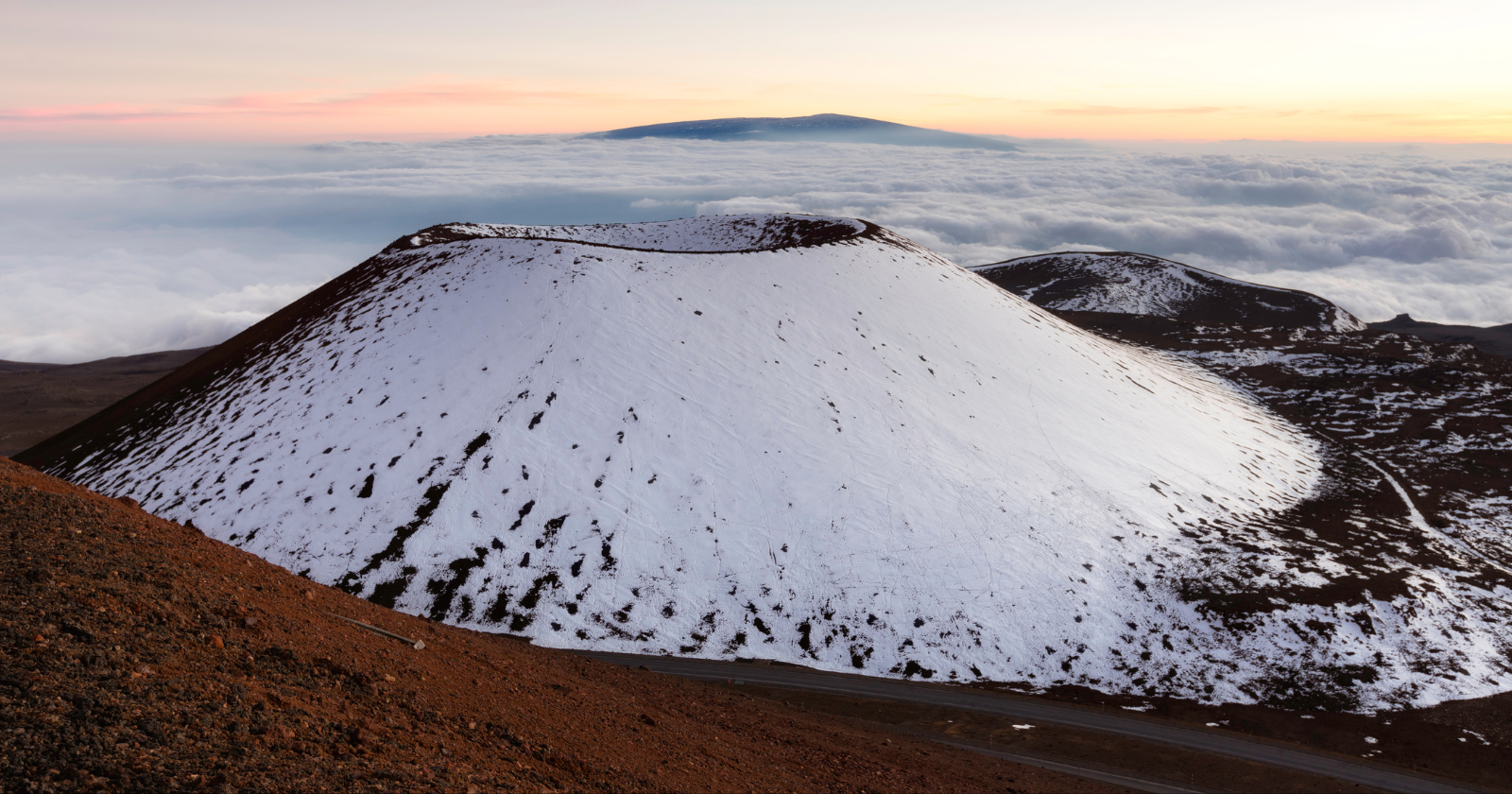
On Hawaii’s Big Island, Mauna Kea rises 4,205 metres above the Pacific. From the surface, it is far lower than Everest. But the volcano does not begin at the shoreline. According to the U.S. Geological Survey, Mauna Kea extends about 6,000 metres below sea level to the deep ocean floor, giving it a total base-to-summit height of nearly 10,211 metres. That makes it more than 1.3 kilometres taller than Everest by that measure.
The argument is really about the starting line
Everest is measured against mean sea level because that is how elevation normally works on land. On maps, in climbing records, and in ordinary geography, the question is how high a point stands above the average level of the ocean.
By that rule, Everest wins clearly.
Mauna Kea’s claim uses a different reference point: the place where the mountain begins on the sea floor. The National Oceanic and Atmospheric Administration puts the distinction neatly. Everest has the highest altitude above mean sea level; Mauna Kea is the tallest mountain from base to peak, rising more than 10,210 metres from its underwater base.
That is not a trick so much as a reminder that “highest” and “tallest” are not identical words. Highest asks where the summit sits relative to sea level. Tallest asks how much mountain there is from bottom to top.
Why so much of Mauna Kea is hidden
Mauna Kea is a shield volcano, built by repeated lava flows over a long span of geologic time. Hawaiian volcanoes grow from the ocean floor as the Pacific Plate moves over a hot spot. The part visible above water is only the upper section of a far larger volcanic structure.
This is why the comparison feels odd at first. Everest is part of a continental mountain range lifted by the collision of tectonic plates. Mauna Kea is an oceanic volcano rising from the floor of the Pacific. One looks taller because its base is already high on the Asian continent; the other looks shorter because most of its body is submerged.
The USGS figure gives the standard comparison: Mauna Kea rises 13,796 feet above sea level and continues about 19,700 feet below it, for a total of nearly 33,500 feet. Everest’s summit is higher in altitude, but the mountain does not have the same hidden underwater column beneath it.
The Mauna Loa complication
There is one useful caveat. The USGS also describes Mauna Loa, not Mauna Kea, as the tallest mountain in the world when its full volcanic structure is measured from the depressed sea floor beneath it. In that framing, Mauna Loa’s summit sits about 17 kilometres above its base, because the volcano’s mass pushes the oceanic crust downward.
That is a broader definition of “base” than the one usually used in the Mauna Kea comparison. It does not erase the familiar claim, but it does show why the wording matters. If the base is taken as the deep ocean floor where Mauna Kea begins to rise, Mauna Kea is widely cited as the tallest mountain from base to summit. If the base includes the deeper depression of the crust beneath the Hawaiian volcanic mass, Mauna Loa has its own claim.
The cleaner published version is therefore not that Everest is somehow “less” than Mauna Kea. It is that Everest and Mauna Kea win under different measuring rules.
Chimborazo adds a third answer
There is also a third way to ask the question. NOAA points out that Mount Chimborazo in Ecuador is farther from Earth’s centre than Everest, because Earth bulges at the equator. Chimborazo is much lower than Everest above sea level, at 6,268 metres, but its position near the equator places its summit more than 2,072 metres farther from Earth’s centre than Everest’s summit.
So the answer changes with the measurement.
Highest above sea level: Everest.
Tallest from ocean-floor base to summit in the standard popular-geography comparison: Mauna Kea.
Tallest when the full volcanic structure and depressed sea floor are included: Mauna Loa.
Farthest from Earth’s centre: Chimborazo.
What the comparison is good for
The Mauna Kea fact works because it does not really diminish Everest. It sharpens the question. Everest is still the mountain with the highest summit on land, the one whose altitude produces the conditions climbers mean when they talk about the top of the world. Mauna Kea is a different kind of giant, mostly unseen, with its visible summit only the final section of a volcanic structure rising from the Pacific floor.
Both claims can be true because they are answering different questions.
