
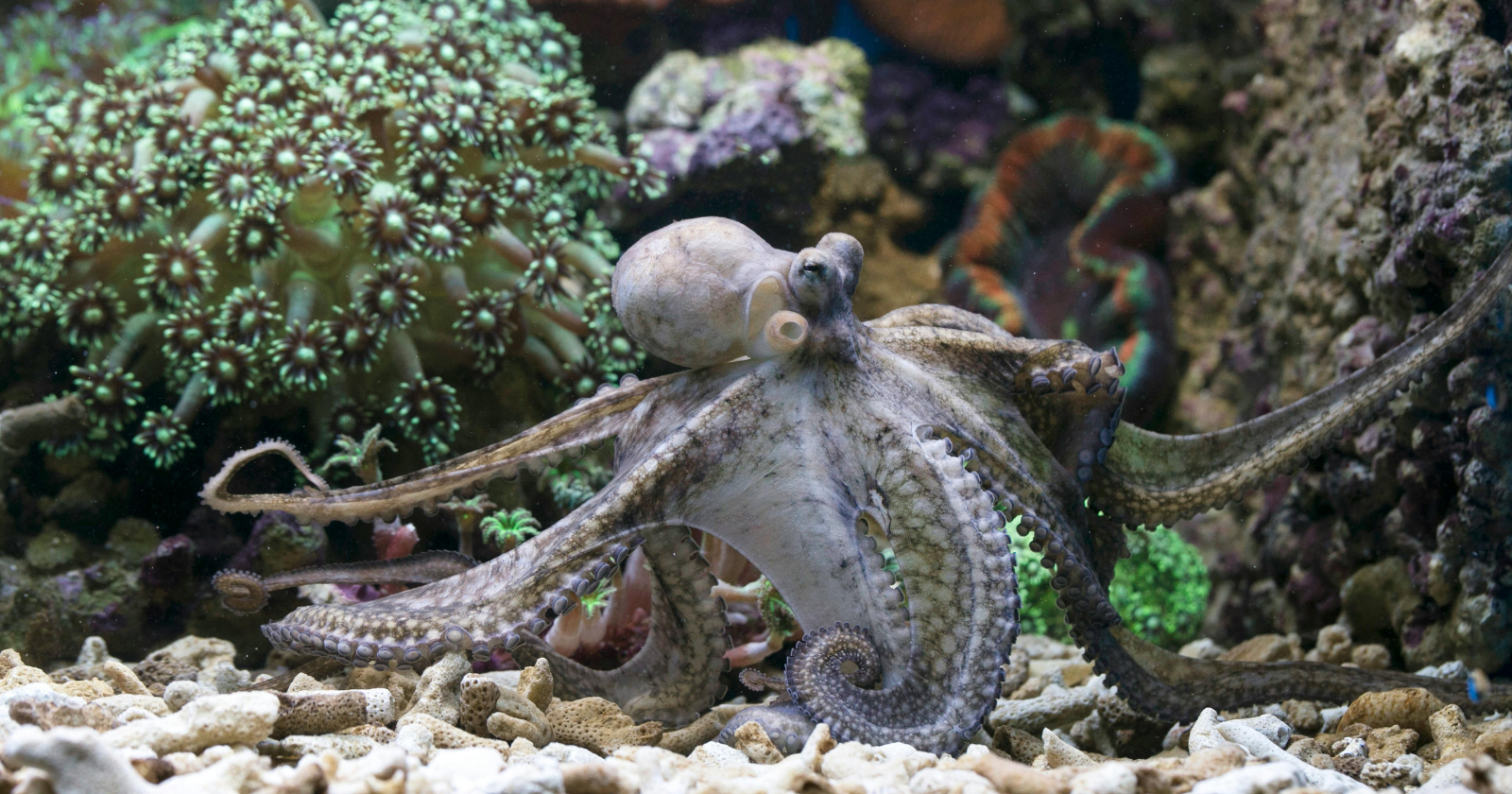
An octopus has three hearts. Its blood is blue, and carries oxygen using copper rather than the iron our own blood uses. And the heart that supplies its body stops beating whenever it swims, which is part of why many bottom-dwelling octopuses spend their time crawling across the seafloor rather than swimming for long stretches.
These are usually presented as three separate pieces of trivia. They are better understood as linked features of a single problem: how an active, oxygen-hungry animal with copper-based blood keeps its tissues supplied in cold water.
The three hearts
Two of the hearts are branchial hearts, sitting at the base of each gill. Their job is to push blood through the gills, where it picks up oxygen from the water. The third, the systemic heart, sits in the centre of the body and pumps that oxygenated blood out to the organs and arms.
This is not an octopus peculiarity. It is the standard cephalopod arrangement, shared by squid and cuttlefish. The reason the lineage took the three-heart route rather than the single-pump route familiar from vertebrates comes down to what their blood is made of.
The blue blood
Where our blood uses haemoglobin, an iron-based protein that turns red when it binds oxygen, octopus blood uses haemocyanin, a copper-based protein that turns blue. In molluscs it is dissolved directly in the blood rather than packed into cells.
The common claim is that copper-based blood is simply more efficient, and that is too tidy. Haemocyanin is not universally better than haemoglobin. Its performance depends heavily on temperature, oxygen levels and the acidity of the blood, and it tends to suit the cold, low-oxygen water where most octopuses live rather than warm, oxygen-rich conditions. Even there the physiology is not simple, since in very cold water haemocyanin can bind oxygen so tightly that releasing it to the tissues becomes a problem of its own.
The hearts are part of how the octopus manages this. The two branchial hearts give the gills dedicated pumping power, driving blood through them to load oxygen before the systemic heart sends it out to the body, which helps keep an active animal supplied. The copper blood is also why octopuses are unusually sensitive to acidity. Haemocyanin’s grip on oxygen weakens as the water turns more acidic, so a drop in pH can leave the animal unable to move enough oxygen around.
The heart that stops
The strangest part is the systemic heart. When an octopus swims by jet propulsion, drawing water into its mantle and forcing it out through the siphon to shoot backwards, the heart that supplies the body stops. A 1987 study in the Journal of Experimental Biology by M. J. Wells and colleagues, working with Octopus vulgaris, found that jet propulsion is accompanied by cardiac arrest. The pressure that builds inside the mantle during a jet is high enough to stop blood returning to the heart, which then has nothing to pump.
This is not a medical emergency, and it resolves the moment the jetting stops. But it makes fast swimming costly. The same study found that because the oxygen debt an octopus can carry is small, on the order of 22 millilitres of oxygen per kilogram, jet propulsion is not viable for more than a few metres at a time.
So the behaviour follows from the plumbing. An animal whose main pump cuts out every time it sprints has good reason to avoid sprinting, and benthic octopuses tend to crawl, glide and feel their way along the bottom instead, saving the jet for escaping a predator. Not every octopus lives this way, since some open-water species swim more freely, but for the seafloor dwellers the preference for crawling is the sensible response to how their circulation is built.
Linked parts of one problem
Put together, the picture is coherent rather than merely odd. The copper-based blood suits a cold, low-oxygen life, the gill hearts give the system the pumping power that blood needs, and the systemic heart’s pause during jetting makes sprinting expensive, so the animal crawls.
The three hearts, the blue blood and the preference for crawling are not isolated quirks. They are linked parts of the same oxygen problem: how to keep a high-energy animal supplied when its blood, its gills and its way of moving all work so differently from ours.
