
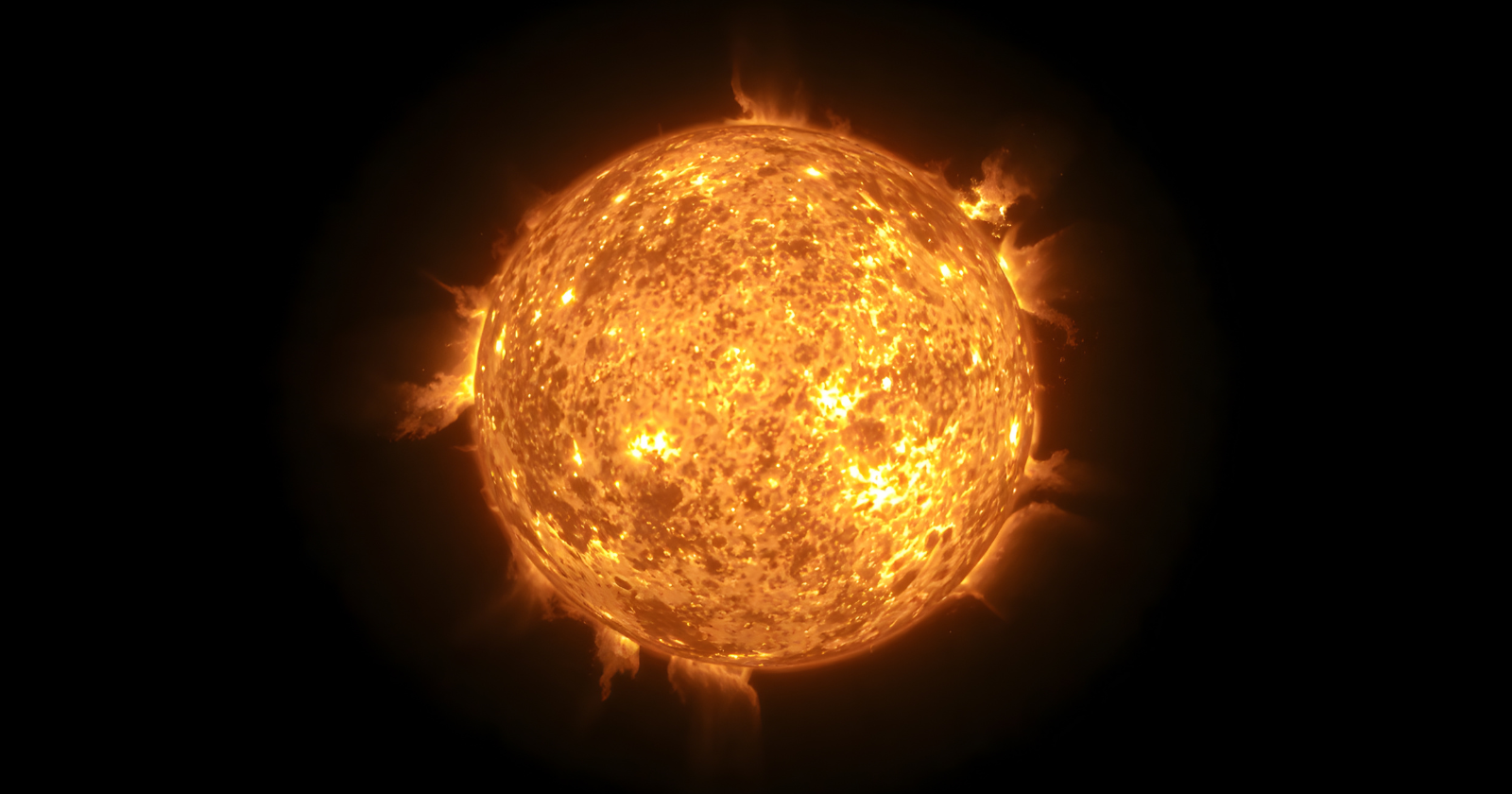
The Sun accounts for about 99.86 per cent of all the mass in the solar system. Put the other way around, every planet, moon, asteroid and comet combined comes to roughly 0.14 per cent of the total, which is the basis for the familiar line that everything other than the Sun is little more than a rounding error. The Sun is about 333,000 times the mass of Earth, and you could drop more than a million Earths inside it.
The figure is correct. What it quietly hides is more interesting than the figure itself.
The rounding error has its own rounding error
That leftover 0.14 per cent is not spread evenly. Almost all of it is Jupiter. Jupiter is about 318 times the mass of Earth, and it would take roughly 1,047 Jupiters to equal the Sun, which means Jupiter alone makes up something like two-thirds of everything in the solar system that is not the Sun.
Add Saturn and you have accounted for the overwhelming majority of the planetary mass. The four rocky inner planets, Earth among them, are what is left after that, and they are tiny. Earth comes to about 0.0003 per cent of the solar system. If the planets are a rounding error against the Sun, the terrestrial planets are a rounding error against Jupiter.
Why the leftover is not negligible
Small in mass is not the same as unimportant, and the clearest demonstration is that the Sun does not actually sit still at the centre. The Sun and the planets orbit their common centre of mass, the barycentre, and because Jupiter is so much heavier than everything else outside the Sun, that point does not sit at the Sun’s centre. It can lie just outside the Sun’s surface, which means the Sun itself traces a small loop around it.
That wobble is not a curiosity. It is one of the main ways astronomers find planets around other stars, by detecting the tiny back-and-forth motion a planet imposes on its star. The 0.14 per cent is what makes the 99.86 per cent move.
The thing the mass figure hides
The real surprise is angular momentum, the measure of how much orbital and rotational motion a system carries. By mass the Sun dominates completely. By angular momentum it barely registers.
The Sun holds only on the order of one to two per cent of the solar system’s total angular momentum, and some analyses put it below one per cent. The planets, with under one per cent of the mass between them, carry more than 99 per cent, most of it in the orbits of Jupiter and Saturn. A peer-reviewed treatment in Astronomy & Astrophysics puts the Sun’s share at under 0.6 per cent, and the popular framing of the same fact, that the Sun has almost all the mass and the planets nearly all the motion, is laid out in overviews such as this one on the angular momentum paradox.
This is one of the classic puzzles in solar-system formation. A collapsing cloud of gas should pile both the mass and the angular momentum into the centre. The mass ended up there. The angular momentum did not. The broad explanation is not mysterious, since young stars are known to shed angular momentum through magnetic coupling to the disk of material around them and through their outflowing wind. Exactly how the budget came to be quite this lopsided is still a research topic.
What the figure is good for
So the 99.86 per cent is accurate and, taken alone, a little misleading. It is true that the Sun holds almost all the matter, and that on a mass scale the planets vanish. It is also true that nearly all the system’s rotational motion, and the gravitational tug that moves the Sun around the barycentre, live in that thin remainder.
The rounding error, in other words, is where most of the interesting questions are. The mass went to the Sun. Most of the angular momentum stayed with the planets.
