
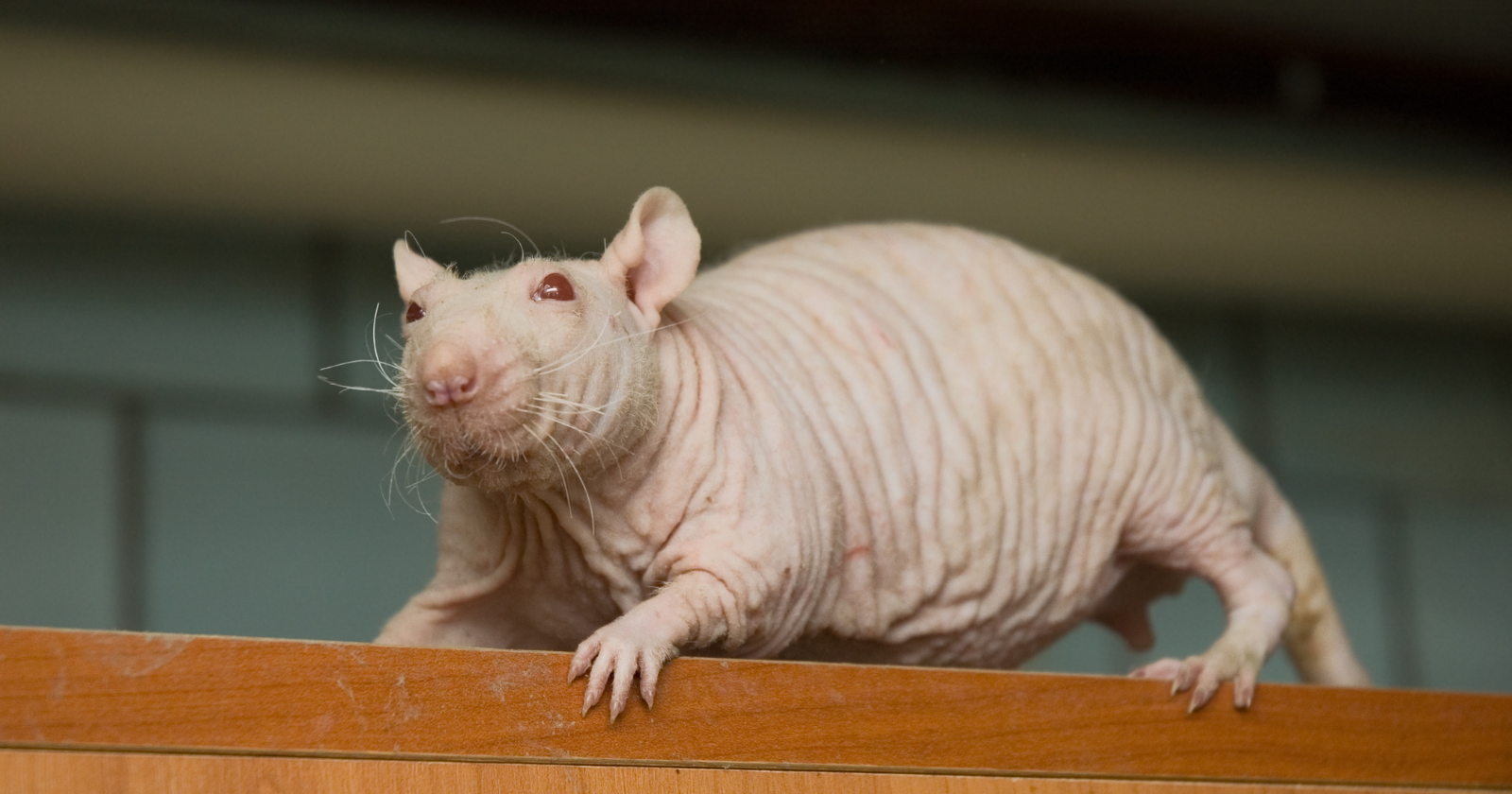
The naked mole-rat is a small, hairless, more or less blind rodent that lives in colonies under the deserts of East Africa. It is about the size of a mouse, and a mouse lives around four years. The naked mole-rat lives more than thirty, with the oldest on record approaching forty. For its size, it lives roughly ten times longer than expected, it rarely develops cancer, and it can survive long stretches with little oxygen, and shorter periods with none at all. That combination is why it has become one of the most closely studied animals in the biology of ageing.
None of these traits is magic, and each is better understood as a specific mechanism than as a general gift. The interest lies in those mechanisms, and in how far they might carry beyond the animal itself.
How long, and how oddly, it ages
The unusual part is not only the length of life but its shape. In most animals, including humans, the risk of dying rises steadily with age. In the naked mole-rat, studies of large captive colonies have found that the risk of death does not climb with age in the same way, a pattern biologists call negligible senescence. The animals stay physically capable and the breeding females stay fertile until close to the end.
That is a striking demographic fact, not a claim of immortality. They do die, and how they avoid the usual decline is still being worked out, with proposals ranging from unusually stable protein maintenance to well-regulated gene splicing. They also carry high levels of oxidative damage while living a long time, which sits awkwardly with the once-popular theory that oxidative stress drives ageing. The research literature treats them less as a solved case than as a useful puzzle.
Why it rarely gets cancer
Cancer is the trait with one of the clearest mechanisms. Multi-year observations of colonies turned up essentially no cancer, though a handful of cases have since been recorded in captivity, so the accurate description is exceptionally rare rather than impossible.
In 2013, Vera Gorbunova, Andrei Seluanov and colleagues at the University of Rochester reported in Nature that naked mole-rat tissues are loaded with an unusually large form of hyaluronan, a molecule found in the spaces between cells, more than five times the size of the human or mouse version. It builds up because the animal’s hyaluronan synthase gene produces longer chains and the enzyme that breaks the molecule down is less active. The effect is that cells stop dividing as soon as they become crowded, an early brake on the runaway growth that becomes a tumour. When the researchers stripped that large hyaluronan out of the cells, the cancer resistance disappeared, which is the kind of direct, reversible result that makes a mechanism credible. It is probably not the only defence the animal has, but it is the best characterised.
How it survives without oxygen
The third trait is the strangest. Naked mole-rats live packed into poorly ventilated burrows where oxygen runs low and carbon dioxide runs high, and they have adapted to it. In a 2017 paper in Science, Thomas Park and colleagues showed that the animals can tolerate an atmosphere of just 5 per cent oxygen for hours, and survive about eighteen minutes with no oxygen at all before recovering.
They manage it by changing fuel. Deprived of oxygen, the naked mole-rat can route fructose into energy production in its vital organs, helping keep cells alive when the usual oxygen-dependent pathway fails.
What it can, and cannot, tell us about human ageing
The reason any of this matters beyond zoology is the hope that the mechanisms transfer. The strongest test so far came in 2023, when the Rochester group reported in Nature that they had inserted the naked mole-rat’s hyaluronan gene into mice. The modified mice produced more of the large hyaluronan, developed fewer tumours, showed less age-related inflammation and lived longer.
The size of the effect is worth stating plainly, because it is where coverage tends to inflate. The lifespan gain was about 4.4 per cent at the median, a real but modest extension, alongside a clearer reduction in cancer in older animals. The team has said its aim is now to find ways to raise or preserve this hyaluronan in humans, and is testing molecules that slow its breakdown in pre-clinical work.
That is a genuine step, and it is still an early one. A mechanism that works in a mole-rat, and then helps a mouse a little, has a long way to go before it helps a person, and the naked mole-rat is one of several long-lived animals, alongside certain whales and bats, that researchers mine for the same reason. What the animal offers is not a route to a longer human life so much as a set of concrete, testable mechanisms for why ageing and cancer might be slowed. The honest position is that it is among the better clues available, and that a clue is what it remains.
