
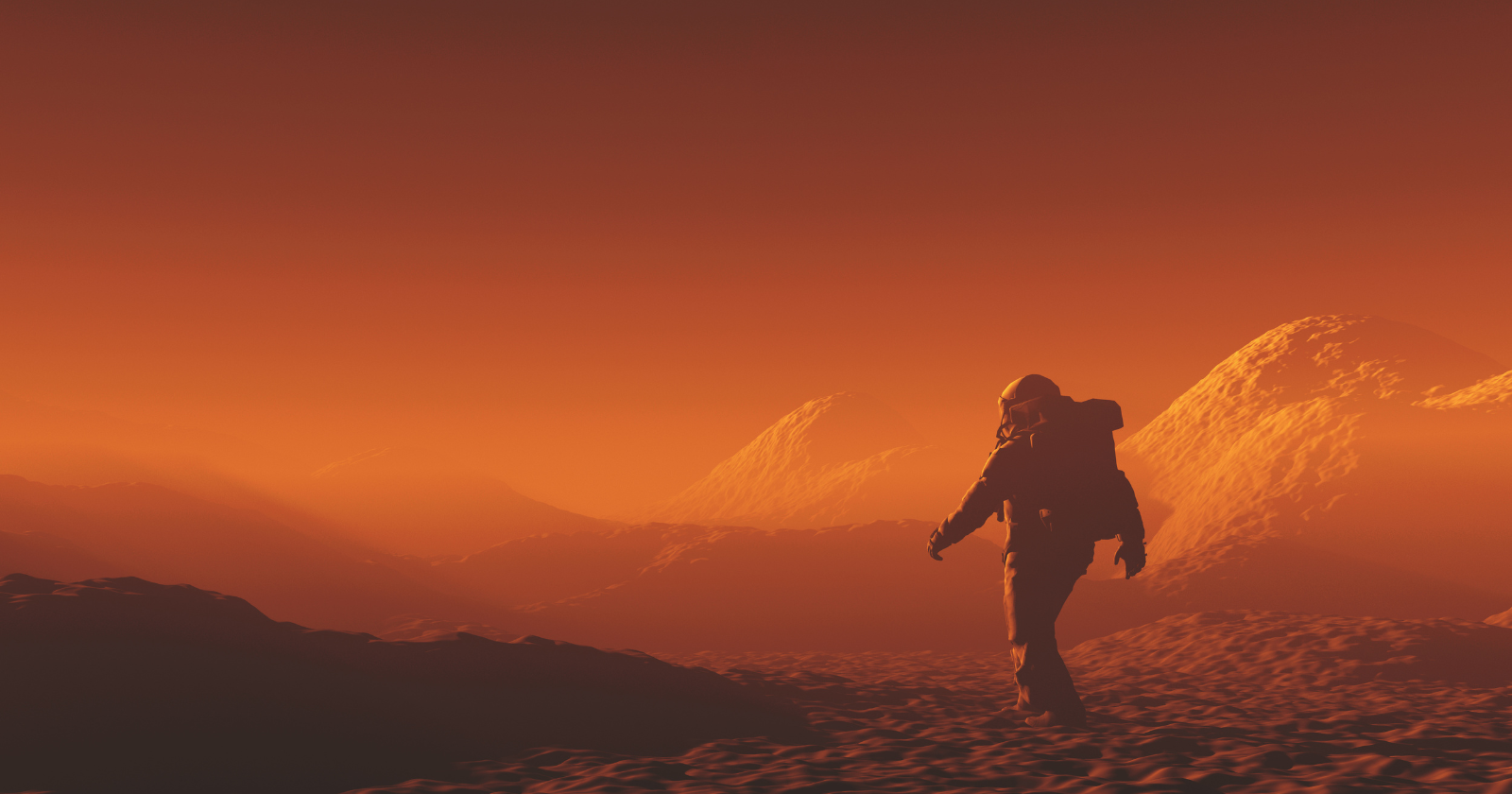
The image we have inherited of the first Mars crew is a figure on a ridge at dawn, helmet catching the light, a red desert running out to a pink horizon. It is a good image. It is also the smallest part of what those first crews will actually do.
Most of their days will go to managing three hazards that share a single quality. None of them is the cinematic kind of danger, the sudden one that arrives with music and ends in minutes. All three are slow, cumulative and largely invisible, the kind that has to be tracked, logged and pushed back against every single day. On Mars, the danger is less dramatic than constant.
The radiation worker
Mars has no global magnetic field and an atmosphere with about one per cent of Earth’s surface pressure, so the surface sits exposed to galactic cosmic rays and the occasional storm of particles from the Sun. We know roughly how much, because the Curiosity rover carried a detector through the trip and across the surface.
According to the measurements published by the RAD team in the journal Science, the round-trip transit alone would deliver about 0.66 sieverts under current propulsion and ordinary solar conditions, and a full mission with around 500 days on the surface would bring the total close to one sievert. A dose of one sievert is associated with roughly a five per cent increase in lifetime fatal cancer risk. NASA’s current career limit is 600 millisieverts and the European Space Agency’s is 1,000. By either standard, a conventional Mars mission consumes a large fraction of an astronaut’s lifetime radiation allowance, and may exceed NASA’s. The exact figure would depend on shielding, propulsion, trajectory and the solar cycle, but the scale of the problem is not in doubt.
So the first crews will live as radiation workers do, which means living by a number. The dose only ever climbs. It is managed by shielding, by limiting time outside, by watching for solar events and sheltering when one arrives. The work is dosimetry and discipline, not heroics, and the cost is mostly paid decades later.
The dust-control technician
The second hazard is the ground itself, ground up fine. Martian dust is often only a few micrometres across, a small fraction of the width of a human hair, fine enough to lodge deep in the lungs and pass into the bloodstream.
A 2025 review in the journal GeoHealth, led by Justin Wang at the University of Southern California, catalogued what that dust carries: perchlorates, which can disrupt the thyroid and the production of blood cells; silica, the cause of silicosis in miners and stoneworkers on Earth; iron oxides; and trace toxic metals whose amounts are still debated. The authors note that inhaling only a few milligrams would exceed a safe daily dose by Earth standards.
The dust is also electrostatically charged, so it clings to suits and rides back inside, the same problem the Apollo crews met with lunar dust, which left them coughing with what they called lunar hay fever after only a few days. Mars crews will be outside far more often, for far longer, with no quick trip home if something goes wrong and a communication delay of up to about forty minutes round trip. Keeping the dust out, through filters, airlocks, suitports and constant cleaning, becomes a permanent housekeeping operation. It is unglamorous, repetitive and central to staying healthy.
The weather-watcher
The third hazard is the one fiction has most distorted. The opening of The Martian, in which a windstorm topples equipment and strands an astronaut, cannot happen. NASA has said so plainly in its own account of the fact and fiction of Martian dust storms: because the air is so thin, even the strongest Martian winds, which top out around 60 miles per hour, carry almost no force. A 60 mile-per-hour Martian wind does not push the way a 60 mile-per-hour wind does on Earth. It would not knock a person over or tear an antenna loose.
What dust storms do instead is block the Sun. They lift fine dust high into the atmosphere, where it lingers for weeks and cuts the light reaching the ground. In 2018 a planet-encircling storm darkened the sky enough to drain the solar-powered Opportunity rover, which never woke again. Continent-sized storms appear most years, and the rarer planet-encircling ones arrive roughly once every three Martian years, without much warning.
So the weather-watcher’s job is not to brace against wind. It is to track how much light is getting through, measured as optical depth, to watch for storms forming, and to manage power and dust accumulation as the sky thickens. It is closer to monitoring a slow eclipse than weathering a gale.
Why the danger is constant, not dramatic
Put the three together and the texture of the work comes into focus. A rising dose that has to be rationed. A toxic powder that has to be kept out. A sky whose brightness has to be watched. Each is chronic rather than acute, and each is met with procedure rather than reflex.
This is the part the inherited image leaves out, and it has a practical consequence. The people best suited to the first surface missions are not only the boldest but the most methodical, the kind who can change a filter for the four hundredth time with the same care as the first, and who can read a dose log without flinching or ignoring it. The frontier rewards temperament more than nerve.
There will be moments that match the image. The first footprints will be real, and so will the view from the ridge. But the days that follow will be spent on dose budgets, dust filters and opacity readings, the quiet maintenance that keeps a body alive somewhere it was never built to be. The desert at dawn is the reward. The work is everything that happens before and after it.
