
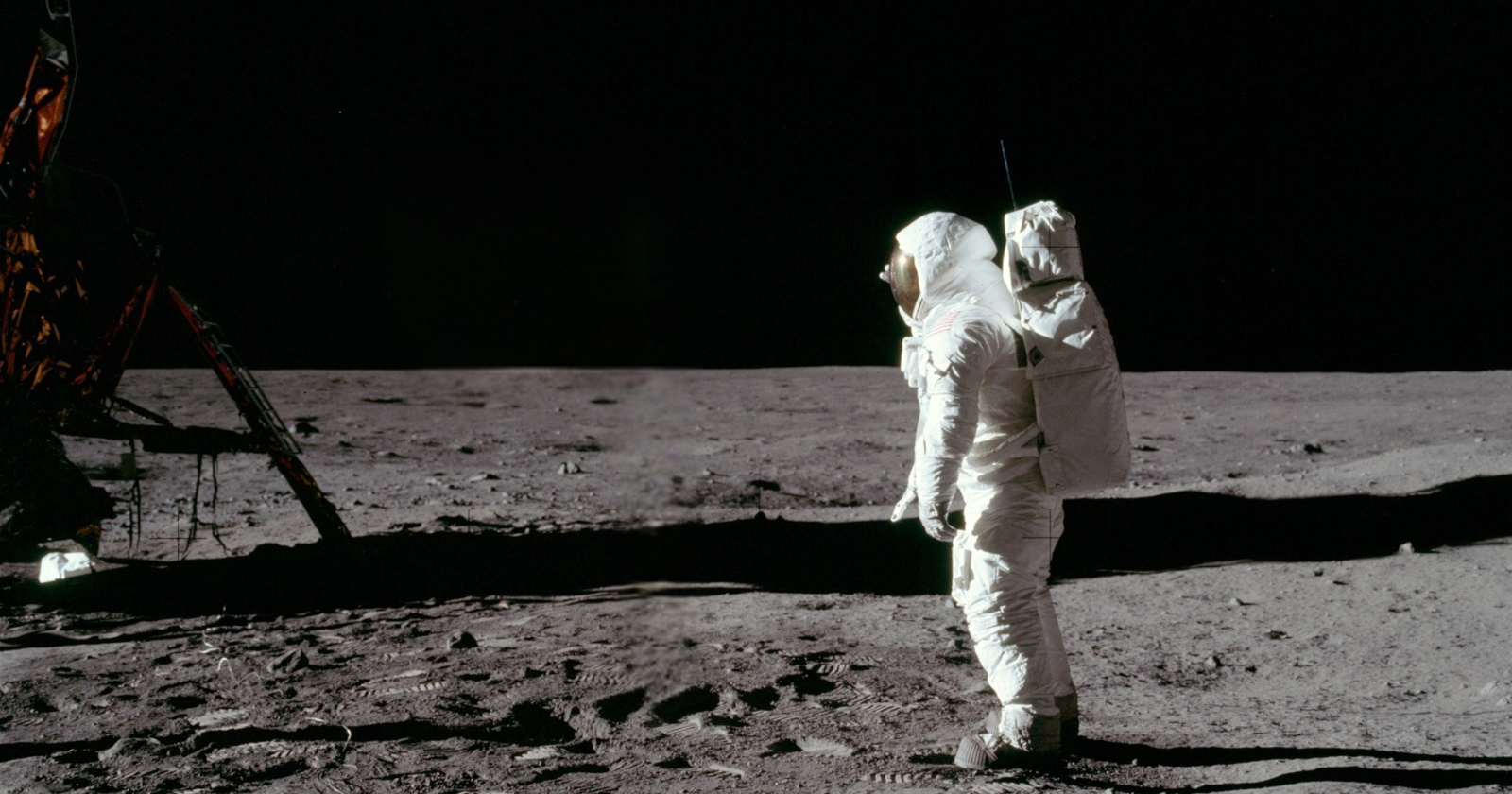
On 2 August 1971, in the dust of the Hadley-Apennine landing site, Apollo 15 commander David Scott crouched beside the Lunar Roving Vehicle, scooped a small hollow in the regolith, and placed inside it a 3.5-inch aluminium figurine of a stylised astronaut in a spacesuit. Beside it he laid a small engraved plaque, listing fourteen names — eight Americans and six Soviets — every human who had died in the effort to reach space. He photographed it, climbed back into the rover, and said nothing about it on the open air-to-ground loop. He had quietly cleared the gesture with a handful of senior NASA officials beforehand, but the public — and most of the agency — would not learn of it until after the crew was home.
The piece is called Fallen Astronaut. It is still there. It is the only figurative sculpture on another world.
A memorial kept off the world’s most monitored mission
Apollo 15 was the first of the so-called J-missions, the long-stay scientific expeditions that gave geologists three days on the surface and a battery-powered rover to drive across it. Every gram of payload was accounted for. Every minute of the EVA timeline was scripted in Houston. The crew — Scott, Jim Irwin, and command module pilot Al Worden — were under constant telemetry and voice link. There was almost no room, physical or procedural, for a private gesture.
Scott made room anyway. He had quietly commissioned the figurine months earlier from the Belgian sculptor Paul Van Hoeydonck, whom he had met at a dinner in New York. The two men’s later accounts of what they agreed differ sharply, and that disagreement would haunt the piece for decades. But the basic facts are not in dispute. Scott wanted something to commemorate the dead. Van Hoeydonck made it. Scott carried it to the Moon in a stowage pocket, set it down in a small crater near the rover’s final parking spot, about twenty feet north of where he left the rover, and kept it off the air-to-ground loop until the crew was safely back in quarantine.
According to Space.com’s obituary of Van Hoeydonck, who died in 2025 at the age of 99, the sculptor was given a set of specifications that read more like an engineering brief than an art commission: the figure had to be light, robust enough to survive the temperature swing between lunar day and lunar night, and androgynous and non-ethnic enough to represent any astronaut or cosmonaut.
The fourteen names on the plaque
The plaque is small, and the names are listed alphabetically, with no nationality given. Reading them in order is a compressed history of the first decade of human spaceflight and the price it extracted.
The Americans: Charles Bassett and Elliot See, killed when their T-38 jet crashed into the building containing their Gemini 9 spacecraft in 1966. Roger Chaffee, Gus Grissom and Ed White, killed in the Apollo 1 cabin fire on the launch pad in January 1967. Ted Freeman, killed in a T-38 crash in 1964. Ed Givens, killed in a car accident in 1967. Clifton Williams, killed in a T-38 crash in 1967.
The Soviets: Pavel Belyayev, who flew Voskhod 2 and died of illness in 1970. Georgy Dobrovolsky, Viktor Patsayev and Vladislav Volkov, the Soyuz 11 crew who suffocated in June 1971 when a valve opened during re-entry — only weeks before Apollo 15 launched. Vladimir Komarov, killed when Soyuz 1’s parachute failed in 1967. Yuri Gagarin, the first human in space, killed in a MiG-15 training crash in 1968.
The Soyuz 11 crew’s deaths were so recent that their names were a last-minute addition. The three cosmonauts died on 30 June 1971 — twenty-six days before Apollo 15 launched, and just thirty-three days before the figurine was set down on the Moon.
Why it stayed quiet, and how it came out
There was no rule that explicitly forbade leaving a personal memorial on the lunar surface. There were rules — heavily enforced ones — about unauthorised commercial activity, personal items, and anything that might embarrass the agency or its Cold War posture. Listing six Soviet cosmonauts on a plaque beside eight Americans, in the middle of a Moon race the United States had spent billions of dollars to win, was politically delicate. Scott has said he cleared the idea quietly with a few senior people at NASA, who thought it a fitting gesture, but it was never written into the mission plan, never narrated on the air, and never announced until the crew was home.
The gesture had to be quiet, anonymous, and equal. The plaque deliberately lists the names without flags or nationalities. The figurine itself has no insignia. It is wearing a generic pressure suit. Van Hoeydonck later said he had wanted to make something that affirmed life on the Moon — the artist’s own reading of the figure was as a representation of all humanity, not specifically of the dead. Scott’s reading was the funereal one, and Scott was the one with the spacecraft.
The crew disclosed the memorial at the post-flight press conference, and a photograph Scott had taken of the figurine in the dust circulated soon after. The image is striking: a tiny silver figure lying on its side, casting a long shadow across the regolith, with the plaque propped vertically next to it. The aluminium catches the unfiltered sun. The dust around the base is faintly disturbed where Scott’s gloved hand smoothed it.
What happened next is where the story gets uglier. According to a ScienceAlert account of the affair, Van Hoeydonck — under what he later described as a misunderstanding of the agreement — arranged through a New York gallery to sell 950 signed replicas of the figurine for $750 each. NASA, which had already been embarrassed by the Apollo 15 crew’s separate postal covers scandal involving unauthorised stamped envelopes flown to the Moon, was furious. The replica sale was halted before it really began. A replica was donated to the Smithsonian’s National Air and Space Museum, where it remains on display today.
Scott and Van Hoeydonck stopped speaking. Their accounts of who had agreed to what, and whether the piece was ever supposed to be commercial, never reconciled. The artist maintained for the rest of his life that he had been promised credit and recognition. Scott maintained that the whole point had been anonymity, and that selling replicas had broken faith with that intent.
The geology mission that hid a sculpture
The strange thing about Fallen Astronaut is how completely it is overshadowed, in the historical record, by the science Apollo 15 was actually there to do. The mission’s main work — described in detail in NASA’s retrospective on Apollo lunar sample science — was geology. Scott and Irwin spent 18.5 hours on the surface across three EVAs, drove the rover roughly 28 kilometres, and brought back 77 kilograms of rock, including the famous Genesis Rock, an anorthosite fragment that turned out to be a piece of the Moon’s primordial crust.
Those samples are still yielding results. The samples Scott and Irwin chipped off Hadley Rille more than fifty years ago are now being measured with instruments that didn’t exist when they were collected. The sculpture they left behind has not been touched, photographed up close, or formally surveyed since.
What the figurine looks like now
Nobody knows, exactly. The site has not been revisited. NASA’s Lunar Reconnaissance Orbiter has photographed the Apollo 15 landing area from about 24 kilometres up, and the rover tracks and equipment shadows are visible, but a 3.5-inch aluminium figurine is below the resolution limit of any orbital camera that has ever flown.
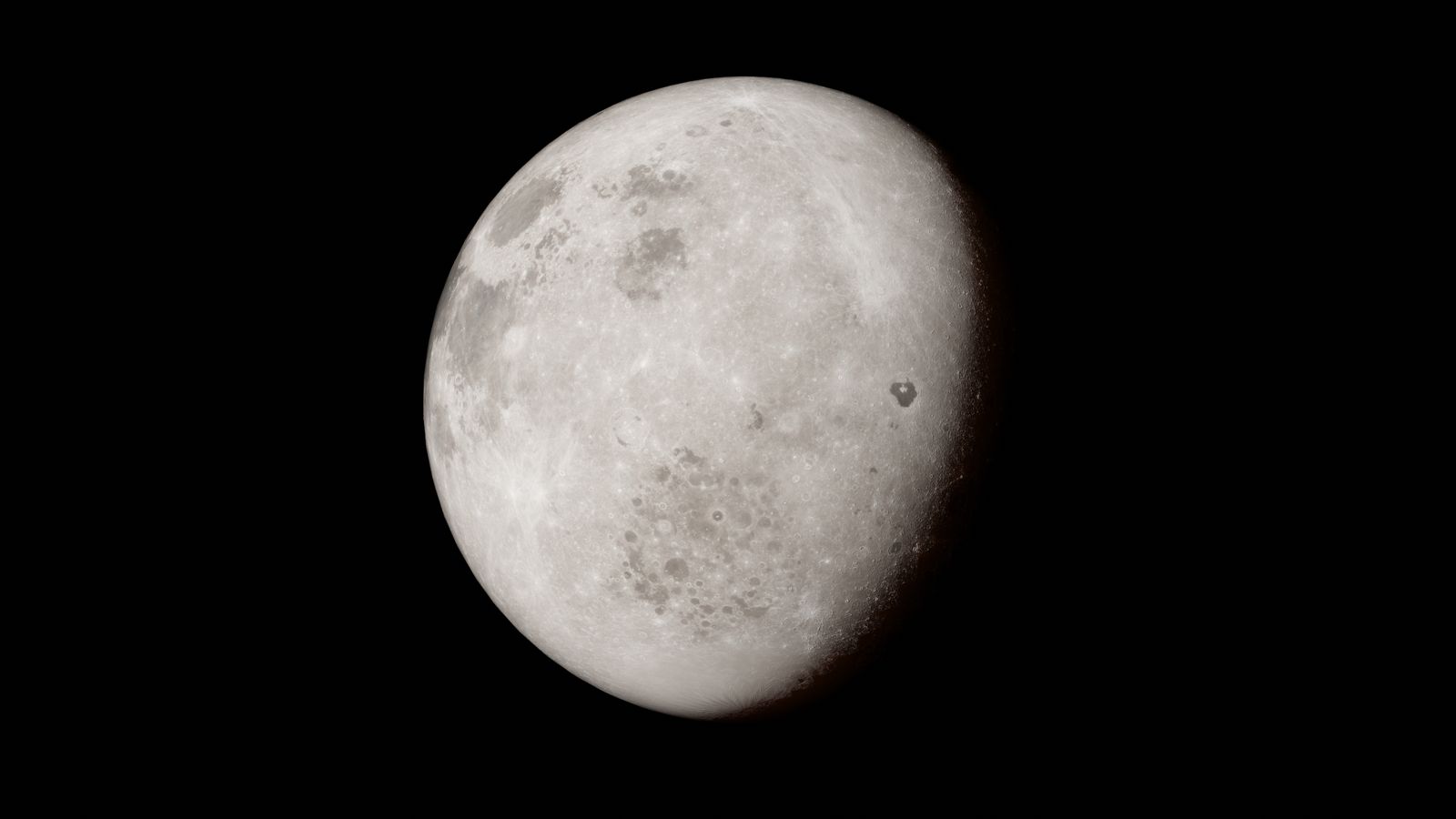
The lunar surface is harsh in ways that matter for a small piece of metal. Temperatures at Hadley swing from roughly +120°C in lunar day to -170°C in lunar night, a cycle that repeats every 29.5 Earth days. Micrometeorite bombardment is constant. Cosmic rays and solar wind sputter atoms off any exposed surface over geological time. None of that is enough to destroy a solid aluminium casting in fifty-five years. The figurine is almost certainly still lying exactly where Scott placed it, the plaque beside it, both possibly coated in a thin grey film of disturbed regolith.
That may not stay true for much longer. The Artemis 2 crew will fly past the Moon without landing, but Artemis 3 and the missions that follow will put humans back on the surface, and a broader programme of crewed and robotic visits is being planned around the legacy Apollo sites. The Hadley-Apennine region is one of the more scientifically interesting Apollo landing zones, and there are open conversations within the planetary science community about whether — and how — to protect the original artefacts.
The only figurative sculpture on another world
There are other objects on the Moon. Hundreds of them. Six American flags, all of which have likely been bleached white by ultraviolet light. Three lunar rovers. Twelve pairs of overboots. Hammers, tongs, sample bags, the falcon feather Scott dropped alongside a hammer in front of a TV camera to demonstrate Galileo’s law of falling bodies. A red Bible that Scott propped open on the rover’s control panel. Family photographs. A gold-plated olive branch from Apollo 11. A set of laser retroreflectors that scientists still bounce beams off today to measure the Moon drifting away from Earth at roughly the rate fingernails grow.
But none of those is a sculpture in the art-historical sense. None depicts a human figure. None was commissioned from an artist, cast in a studio, and placed on the surface as a memorial. Fallen Astronaut sits alone in that category — a tiny aluminium body on a grey plain, with fourteen names beside it, left quietly by a commander who had decided that the people who died trying to get there deserved to be there too.
The arguments over authorship and commerce that followed the mission have outlived almost everyone involved in them. Van Hoeydonck is gone. Most of the men whose names are on the plaque have been dead for sixty years. Scott is in his nineties. The figurine is still there, and will be there for as long as the Moon is. In the timescales the Apollo samples now reveal — billions of years of crust, magma oceans, basin-forming impacts — fifty-five years is nothing. A flash. The figurine has barely begun its time on the surface.
If a future astronaut walks up to that small crater at Hadley and brushes the dust off, the names will still be readable. The aluminium will still be bright. The sun will still be unfiltered and brutal, and the shadow the little figure casts will fall in the same direction it fell on 2 August 1971, when a commander placed it in the regolith and decided not to mention it on the loop.
