
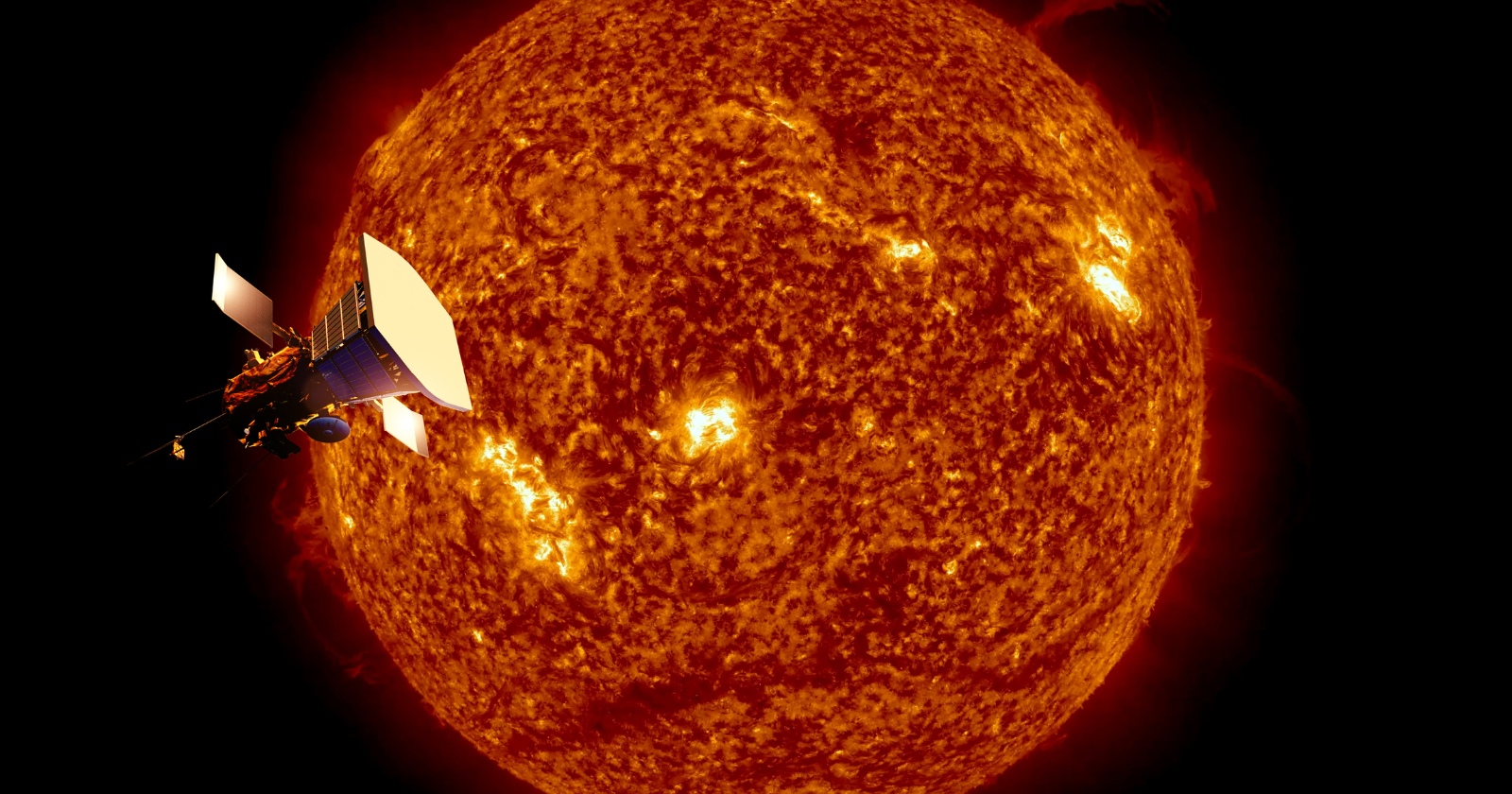
NASA’s Parker Solar Probe has spent the past few years flying repeatedly through the Sun’s corona, the outer atmosphere where temperatures run to more than a million degrees Celsius while the visible surface below sits at about 5,500. On 24 December 2024 it came within 6.1 million kilometres (3.8 million miles) of that surface, the closest any spacecraft has been, moving at roughly 692,000 kilometres per hour, the fastest any human-made object has travelled. A beacon tone two days later confirmed it had survived the pass. Telemetry began arriving on 1 January, and NASA reported the spacecraft was healthy the next day.
The reason this is worth doing comes down to a temperature gap that has bothered solar physicists for a long time.
Why the temperature gap is a problem
Heat does not flow from a cooler body to a hotter one on its own. Yet the corona is hundreds of times hotter than the photosphere beneath it, even though the photosphere is closer to the Sun’s energy source. Something is depositing energy high in the atmosphere, and the question of what has been open since the 1940s, when coronal spectral lines were identified as coming from highly ionised iron and the million-degree temperature was first established.
Two broad families of explanation have competed for decades. One is wave heating, in which magnetic waves travelling up from the lower atmosphere dissipate their energy in the corona. The other is small-scale magnetic activity, sometimes called nanoflares, in which countless tiny reconnection events release heat. The two are not mutually exclusive, and neither has been confirmed as the dominant mechanism.
What flying through it actually allows
Until Parker, the corona had been studied only remotely, and the solar wind had been sampled only much farther from the Sun. Parker is the first spacecraft to take readings directly inside the near-Sun corona, using a carbon-composite shield about 11 centimetres thick, rated to around 1,400 degrees Celsius, to keep its instruments near room temperature while they measure the plasma’s density, temperature, magnetic field and flow.
It reached this position gradually. Seven Venus gravity assists, the last in November 2024, lowered its orbit until the Sun’s gravity could pull it to the record distance. It first crossed into the corona in April 2021, about 13 million kilometres out, and has been spending more time inside the atmosphere on each subsequent pass.
Switchbacks, and what one study refined
Among Parker’s clearer findings are switchbacks, abrupt S-shaped reversals in the direction of the Sun’s magnetic field that appear in abundance in the young solar wind close to the Sun. They are a candidate contributor to both heating the corona and accelerating the solar wind, because they carry magnetic energy that can be released as they travel.
How they form has been the contested part. A study led by Mojtaba Akhavan-Tafti at the University of Michigan, published in The Astrophysical Journal Letters in July 2024, found that switchbacks are common in the solar wind near the Sun but absent from inside the corona itself. The authors argue that mechanisms in the solar wind are necessary to produce fully formed switchbacks, even if processes lower in the atmosphere supply the initial seeds. This is a single study, and it addresses where switchbacks form, not the larger heating question. It refines the picture rather than settling it.
What is and is not settled
It is easy to read coverage of Parker as though the heating problem has been solved. It has not.
What the mission has done is clarify adjacent questions. NASA scientists have described the acceleration of the fast solar wind as partly powered by switchbacks, and the probe has confirmed that the slower solar wind comes in two distinct types with different likely origins. These bear on how the corona feeds the wind that fills the solar system. They do not amount to a confirmed account of why the corona reaches the temperatures it does. The energy budget, and which mechanism dominates where, remains under study.
What to watch
Parker is no longer setting a new record on every loop. It has returned to the same 6.1-million-kilometre orbit several times since, in March, June, September and December 2025, and again on 11 March 2026 on its 27th close approach, gathering data while the Sun is in the active phase of its eleven-year cycle, which is when reconnection events and eruptions are most frequent.
The question worth tracking is whether the data from these repeated passes lets researchers distinguish wave heating from small-scale reconnection, rather than continuing to show that both are present. The mission’s next phase, beyond late 2026, is formally under NASA review. The spacecraft is in the right place to test the competing explanations, which is not the same as having chosen between them.
