
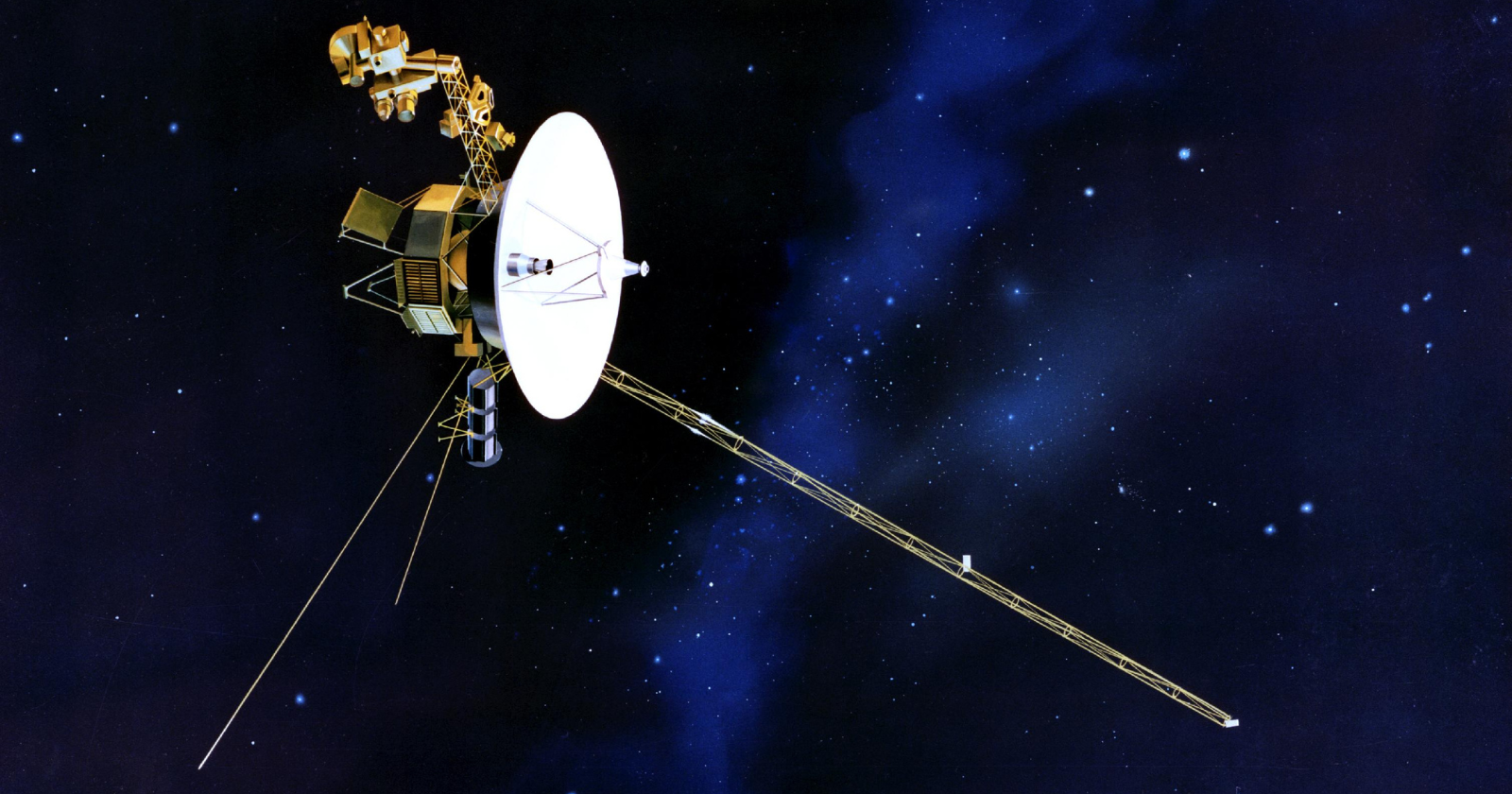
Voyager 1, the first human-made object to cross into interstellar space, carries a gold-plated copper phonograph record holding music, spoken greetings, and the sounds of Earth. The popular description is that it is a message to aliens. The people who assembled it understood it as something more modest and more honest, and the timescales involved are what make that worth spelling out.
The spacecraft is now more than 25 billion kilometres from Earth, far enough that a command takes about 23 hours to reach it, and it is still returning data. It will not stay in contact for much longer.
What the record is, and who chose it
The contents were selected for NASA by a small committee chaired by the astronomer Carl Sagan at Cornell University. They settled on more than a hundred images, natural sounds, and greetings in fifty-five languages, along with roughly ninety minutes of music drawn from many cultures and eras and a written message from the US president of the day. A cover engraved with playing instructions and a map locating the Sun against a set of pulsars was fixed over the disc, which its makers expected to last on the order of a billion years in the near-vacuum between the stars.
That last figure is the one that does the strange work. Erosion out there is negligible, so the record is likely to outlast not only the spacecraft but the Earth itself, which the ageing Sun is expected to render uninhabitable and eventually engulf billions of years from now.
It is not heading “near” a star in any ordinary sense
Neither Voyager is aimed at a star. They were thrown out of the Solar System by planetary flybys and now coast on whatever heading those encounters left them. In about 40,000 years, Voyager 1 will make its closest future approach to another star, passing within roughly 1.6 light-years of Gliese 445 in the constellation Camelopardalis, as National Geographic has reported. Voyager 2 will come within about 1.7 light-years of Ross 248 around the same time.
The word “near” needs reading carefully here. A distance of 1.6 light-years is about 15 trillion kilometres. It is less than the distance to Proxima Centauri, the Sun’s nearest stellar neighbour today, but it is not a visit. The spacecraft will not enter that star’s planetary system or pass anything a person would call close. It will glide by in the dark, far outside any plausible range at which the record could be noticed.
What its makers actually claimed
Sagan was direct about the odds. The record would only ever be played, he said, if advanced spacefaring civilisations happened to exist in interstellar space to find it, and he treated the act of sending it as a statement about the people doing the sending rather than a realistic attempt at contact. The chance of interception is, by any measure, close to zero. We know roughly where the craft will be in 40,000 years, and there is nothing there to catch it.
This is why the record has always made more sense as a self-portrait than as outgoing mail. By the account of the people who made it, every decision assumed two audiences at once, those of us on Earth and any listeners among distant stars, and the first of those was never an afterthought. The committee was deciding how a species wished to represent itself in 1977: which music, whose voices, what images of work and weather and anatomy. The audience that has actually heard it is us. Copies and reconstructions have circulated on Earth for decades, and the real work of the project, the choosing, was done here.
Three clocks on one object
The most concrete thing to say about Voyager 1 now concerns power, not philosophy. The spacecraft runs on a radioisotope generator fuelled by decaying plutonium, and it loses about four watts a year. To stretch the mission, engineers at NASA’s Jet Propulsion Laboratory have been switching off instruments one at a time. Eight of Voyager 1’s ten original science instruments are now off, and each further shutdown buys roughly another year. The mission’s own scientists have said plainly that every day could be the last.
So three clocks run on the same object at once. The powered systems that let Voyager 1 keep speaking to us may have only a few years left. The record bolted to its side is built for a billion. The next time the spacecraft comes anywhere near a star is 40,000 years away, and even then it misses by some 15 trillion kilometres.
The part of Voyager made to talk to us will fall silent first. The part made to talk to someone else will carry on without it, almost certainly unheard. The only audience anyone could ever be sure of was the one that chose what to send.
