
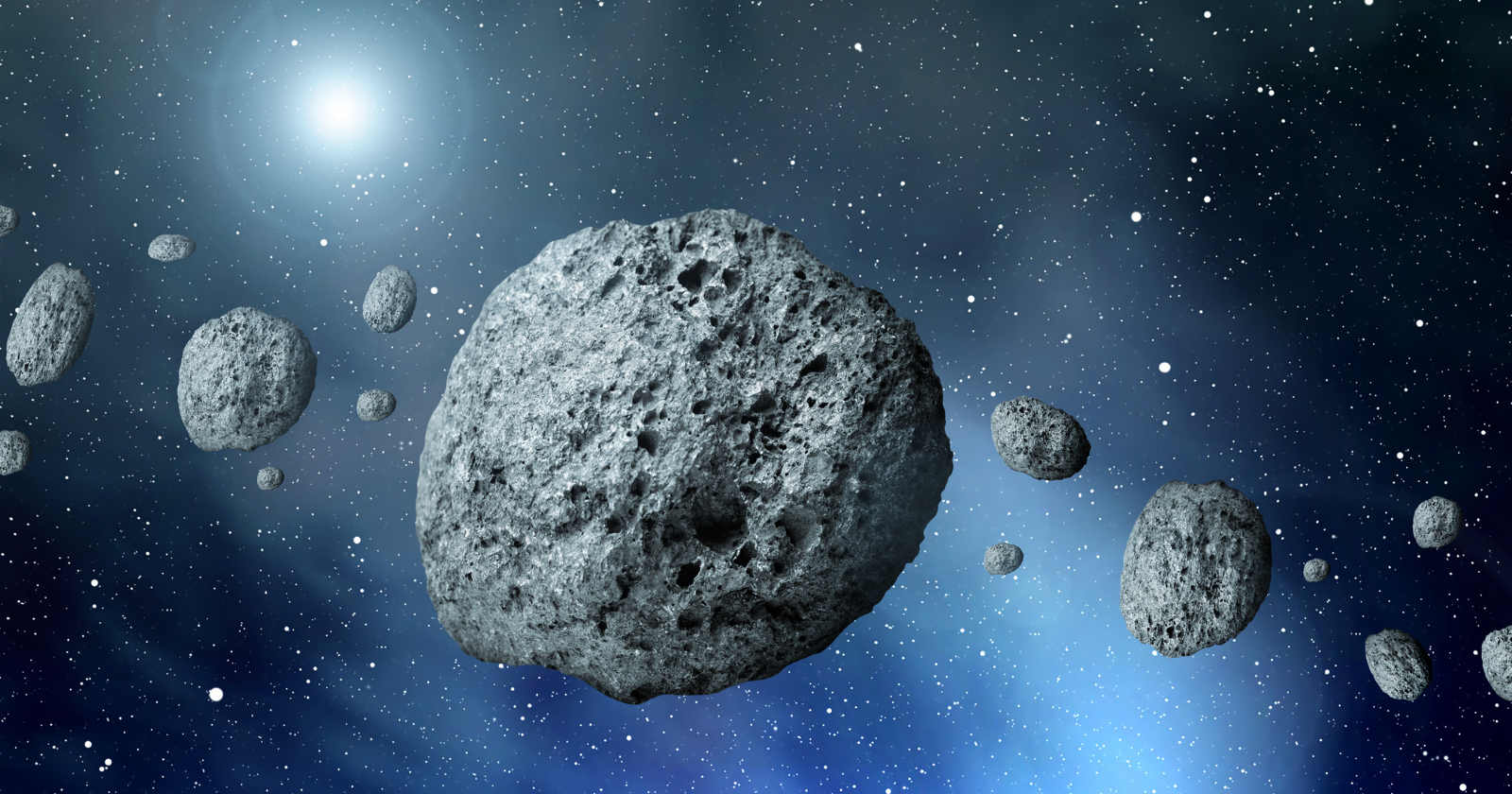
The asteroid belt of the films is a wall of tumbling rock, the kind a pilot has to weave through at speed while boulders close in from every side. The real belt between Mars and Jupiter holds more than a million sizeable objects, and a spacecraft can fly straight through it without steering around a single one. The chance of striking anything on a given crossing is close to nil.
The two pictures are hard to reconcile until you look at the volume those objects are spread through. The belt is not crowded. It is one of the emptiest places we routinely send hardware.
The numbers behind the emptiness
The main belt sits roughly between 2.2 and 3.2 times the Earth’s distance from the Sun. That gives it a radial width of about 150 million kilometres, before you account for the fact that its objects are spread all the way around the Sun in an enormous three-dimensional ring. Astronomers estimate it contains between 1.1 and 1.9 million asteroids larger than about a kilometre, along with a great many smaller ones.
That sounds crowded. It is not, because the space they occupy is enormous. Estimates of the average gap between asteroids vary with the size cut-off used, but a figure of around a million kilometres between sizeable bodies is commonly quoted, roughly two and a half times the distance from the Earth to the Moon. For the larger objects in particular, the NASA scientist David Morrison has put the typical spacing at several million kilometres.
The belt’s total mass tells the same story. Gather every asteroid into a single body and you would get a dwarf planet about 1,500 kilometres across, with a mass near 3 per cent of the Moon’s, as Astronomy magazine sets out. Ceres alone accounts for something like a quarter to a third of that.
The crossings that settled it
None of this was obvious before anything had flown through. When NASA sent Pioneer 10 toward Jupiter in 1972, the belt was a real unknown. The worry was not the large asteroids, whose orbits were tracked, but the small particles and dust that might be too numerous to avoid and quick enough to wreck a spacecraft. In NASA’s own account of the mission, it was uncertain whether Pioneer 10 would get through safely because the density of damaging particles was not yet known. By some accounts, planners put the odds of a clean passage at about nine in ten.
Pioneer 10 entered the belt in July 1972 and emerged from the far side in February 1973, having recorded fewer small-particle hits than expected. Its trajectory kept it about 8.8 million kilometres from the nearest known asteroid, which is to say it never came near one. Spacecraft since then have crossed the belt routinely without having to dodge asteroids. Voyager, Galileo, Cassini, Dawn, Juno, New Horizons and Lucy have all made the trip.
The point runs the other way as well. Getting close to an asteroid is the hard part, not avoiding one. Galileo’s 1993 pass by the asteroid Ida took deliberate aim and planning. New Horizons’ principal investigator, Alan Stern, has described the odds of hitting something on a crossing as far less than one in a billion. Lucy, now bound for Jupiter’s Trojan asteroids, will pass through the belt without ever firing its thrusters to get out of the way.
What the empty picture leaves out
None of this means asteroids never collide. They do, only not on the timescale or at the density a film suggests. Over millions and billions of years the belt grinds itself down, and the debris of past impacts is still visible in the asteroid families that share similar orbits, the best studied being the Karin family, thought to have formed in a breakup around 5.8 million years ago. The belt is also thought to have shed the overwhelming majority of its original mass early in the Solar System’s history.
The way to hold both facts at once is to keep the timescales apart. On the scale of a single crossing, lasting months, the belt is effectively empty and the collision odds are tiny, though not literally zero. On the scale of millions of years, collisions are routine, and they are what produced the families and the dust we can measure. The Hubble Space Telescope has even imaged the object P/2010 A2, read by astronomers as the aftermath of a collision or disruption in the main belt.
The mental image of a crowded field is mostly a product of how the belt gets drawn. To fit a ring this size onto a single illustration, an artist has to pack the asteroids together until they nearly touch. Spread them back across the real volume and they all but vanish. The films kept the crowding because a wall of rock makes a better chase than a probe drifting through empty space for half a year and meeting nothing.
