
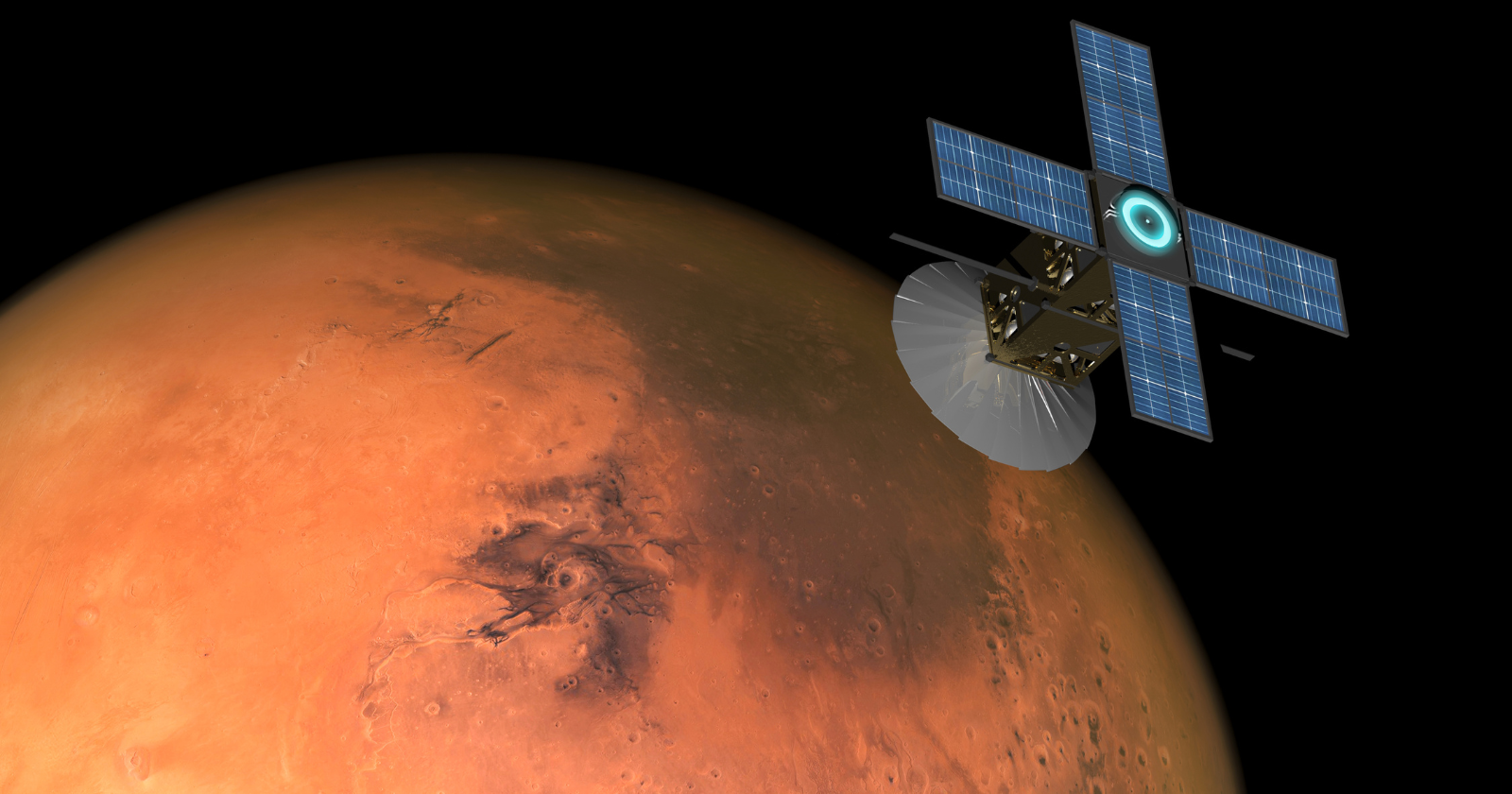
Building a nuclear-powered interplanetary spacecraft typically takes a decade. NASA is trying to do it in roughly two and a half years — and the only way the math works is by welding together two programs that were never designed to talk to each other.
The mission, called Space Reactor 1 (SR-1) Freedom, was announced in early 2026 with a target launch in late 2028. To hit that window, NASA is grafting a Department of Energy research reactor onto a spacecraft bus originally built for a lunar space station. Neither piece of hardware was designed for what it’s now being asked to do.
The short answer for how this is supposed to work: borrow heavily, build narrowly, and hope the seams hold.
The two-program merger at the heart of the gamble
The technical foundation of SR-1 Freedom is hardware that already exists, or nearly so. The Power and Propulsion Element (PPE) spacecraft bus — originally the cornerstone of the Gateway lunar outpost — has been redirected to carry the Mars demonstrator. It is the most advanced piece of the puzzle, and without it the 2028 timeline would be impossible.
The reactor side of the merger is harder. Rather than ask industry to design a flight-ready fission system from scratch — the approach that stalled NASA’s earlier Fission Surface Power solicitations — the agency is partnering with the Department of Energy to adapt existing research reactor designs. Program executives described the previous industry-led approach as overreach.
But adapting a ground-based research reactor for spaceflight is not a paperwork exercise. Research reactors sit in concrete-shielded buildings, run with abundant cooling water, and are tended by on-site operators. A space reactor has to survive launch vibration, reject heat into vacuum through radiators rather than coolant loops, autonomously start up in deep space after months of dormancy, and operate unattended for years while sharing a truss with sensitive electronics. The shielding strategy alone is fundamentally different: ground reactors shield in all directions; a space reactor shields only the spacecraft side, using a shadow shield, to save mass.
The new model brings NASA in-house as the prime, with DOE supplying reactor expertise. The 20-kilowatt reactor will run on high-assay low-enriched uranium (HALEU) and sit at one end of a truss, with radiators in the middle and the PPE-derived electric propulsion system at the other end. Solar arrays will provide power immediately after launch, before the reactor is activated in deep space.
A preliminary design review is planned for the fall. That review will be the first real stress test of whether the two halves of the program can be made to fit.

Why nuclear electric, and why now
Nuclear electric propulsion uses reactor-generated electricity to drive ion thrusters that accelerate charged xenon atoms out of a nozzle. The thrust is tiny compared with a chemical rocket, but it can be sustained for years — a profile suited to moving heavy cargo through deep space, where solar arrays grow weaker the farther a spacecraft drifts from the Sun.
NASA distinguishes between two main approaches to space nuclear power: thermal propulsion, which heats hydrogen with reactor energy for fast crewed trips, and electric propulsion, the slow-but-steady option being demonstrated by SR-1 Freedom. Nuclear thermal could cut Mars travel times significantly. Electric is more efficient over the long haul.
The physics has been settled for sixty years. The execution has not. The United States has launched exactly one fission reactor into orbit — SNAP-10A, in 1965 — and it operated for 43 days before a voltage regulator failure ended the mission. Program officials have characterized the absence of operational space nuclear reactors since as an execution problem rather than a technological barrier, pointing to four recurring failure modes from past efforts: weak mission demand, overly ambitious projects, unrealistic timelines, and fragmented leadership.
The irony of SR-1 Freedom is that it is openly courting at least two of those failure modes — unrealistic timelines and an ambitious scope — and trying to outrun them with hardware reuse.
The SkyFall payload and what arrives at Mars
SR-1 Freedom carries more than a propulsion experiment. About a year after launch, the spacecraft will deploy SkyFall, a payload of three small helicopters based on the Ingenuity rotorcraft that flew alongside the Perseverance rover. The helicopters will scout terrain at a potential future human landing site, including searching for subsurface water ice.
NASA’s associate administrator for science said the helicopters will carry cameras and have capabilities similar to Ingenuity, but described them as scouts rather than dedicated science platforms. The fate of the mother spacecraft after SkyFall deployment has not been decided. Options under consideration include entering Mars orbit or executing a flyby toward a more distant target to further wring data from the propulsion system.
The money came from Gateway
NASA has not produced a formal cost estimate for SR-1 Freedom. Funding will come from reallocating money in the fiscal year 2027 budget request and from prior appropriations — including billions originally provided for Gateway. The same dollars that would have built a lunar outpost are now buying a Mars technology demonstration, with the PPE spacecraft itself as the most visible piece of repurposed value.
A pathfinder, not an endpoint
SR-1 Freedom is being designed as a first step rather than a one-off. NASA plans to share the reactor design with industry without proprietary restrictions, and program officials have described the technology as extensible to a planned lunar surface power system targeted for 2030. The longer-term vision involves scaling to hundreds of kilowatts or even megawatts by the mid-2030s — power levels that would support the kind of permanent lunar base that would be difficult to sustain on solar power alone in certain lunar regions.
That extensibility is the real prize, and it is also what raises the stakes of the 2028 attempt. SR-1 Freedom is not just a Mars mission; it is the pathfinder design that lunar surface power and every follow-on reactor are supposed to inherit. If the merged-program approach works, the United States will have its first flying reactor in more than 60 years, the first ion-driven interplanetary spacecraft to reach another planet under nuclear power, and a reference design that industry can build on without starting over.
If it slips — and the Mars transfer geometry is unforgiving, with a missed window costing at least two years — the consequences extend beyond one mission. A high-profile failure or a quiet cancellation would validate the institutional skepticism that has kept space reactors grounded since 1965: that the timelines never hold, that the scope always grows, that the political support always evaporates before the hardware flies. The lunar surface reactor planned for 2030 depends on this one working. So does the credibility of the next decade of US space nuclear ambition.
The fall design review will tell the first part of that story — whether two programs that were never supposed to meet can be made to fly together, or whether SR-1 Freedom joins the long list of space reactors that never left the ground.
