
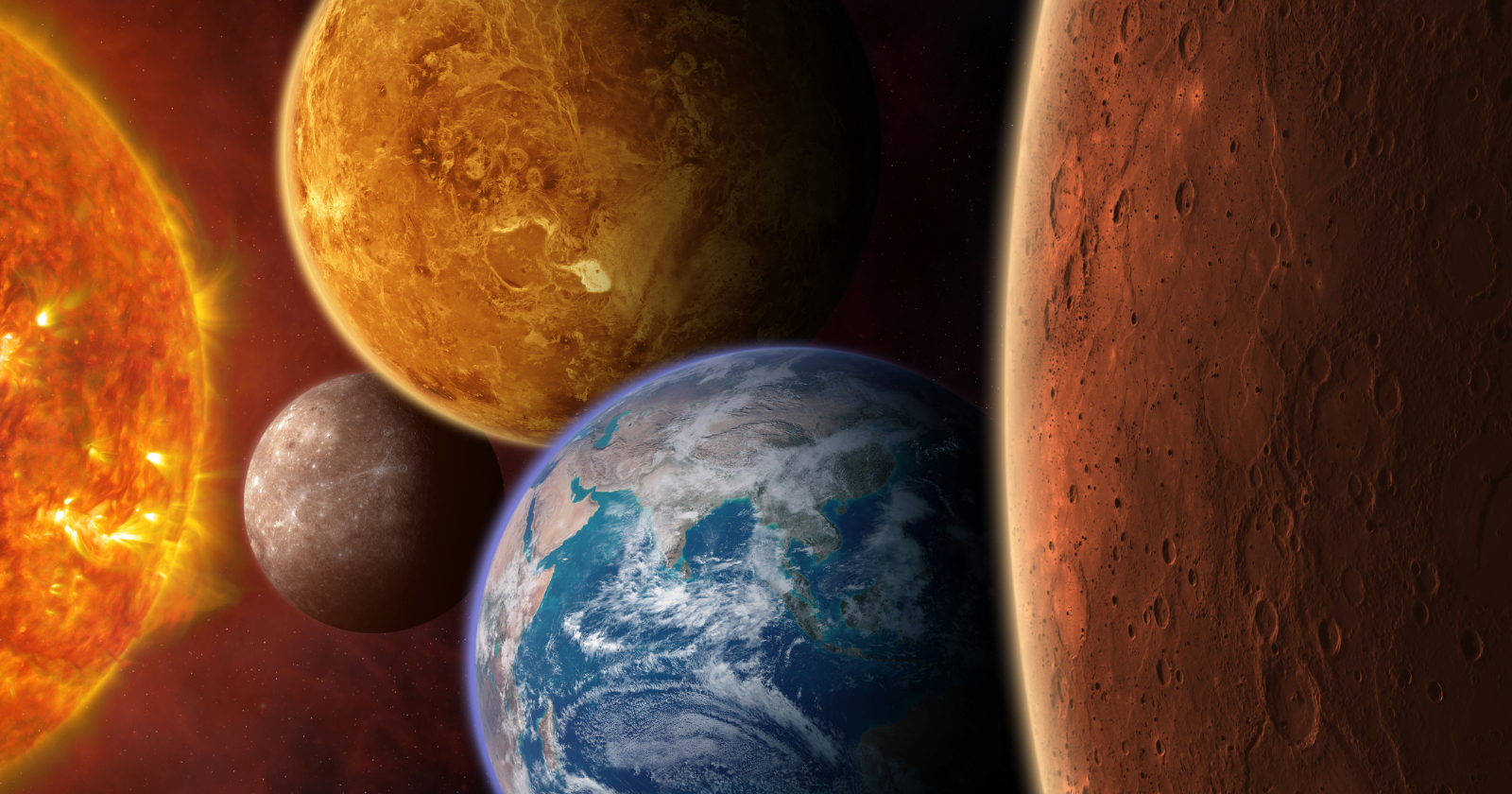
Venus is the hottest planet in the solar system, and it is not a close contest. The planet’s mean surface temperature sits at about 464 degrees Celsius, according to NASA’s overview of solar system temperatures. Mercury, which orbits far nearer the Sun, has a mean surface temperature of about 167 degrees, and even its sunlit face tops out near 430.
The gap runs against intuition. Mercury sits roughly 58 million kilometres from the Sun. Venus is almost twice as far, at about 108 million. Sunlight weakens with the square of distance, so each square metre of Venus receives only about a third as much solar energy as Mercury receives.
By the obvious logic, Mercury should win comfortably. It does not.
What the numbers actually say
It is worth being precise here, because these figures tend to get rounded into mush. NASA lists Venus at 464 degrees Celsius, hot enough to melt lead, while its Venus facts page rounds slightly differently, to about 467. The number that matters more sits alongside them: the day-night temperature range is close to zero. Venus is about as hot at midnight as it is at noon.
Mercury is the opposite case. Its dayside can reach roughly 430 degrees near the equator, while the nightside falls to about minus 180. That is a swing of more than 600 degrees across a single Mercurian day. Among the planets, Mercury is the classic extreme-temperature case.
Proximity is not the mechanism
There is a further wrinkle the “closer means hotter” story skips. Venus is wrapped in bright cloud, and that cloud reflects most of the sunlight reaching it. Its Bond albedo is about 0.77, meaning roughly three-quarters of incoming solar energy is bounced back to space before it can warm anything at all. Measured by sunlight actually absorbed, Venus is not even the obvious frontrunner.
So the heat is not a question of how much sun arrives. It is a question of what happens to the fraction that gets through, and whether the planet can hold on to it.
The atmosphere does the work
Venus has a surface pressure about 93 times Earth’s, with an atmosphere composed mostly of carbon dioxide and a deck of sulfuric acid cloud above. Carbon dioxide lets incoming visible light pass but absorbs the longer-wavelength infrared that a warm surface radiates back out. Heat enters, and far less of it leaves. The surface warms until it reaches a balance, and on Venus that balance point sits above the melting temperature of lead. NASA describes this as a runaway greenhouse effect, the most extreme in the solar system.
The same density explains the missing day-night difference. A thick atmosphere moves heat around the planet and stores an enormous amount of it, so the long Venusian night never cools the surface much before sunrise. The air itself is the reservoir.
Why Mercury cannot keep the heat
Mercury has no meaningful atmosphere, only a vanishingly thin exosphere made of atoms blasted from its surface by solar wind and micrometeoroid impacts. There is nothing there to trap infrared, and nothing to carry warmth from the day side to the night side.
So Mercury behaves the way an airless rock behaves. It heats fast where the Sun strikes it, reaching extreme temperatures quickly, then radiates that heat straight back to space the moment the Sun drops below the horizon. Without an atmospheric blanket, the warmth has nowhere to go but out. That is why the sunlit rock can sit near 430 degrees while the dark side, hours later, falls below minus 170.
What is useful to take from this
The Venus comparison usually gets wheeled out as trivia, but the part worth keeping is the mechanism rather than the ranking. A planet’s surface temperature depends less on how much sunlight reaches it than on how well its atmosphere retains the heat that gets through. A world can sit closer to the Sun and stay colder, or sit farther out and run hotter, depending on what surrounds it.
It is the same basic physics that keeps Earth warm enough to live on, shown here at an extreme that leaves little room for argument. Venus has the thick carbon dioxide atmosphere, the near-zero day-night range, and a surface that stays above the melting point of lead.
