
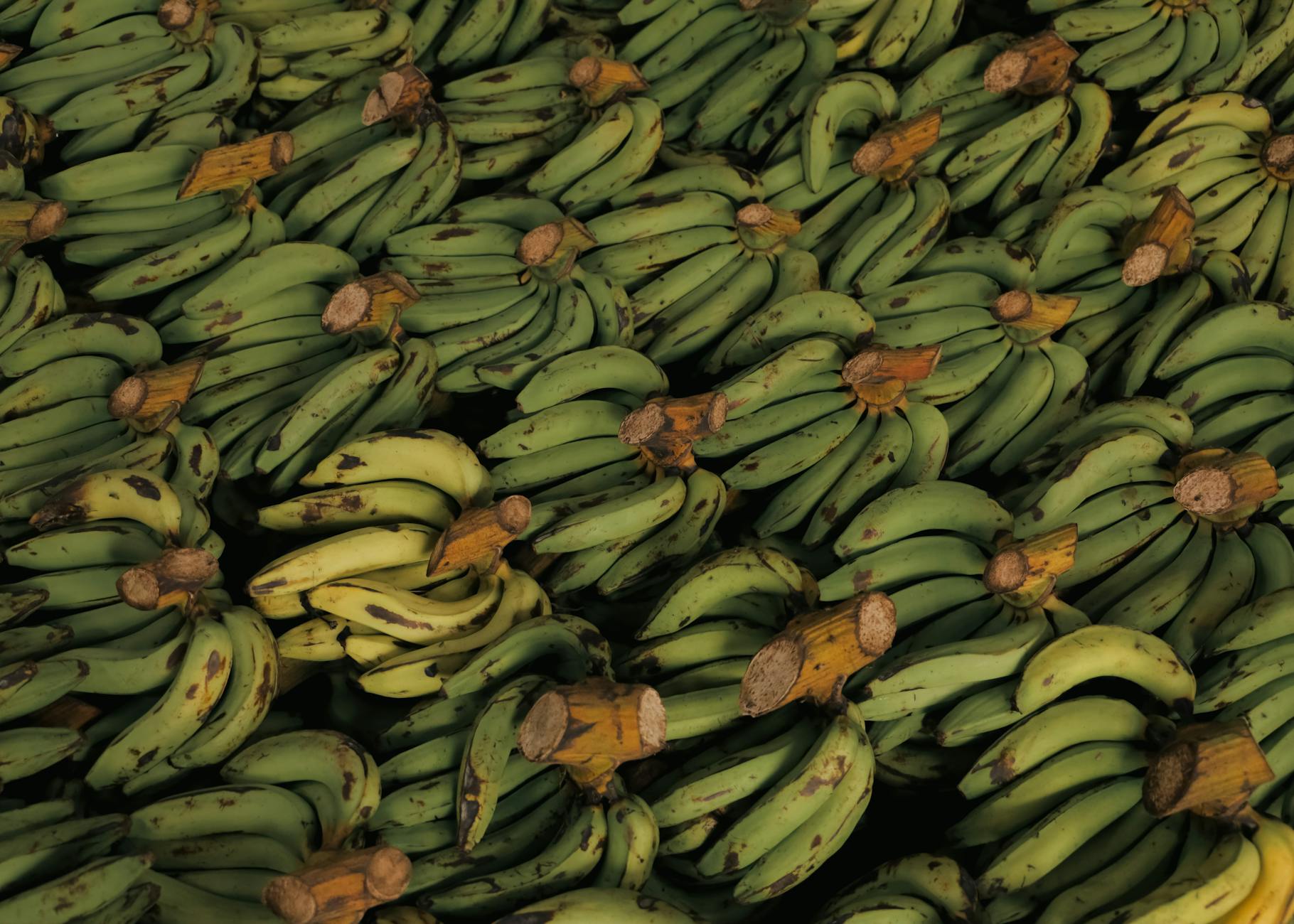
Every Cavendish banana in a Tesco, a Whole Foods, a corner bodega in Queens, or a wet market in Manila is a genetic clone of a single plant. The fruit reproduces not by seed but by suckers cut from the parent corm, which means the global banana trade is one enormous orchard of identical twins. And a soil fungus called Fusarium oxysporum f. sp. cubense Tropical Race 4, first identified in Taiwan in 1989, has been quietly working its way through that orchard ever since.
It has now reached plantations in Asia, Africa, the Middle East, Australia and Latin America, including Colombia and Peru, the heartland of the export trade. There is no cure. Once the spores are in the soil, they stay viable for decades.
The clone in your fruit bowl
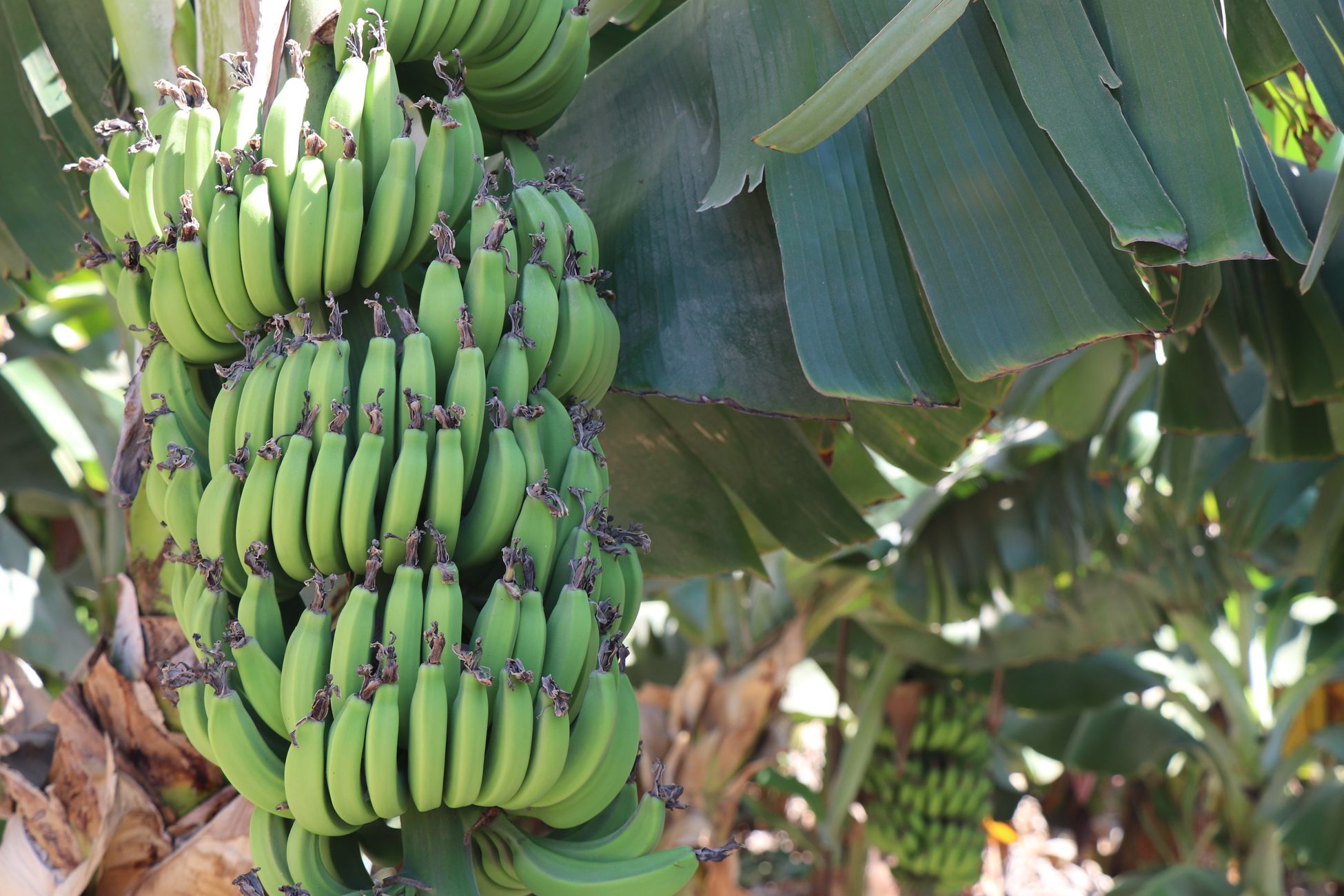
The Cavendish is a triploid — three sets of chromosomes instead of two — which leaves it sterile. Those tiny black specks down the centre of the fruit are aborted ovules, not viable seeds. Every commercial plant is propagated vegetatively, either from rhizome cuttings or, increasingly, from tissue culture in laboratories that mass-produce identical plantlets.
That is efficient. It is also the textbook setup for a pandemic.
A pathogen that can kill one Cavendish can, in principle, kill every Cavendish. There is no genetic variation to act as a firebreak. The same uniformity that makes the fruit ripen predictably on a container ship from Ecuador to Hamburg also makes the entire crop a single target.
What happened to the Gros Michel
None of this is hypothetical. The Cavendish is the understudy. The star was a different banana entirely: the Gros Michel, or “Big Mike,” a thicker-skinned, creamier, reportedly sweeter cultivar that dominated global exports from the late 19th century through the 1950s.
Then a different strain of the same fungus — Race 1 — swept through plantations in Central and South America. Within roughly two decades, Fusarium wilt of banana drove the Gros Michel to functional extinction as a commercial crop. Plantations in Honduras, Costa Rica and Panama were abandoned. The disease became known as Panama disease, the name it still carries.
The industry survived only because the Cavendish, then a minor variety grown mostly as a backup, happened to be resistant to Race 1. Growers ripped out the dying Gros Michel and replanted with Cavendish. Consumers in the United States and Europe, who had grown up on Big Mike, were handed a smaller, blander fruit and told it was a banana. They mostly accepted it.
That is why older flavourings labelled “banana” — the artificial isoamyl acetate in Runts candy, in some banana-flavoured medicines — taste like a stronger, more perfumed banana than the one in your kitchen. They were calibrated to the Gros Michel.
Tropical Race 4
Tropical Race 4 is a different strain of the same species of fungus, and it does to Cavendish what Race 1 did to Gros Michel. The pathogen enters through the roots, colonises the vascular tissue, and chokes off the plant’s ability to move water. Leaves yellow from the bottom up. The pseudostem splits. The plant collapses without ever producing a marketable bunch.
Spores survive in soil for decades and travel easily on boots, tyres, irrigation water and infected planting material. A single contaminated truck moving between farms can seed a new outbreak. Once a field is infected, it is effectively retired from Cavendish production for a human lifetime.
From its 1989 emergence in Taiwan, TR4 spread through Indonesia, Malaysia and the Philippines, then jumped to the Northern Territory of Australia, then to Oman, Jordan, Lebanon, Mozambique and Pakistan. Colombia confirmed the fungus on plantations in 2019 — the first detection in the Americas. Peru and Venezuela followed in subsequent years. The Food and Agriculture Organization warned in early 2026 that the disease remains a major threat to plantations worldwide and is endangering livelihoods across Southeast Asia.
Why this matters beyond breakfast
The Cavendish is the most-traded banana variety on Earth. Hundreds of millions of people in tropical countries depend on bananas and their starchy cousins, plantains, for a substantial share of daily calories. In Uganda, banana consumption is among the highest in the world. In Ecuador, the leading exporter, bananas account for a major share of agricultural employment.
The international trade is dominated by a handful of companies — Chiquita, Dole, Del Monte, Fyffes — operating plantations that look, from the air, like geometric sheets of green pulled tight across the soil. Those sheets are monocultures of a single clone. The economic case for that uniformity is overwhelming. The biological case against it is the entire history of the Gros Michel.
The search for a successor
There are hundreds of known banana varieties. Most are grown locally, eaten close to where they are picked, and never seen by a Western shopper. They include red bananas, finger-sized lady’s-finger bananas, starchy cooking bananas, and the wild seeded ancestors of the domesticated crop, whose fruit is unpleasant to eat because it is full of hard black pellets the size of peppercorns.
Those wild ancestors are where the resistance genes live.
In February 2026, researchers at the University of Queensland and collaborators reported a breakthrough: they identified a powerful natural disease-resistance region in a wild banana subspecies. The finding mapped resistance to Fusarium wilt Subtropical Race 4, a genetic variant of Tropical Race 4 found in Australia, and gave breeders a clearer route toward commercial bananas that are naturally protected from Race 4 strains while still tasting, peeling and shipping like the fruit consumers know.
Other groups are taking parallel routes. Australian researchers led by James Dale at Queensland University of Technology have already produced a genetically modified Cavendish, called QCAV-4, that carries a resistance gene from a wild banana relative and was approved for food use and commercial cultivation in Australia. Belgian and Honduran breeders are pursuing conventional crossbreeding using fertile diploid bananas. CRISPR editing of the Cavendish genome itself is underway in several labs.
The catch
Every solution runs into the same wall: consumer acceptance, regulatory approval, and the agronomic reality that swapping out a global crop is not a software update. A new variety has to produce the same yield per hectare, survive ocean transport without bruising, ripen on cue when exposed to ethylene gas in port warehouses, and taste like what people expect a banana to taste like.
It also has to be planted in soil that may already be contaminated with TR4 spores, which means resistance has to be durable enough to hold up for decades against a fungus that mutates.
And even a perfect replacement will only postpone the underlying problem. The monoculture model itself is the vulnerability. Replace the Cavendish with one resistant clone and the clock starts ticking on whatever pathogen evolves to crack that clone next.
What the supermarket shelf is hiding
The yellow fruit in the produce aisle looks like a product of nature. It is closer to a product of industrial standardisation — bred for shipping, ripened in gas chambers, and propagated as a single genetic individual stretched across six continents.
For now, the system holds. Latin American exporters have so far contained TR4 to a limited number of farms through quarantine and the destruction of infected blocks. Boots are dipped in disinfectant. Vehicles are washed at plantation gates. Workers change footwear between fields. It is the agricultural equivalent of trying to keep a virus out of a hospital while the doors keep opening.
If TR4 escapes containment in Colombia, Ecuador or Costa Rica the way it escaped containment in the Philippines, the price of a banana in a New York or London supermarket will not double overnight. The fruit will simply, slowly, start to disappear — first as shortages, then as substitutions, then as a different cultivar entirely, smaller or starchier or differently sweet, sold under the same name to a generation of shoppers who will be told, as their grandparents were in the 1960s, that this is what a banana tastes like.
The last time that happened, almost nobody noticed. The Gros Michel vanished from American kitchens between roughly 1955 and 1970, and the only monument to its flavour is a candy aisle full of artificial banana sweets that taste, to modern palates, slightly wrong.
Somewhere on a research farm in Queensland or Honduras, the next banana is already growing. Whether it reaches the fruit bowl before the Cavendish leaves it is a race being run in soil that the fungus got to first.
