
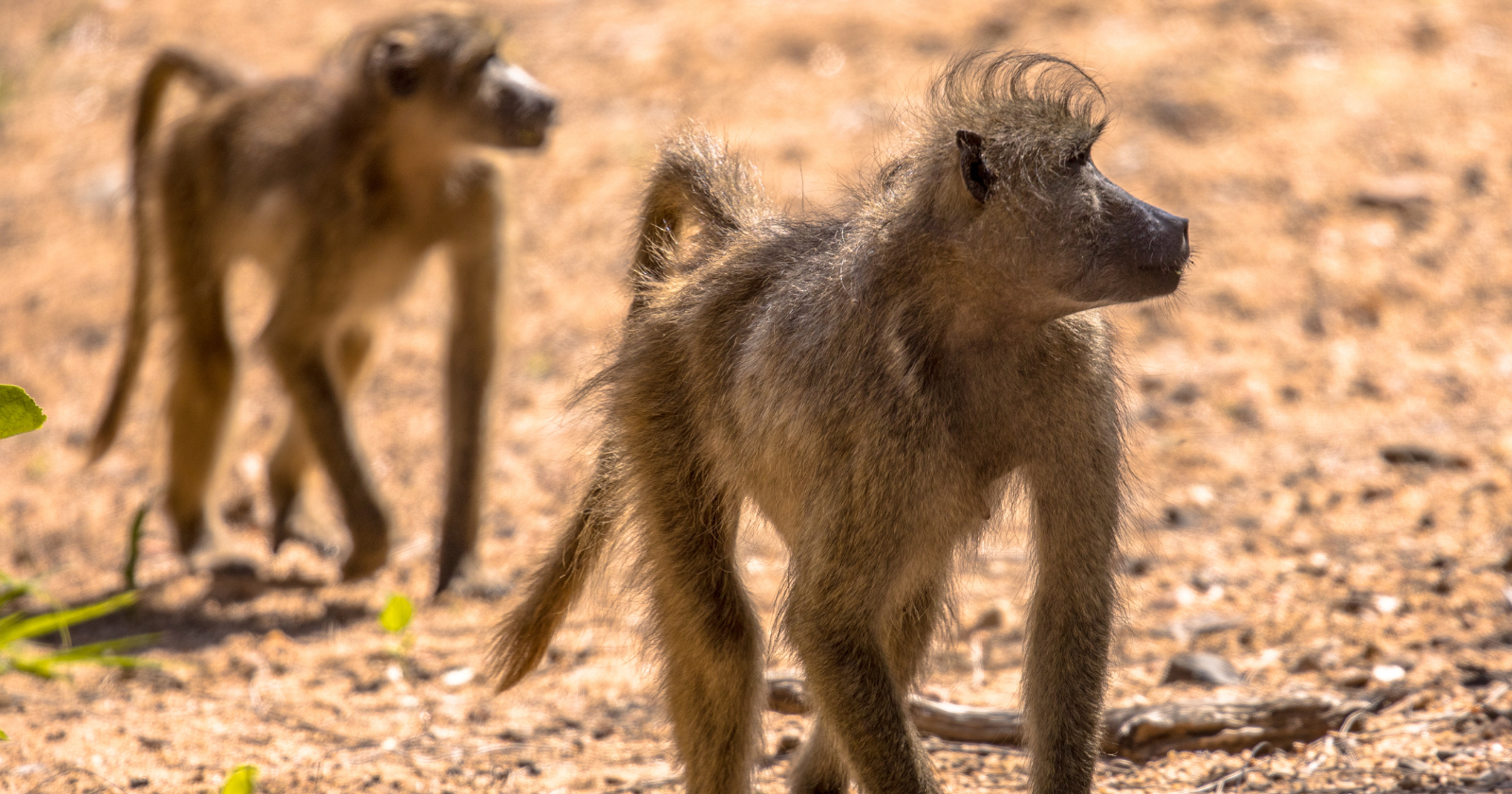
When a troop of chacma baboons moves across the Cape Peninsula, they do it in a line. The same individuals tend to walk in the same positions relative to each other, day after day, across weeks of observation. The ordering looks purposeful. It looks like it should mean something: a dominant animal in front, the vulnerable in the centre, the subordinate at the rear, a logic of risk and rank playing out in the procession.
That interpretation has been offered before. So has the alternative: that the order is random, with no pattern worth explaining. A new study from researchers at Swansea University, published in Behavioral Ecology in 2025, finds both of those explanations to be wrong. The order is consistent, and it is not random. But it is also not strategic. According to the Swansea team’s analysis of 78 travel progressions over 36 days, the baboons line up the way they do for a simpler reason: they are walking with their friends.
This is one study, from one group of wild baboons in one location. Its findings are not a universal rule about collective animal behaviour. But the conceptual frame it introduces is worth sitting with.
What the study actually tested
Lead author Marco Fele, a PhD student at Swansea, and colleagues including Associate Professor Andrew King used high-resolution GPS tracking to record the movement of individual baboons during what are called progressions: the regular, directed group movements a troop makes when travelling to sleeping sites, water, or foraging grounds. The team tested four competing explanations for why individuals ended up where they did in the line.
The first was the risk hypothesis: that vulnerable individuals cluster toward the centre of the group, where they are less exposed to predators at the front and rear. This is observed in some prey species. The second was the competition hypothesis: that individuals position themselves relative to resources, moving toward the front when food or water is ahead. The third was a group decision-making hypothesis: that certain individuals consistently lead, and that the ordering reflects who holds navigational authority.
None of these explained the observed patterns. The fourth hypothesis did. The researchers found that baboons travelled near the individuals they were most socially bonded with, and that this preference, applied consistently, produced a stable ordering across progressions. High-ranking, highly connected individuals tended to end up in the middle, and lower-ranking individuals at the front and rear. But that arrangement was a consequence of the social structure, not a deliberate positioning strategy. As King noted in the Swansea University press release accompanying the paper, the baboons at the front are probably not leading; they are simply out ahead, in a group that already knows where it is going.
The spandrel concept, and why it matters here
The Swansea team uses the word “spandrel” to describe what they have found, specifically a “social spandrel.” The term comes originally from architecture: a spandrel is the roughly triangular space left over between two adjacent arches and the ceiling above them. It is not designed. It is a geometric consequence of building arches side by side. Stephen Jay Gould and Richard Lewontin borrowed the term for evolutionary biology in their 1979 paper in the Proceedings of the Royal Society of London, arguing that some biological traits should be understood not as adaptations selected for, but as structural byproducts of features that were. The shape was there because of something else; it was not itself the point.
What the Swansea paper proposes is that a collective behavioural pattern can work the same way. The travel order of the baboon troop is not an evolved strategy for managing predation risk. It is not a leadership hierarchy. It is a shape left over from the social bonds, a visible consequence of who likes whom. Fele described it plainly in the press release: the consistent order that appears in their data is a byproduct of social relationships, not a strategy with immediate benefits.
The distinction is not trivial. Animal behaviour research has a long history of reading apparent order as evidence of apparent purpose. A formation looks coordinated, so it must serve a coordinating function. An arrangement looks protective, so it must be about protection. The spandrel framework invites a prior question: could this pattern simply be what social bonds look like when a group moves?
What we know about baboon social bonds more broadly
The finding sits within a much larger body of work on baboon sociality, much of it from the Amboseli Baboon Research Project in Kenya, which has tracked individual baboons on a near-daily basis since 1971 across multiple generations. That longitudinal research, involving work by Joan Silk, Susan Alberts, and Elizabeth Archie among others, has established a consistent pattern: stronger social bonds in female baboons are associated with meaningfully greater longevity — the effect is large enough to translate to differences in reproductive output over a lifetime. The effect sizes are large enough to translate to meaningful differences in reproductive output over a lifetime. The mechanism behind that survival advantage remains an area of active investigation; the correlation itself is robust across multiple populations and study designs.
None of that prior research is about progressions or travel order. It concerns grooming, proximity, coalition formation, affiliative social contact. What the Swansea paper adds is a window into how those bonds manifest spatially during routine group movement. The bonds are not formed to produce the travel pattern. But the travel pattern shows them.
What the study does not show
The study is based on one group of chacma baboons (Papio ursinus) on South Africa’s Cape Peninsula. Whether the same social-spandrel dynamic holds in other baboon species, in other habitat types, or under different ecological pressures is not established by this data. The authors do not claim it is. The 78 progressions over 36 days are a meaningful dataset; they are not a cross-population survey.
It is also worth noting what the paper does not resolve about the spandrel concept itself in collective behaviour. Gould and Lewontin’s original argument generated substantial debate about how confidently one can distinguish a byproduct from an adaptation, since a trait that begins as a byproduct can subsequently be selected for. Whether baboon travel order is purely a byproduct of social bonds, or whether the specific spatial arrangement it produces has itself been under any selective pressure at all, is a question this study does not answer. The authors are careful to frame it as a hypothesis the data supports in this population, not a settled claim about baboon evolution.
The pattern worth noticing
What remains is a finding that is, on its face, quite simple. A group of animals moves together in a consistent order. The order reflects who they spend time with, who they groom, who they prefer to be near. It is not a formation in any purposeful sense. It is proximity, repeated across journeys, hardening into something that looks like structure.
The research team has introduced a useful frame for reading group behaviour: before assigning a function to a pattern, ask whether the pattern might just be what a particular kind of social life looks like when it moves. Sometimes the shape is not the strategy. It is only the shape.
