
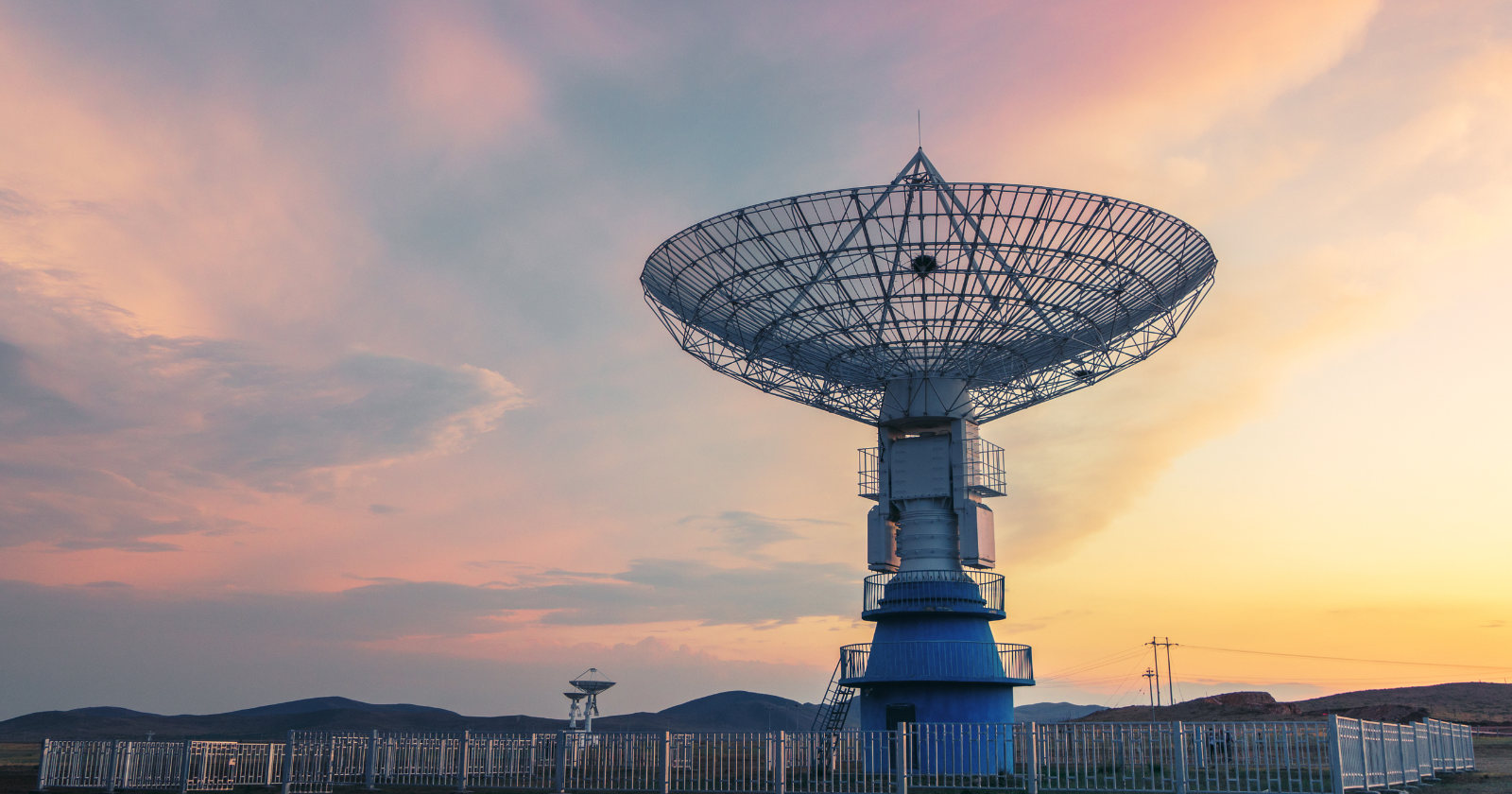
On the night of August 15, 1977, a radio telescope the size of several football fields sat in a field outside Delaware, Ohio, listening to the sky. It heard something. For 72 seconds, a narrowband signal rose and fell from the direction of Sagittarius, close to the 1420 MHz hydrogen line, and peaked far above the background noise. Days later, volunteer astronomer Jerry Ehman found the sequence 6EQUJ5 on the printout, circled it in red ink, and wrote one word in the margin: Wow!
The telescope is gone now. The signal has never returned. Nearly half a century later, after repeated follow-up searches with instruments more sensitive than Big Ear, the Wow! Signal remains the most famous unresolved event in radio SETI: one strip of paper, one 72-second sweep, and no second detection.
What Big Ear heard that night
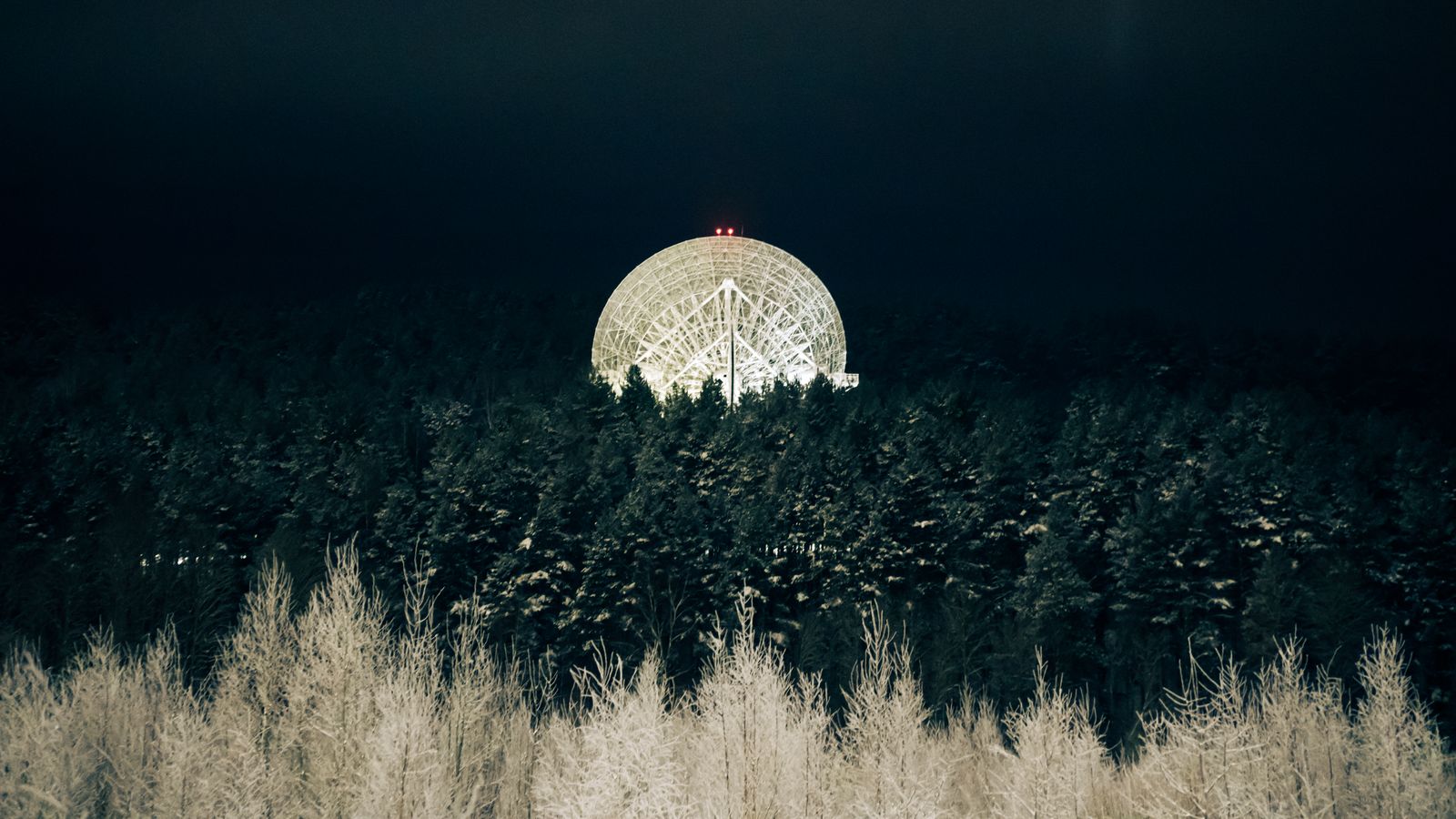
The Ohio State University Radio Observatory, better known as Big Ear, was not a steerable dish. It was a large fixed radio telescope designed by Ohio State radio astronomer John Kraus, with a flat collecting area and two reflectors that used Earth’s rotation to sweep the sky.
Big Ear had already helped produce a radio survey of the sky before it became famous for SETI. By the 1970s, the instrument was being used in the Ohio SETI program, a long-running search for narrowband signals that might stand out from ordinary cosmic radio noise.
The signal arrived near the hydrogen line, the natural radio emission frequency of neutral hydrogen atoms. SETI researchers had long considered the region around 1420 MHz an obvious place to listen because hydrogen is the most abundant element in the universe and the band is relatively quiet compared with many radio frequencies.
What caught Ehman’s eye was not a message. The characters 6EQUJ5 were an intensity code, with each character representing one sample of signal strength. Once the values climbed past 9, the printer used letters, which is why the peak appeared as U.
The shape mattered more than the symbols. The signal rose, peaked, and fell across the exact window in which Big Ear’s beam would have crossed a fixed point in the sky as the Earth turned. That profile made it look celestial, or at least far beyond the telescope, rather than like ordinary local interference.
Why the first explanations failed
The first problem was that Big Ear could not chase the signal in real time. It collected data, printed it later, and waited for people to inspect the pages. By the time Ehman saw the anomaly, the telescope had already moved on with the rotation of Earth.
Ohio State researchers trained Big Ear on the same part of the sky for the next month, according to the observatory’s own history of the event. The signal did not repeat. They returned to the region periodically afterward. Still nothing.
That absence has shaped every explanation since. A satellite, aircraft, or ground transmitter would have to mimic the telescope beam and then vanish. A natural source would have to be intense, narrowband, and short-lived. A deliberate signal would have to transmit once, or transmit in a pattern that nearly every follow-up missed.
The comet explanation, proposed decades later, did not close the case. Critics noted that a cometary hydrogen cloud would be diffuse rather than a sharp 72-second on-off event, and the proposed comets did not solve the problem of why only one of Big Ear’s beams saw the signal.
The safest version of the claim is narrower than the legend. The Wow! Signal has not been proved alien, and it has not been fully explained by terrestrial interference, a comet, or a known object in the sky.
The telescope disappeared before the mystery did
Big Ear did not survive into the era of instant alert astronomy. The observatory ceased operations in late 1997 and was destroyed in early 1998 after the land was developed for a golf course expansion and housing.
That matters because the Wow! Signal is not preserved as a modern data cube, with high-resolution recordings waiting to be reprocessed. The surviving story depends on the printout, the observing records, calibration work, and later attempts to reconstruct what Big Ear was seeing.
The original printout has become an artifact in its own right. Its power is partly visual: a thin column of characters, a red circle, and the handwritten word that turned a technical anomaly into one of the most recognizable objects in the history of radio astronomy.
That is also why the Wow! Signal keeps resisting closure. A modern telescope network could trigger alerts, compare beams, check another site, and preserve raw data in multiple formats. Big Ear gave researchers a clue after the moment had already passed.
What the Arecibo Wow project changed
The strongest recent natural explanation comes from the Arecibo Wow! Project, led by Abel Méndez at the Planetary Habitability Laboratory at the University of Puerto Rico at Arecibo. The team has argued that the signal may have been a rare astrophysical event rather than a message.
In a 2024 preprint, Méndez and colleagues reported narrowband signals near the hydrogen line in Arecibo archival observations, but far weaker than the 1977 event. They identified those signals with small, cold clouds of neutral hydrogen, the kind of object that could produce narrowband emission without requiring technology.
A later 2025 preprint revisiting Ohio SETI archival data sharpened the proposed location and revised the signal’s properties. The team estimated a peak flux density above 250 Janskys and a frequency of about 1420.726 MHz, making the signal stronger and slightly different from older descriptions.
The proposed mechanism is a hydrogen-line flare: a small cold hydrogen cloud briefly brightened by a powerful external trigger, perhaps a magnetar flare or soft gamma repeater. In that scenario, the Wow! Signal would still be extraordinary. It would just be a rare natural flash, not a transmission.
The papers do not end the debate. They are preprints, and the project itself states that radio interference is highly unlikely but that an artificial extraterrestrial origin cannot yet be ruled out. The case has moved, but it has not closed.
The patch of sky is still there
The signal came from the direction of Sagittarius, near the region northwest of the globular cluster M55. In 2020, amateur astronomer Alberto Caballero searched Gaia data for Sun-like stars in the Wow! Signal region and identified 2MASS 19281982-2640123 as one candidate worth observing.
That star is about 1,801 light-years away in Caballero’s estimate. It is not proof of a source. His paper was careful to say the signal could have come from other stars in the region, an uncatalogued source, an extragalactic object, or something else entirely.
Still, the number gives the mystery its scale. If a signal from 1,800 light-years away reached Ohio in 1977, it left its source when Rome was still an empire. A reply sent now would not arrive until nearly four thousand years after the original detection.
That same stretched sense of time runs through other space mysteries, including objects whose orbits are so long that Pluto has still not completed one circuit since its discovery. The Wow! Signal compresses a different kind of distance into one short event: 72 seconds on paper, then decades of silence.
Why listeners still return to it
Modern searches are built around the failure that made the Wow! Signal so haunting. The Green Bank Telescope, the Allen Telescope Array, and optical efforts such as LaserSETI are designed for rapid checking, parallel observations, and confirmation from more than one instrument.
That is the point in Space Daily’s look at the current golden age of alien hunting at Green Bank and in its piece on how researchers would test whether a SETI detection was a hoax or an artifact. A single detection is a candidate. A repeated detection from another instrument is where the story changes.
The Wow! Signal never gave astronomers that second step. It gave them a beam-shaped rise and fall, a hydrogen-line frequency, a Sagittarius sky position, and a printout that could be read only after the source was already gone.
Jerry Ehman died in 2025 without an answer. The ink on the printout is still legible. Somewhere in the direction of Sagittarius, the source – whether it was a cold hydrogen cloud, a rare flare, interference that fooled a telescope, or something stranger – is beyond the reach of that Ohio field now, but not beyond the habit of looking back.
