
Much of what we know about the scale of the universe rests on a method worked out by a woman who was employed, at the time, as a human computer at the Harvard College Observatory. Her name was Henrietta Swan Leavitt. She began as an unpaid volunteer and was later paid thirty cents an hour, slightly more than most of the women doing the same work, to measure the brightness of stars on glass photographic plates.
The relation she found is still in use. It is one of the lower rungs on what astronomers call the distance ladder, the chain of techniques that lets us put a number on how far away other galaxies are. Almost everything built above it depends on it holding.
The work the computers did
In the late nineteenth and early twentieth centuries, the Harvard College Observatory employed a group of women to process its growing archive of photographic plates. They measured, catalogued and classified stars by hand, plate after plate. The director, Edward Pickering, hired women in part because he could pay them less than men with equivalent training. The group was known, with the casual condescension of the period, as Pickering’s computers.
They were not permitted to operate the telescopes. The observing was done by men, and the plates came back to the women to be read. Leavitt joined in 1893, took a permanent post in 1902, and spent most of her career on a single assignment: identifying variable stars, stars whose brightness rises and falls. Over her career she catalogued more than 2,400 of them, a large share of all those known at the time.
What Leavitt noticed
Most of her attention went to two faint patches of light in the southern sky, the Magellanic Clouds, which we now know to be small companion galaxies of the Milky Way. By 1908, working through plates of the Small Magellanic Cloud, she had noticed something in a subset of these stars, later called Cepheid variables: the brighter ones tended to take longer to complete a cycle from bright to dim and back.
Why this mattered turns on a single assumption. All the stars in the Small Magellanic Cloud sit at roughly the same distance from Earth, the way the lights of a distant town are about equally far from you even though the town is wide. So a Cepheid that looked brighter than another in the same cloud really was brighter. Its apparent brightness was not an accident of being nearer.
That let Leavitt convert something you can see, the period of pulsation, into something you usually cannot, the star’s true output of light. In a 1912 Harvard College Observatory circular reporting the periods of twenty-five Cepheids in the Small Magellanic Cloud, she set the relationship out plainly. The stars, she wrote, were “probably at nearly the same distance from the Earth,” so their periods tracked their actual emission of light.
Before this, distances could be measured directly only for relatively nearby stars, using parallax, the small shift in a star’s apparent position as Earth moves around the Sun. Beyond about a hundred light years that method ran out. Leavitt’s relation offered a way past that limit, as long as it could be anchored.
Why it became a ruler
A period-luminosity relation is not yet a distance. To turn it into one, you need the true distance to at least one Cepheid, to anchor the scale. Once anchored, the rule works in three steps: measure how long a Cepheid takes to pulse, read off its true brightness from Leavitt’s relation, then compare that with how bright it appears. The gap between true and apparent brightness gives the distance.
Leavitt was not allowed to take that next step. According to the National Women’s History Museum, Pickering kept her on cataloguing work and did not let her pursue the calibration. The anchoring was done by others, the Danish astronomer Ejnar Hertzsprung and the American Harlow Shapley among them.
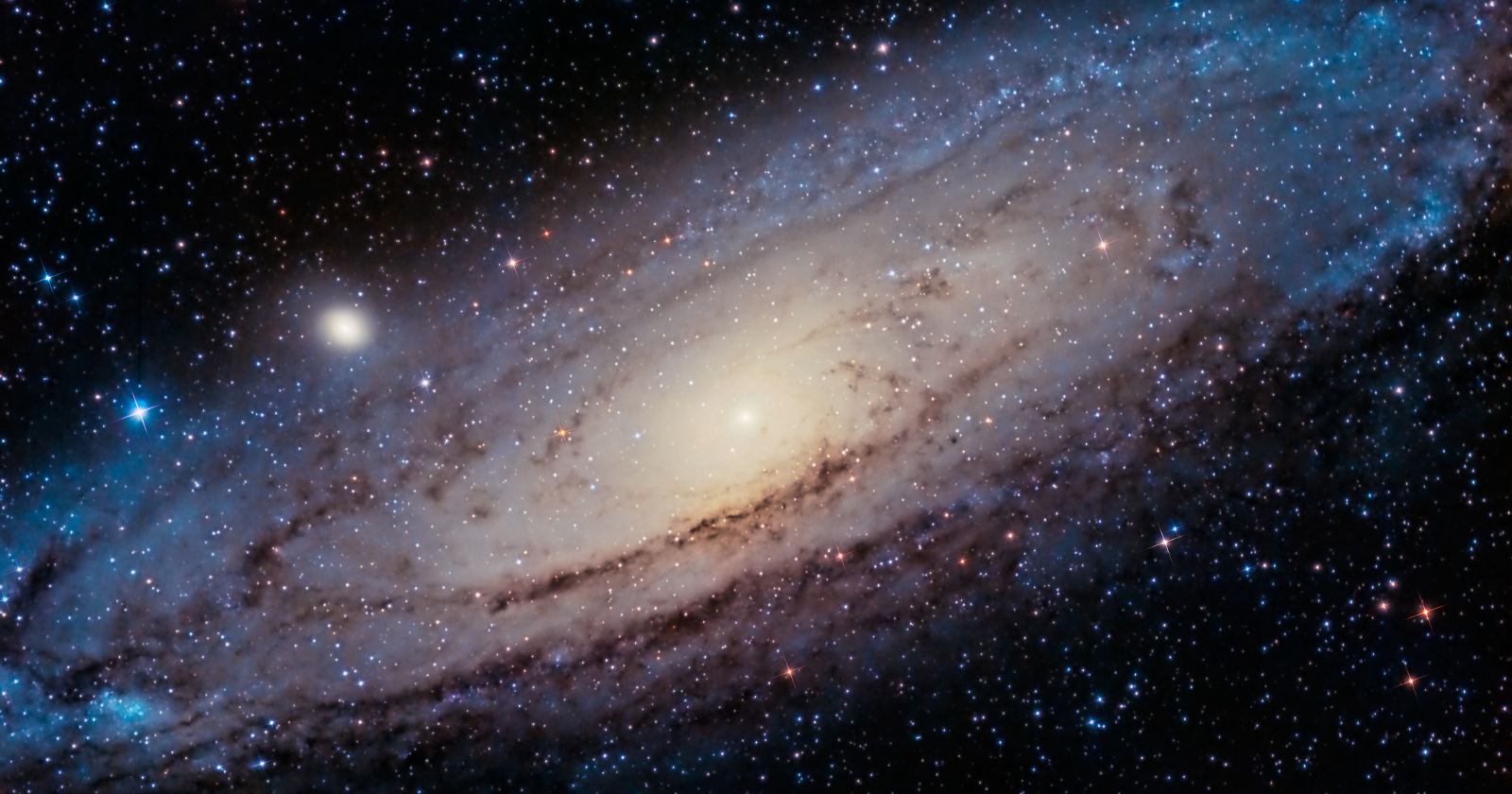
The payoff came in the 1920s. Edwin Hubble found Cepheids in the Andromeda nebula, applied Leavitt’s relation, and showed that Andromeda was far too distant to lie within the Milky Way.
It was a separate galaxy.
The known universe became, in a few years, enormously larger. Hubble then combined galaxy distances with redshift measurements to show that more distant galaxies are receding faster, the observation behind the expanding universe.
The credit
Pickering published Leavitt’s work under his own name, with a note that it had been prepared by Miss Leavitt.
The 1912 circular carries his signature.
Recognition came late and partial. In 1925 the Swedish mathematician Gösta Mittag-Leffler wrote to Leavitt to say he was minded to nominate her for the Nobel Prize in Physics, not knowing she had died of cancer in 1921. The prize is not awarded posthumously. When he asked Shapley, by then the observatory’s director, for more on her work, Shapley replied that much of the credit belonged to his own interpretation of her findings, as the American Physical Society recounts.
What it still does
Leavitt’s relation, now often called Leavitt’s Law, did not stay in 1912. The Cepheid distance ladder is still one of the main ways the present-day expansion rate of the universe is measured, including in the work that shared the 2011 Nobel Prize in Physics for the discovery that the expansion is accelerating. Adam Riess, one of those laureates, built much of his career on extending this same tool.
It is also still being checked against the original. In a 2025 analysis posted to the arXiv, Louise Breuval, Caroline Huang and Adam Riess revisit Leavitt’s 1912 data, comparing her first period-luminosity relation with modern measurements and noting where the early photographic plates skewed it. The authors describe that relation as the first standard-candle method for measuring distances beyond our own galaxy, and as still central to cosmology.
The reason this is more than housekeeping is a live disagreement. The expansion rate measured up the Cepheid ladder does not match the rate inferred from the early universe, and the cause is not yet settled. The lower rungs of that ladder are the ones Leavitt built, which is why a relation first drawn by hand on glass plates is still being re-measured rather than retired.
