
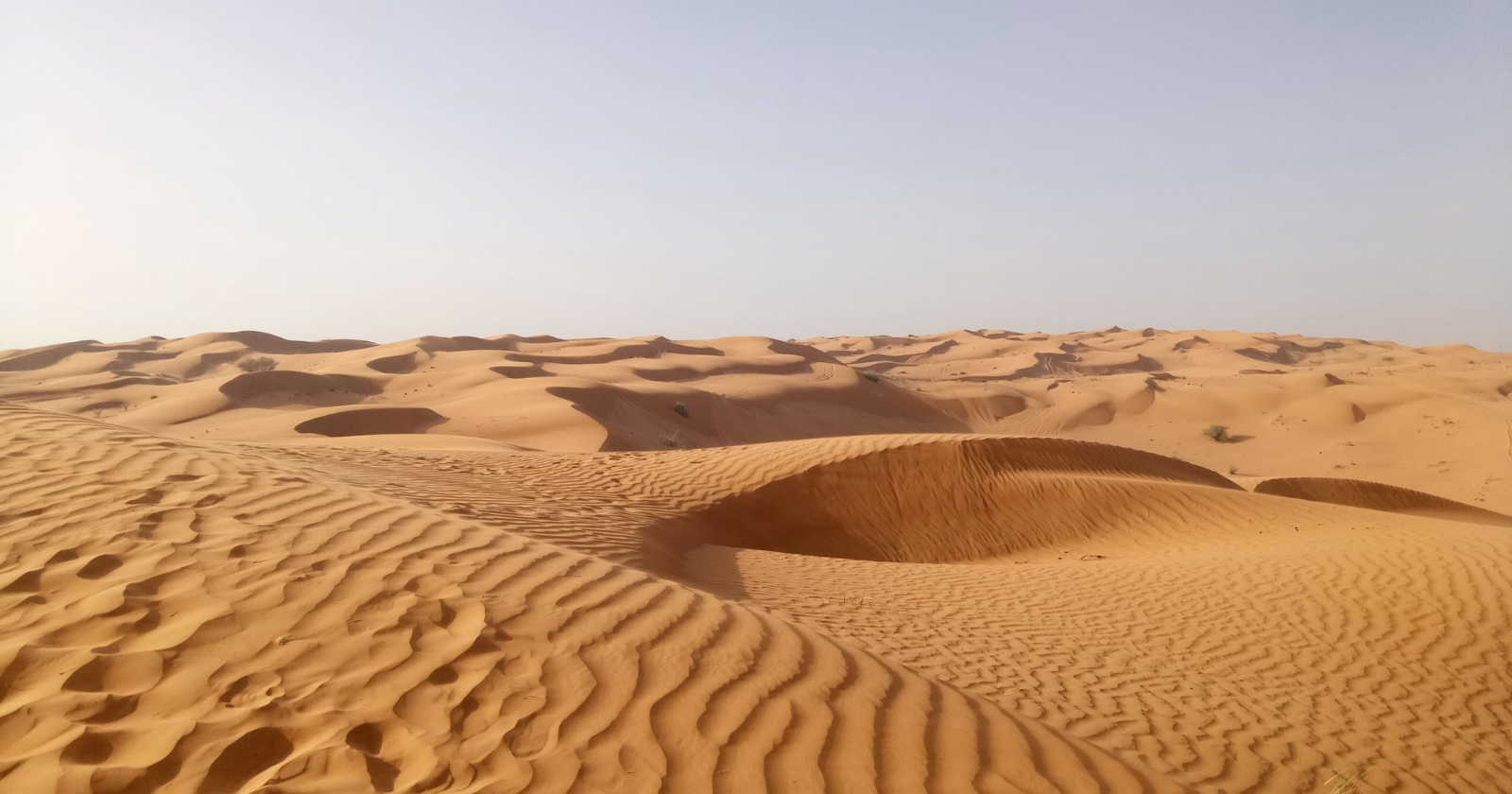
In 2023, Saudi Arabia paid approximately $140,000 to import construction-grade sand from Australia. The figure is small in dollar terms, but the trade flow it represents is the visible part of a much larger phenomenon. Saudi Arabia, a country dominated by some of the largest sand deserts on Earth, cannot use the sand in its own deserts for most construction work. The grains are the wrong shape. They have been polished smooth by thousands of years of wind erosion, and smooth round grains do not bond with cement in the way that concrete requires. Construction-grade sand has to come from somewhere else — from rivers, lakes, seabeds, or quarries, where the grains have been broken sharp by water rather than rounded by air. For a country building cities the size of NEOM and the Red Sea Project, the result is that even abundant sand is the wrong sand, and imports become a structural feature of the economy.
Why desert sand fails
The materials science is straightforward and well understood. Sand grains come in a range of shapes, depending on how they were produced. Grains that have been carried by rivers, tumbled in streams, ground by glaciers, or pulverised in quarries tend to have rough, angular surfaces. They lock together when packed, like irregular puzzle pieces, and they bond mechanically with the cement paste in concrete to produce a strong composite material. Grains that have been carried by wind, in contrast, behave very differently. Each collision between airborne grains, repeated countless times across the dunes of a desert, slightly rounds off the corners and edges. After thousands of years of this process, the grains end up smooth, spherical, and uniform in size. They are beautiful under a microscope. They are nearly useless in concrete.
The behaviour of desert sand in a wet concrete mix is sometimes described in industry literature as resembling ball bearings. Smooth round grains slide past one another rather than interlocking. They fail to engage mechanically with the cement paste, leaving microscopic voids and weak interfaces throughout the cured material. Concrete made primarily with desert sand cracks more easily, weighs more for the same strength, and ages worse than concrete made with angular sand. For a small structure, the difference might be tolerable. For a 200-storey skyscraper or a kilometre-long bridge, it is not. The structural engineers responsible for Saudi Arabia’s mega-projects need sand whose grains can do their structural job, and the grains in the Empty Quarter cannot.
What gets imported, and from where
The construction sand reaching Saudi Arabia comes from a small number of countries with abundant water-eroded sand reserves and the export infrastructure to ship it economically. Australia is among the most important suppliers. According to the Observatory of Economic Complexity, Australia exported approximately $273 million worth of sand in 2023, making it the second-largest sand exporter in the world. Saudi Arabia, the United Arab Emirates, and other Gulf states are among the regular destinations. Australia’s geological history, with its rivers, quarries, and glacial deposits, has produced the sharp-grained sand that concrete production requires. Australia ships it. The Gulf buys it.
The asymmetry is sometimes treated as an absurdity, the kind of fact that seems to contradict common sense, but it is the logical outcome of how sand actually forms. According to a 2026 analysis by Gulf Good News referencing UN Environment Programme research, Dubai’s Burj Khalifa required approximately 330,000 cubic metres of concrete, with most of the sand component imported from overseas because local desert sand could not provide adequate structural strength. The Palm Jumeirah artificial island in the UAE consumed 94 million cubic metres of marine sand, dredged from specific locations in the Persian Gulf where the grain size was suitable, and even that supply could not be drawn from the surrounding desert. The pattern repeats across the Gulf. Mega-construction demands angular sand. Local deserts cannot supply it. Foreign rivers, quarries, and seabeds do.
The wider problem
Saudi Arabia’s situation is the most counterintuitive example of a global pattern. According to the May 2026 United Nations Environment Programme report Sand and Sustainability: An Essential Resource for Nature and Development, the world extracts approximately 50 billion tonnes of sand and gravel every year — a fivefold increase since 1970, when annual extraction stood at 9.6 billion tonnes. Sand is now the second most consumed natural resource on Earth, after fresh water. Demand has grown at an average annual rate of 3.2 percent over the past half-century, and UNEP projects that demand for sand used in buildings alone could rise by up to 45 percent by 2060. The volume of sand humanity already uses each year is enough to construct a wall 27 metres high and 27 metres thick around planet Earth.
The UNEP report emphasises that most of this sand cannot come from deserts. The reserves usable in construction are concentrated in river systems, coastal areas, and continental shelves, and they are being extracted faster than geological processes can replace them. The result is what UNEP describes as the “sand gap,” in which unregulated sand mining is causing riverbed erosion, the destruction of marine habitats, the collapse of beach ecosystems, and the disappearance of small islands. The countries that supply construction sand are paying environmental costs to do so. The countries that import it are insulated from those costs only because their geography happens to produce the wrong kind of sand.
The longer-term response is shifting toward alternatives. Manufactured sand, produced by mechanically crushing rocks into the angular grain shapes that concrete requires, is becoming an increasing share of construction supply in countries that have started to take the problem seriously. Recycled concrete, in which old buildings are crushed and re-incorporated into new ones, is another partial solution. Saudi Arabia itself is investing in both approaches, and is considering domestic manufactured-sand production as part of its Vision 2030 infrastructure plans. The total amount of imported sand the country actually requires for any given year is therefore a moving figure, dependent on how quickly alternatives scale. What stays constant is the underlying physics. The grains in the Arabian deserts have been rounded by the wind for thousands of years. They will not bond with cement. The country that has more sand than almost any other still has to buy the sand it can actually use.
