
In October 1994, a German archaeologist named Klaus Schmidt visited a hilltop near the city of Urfa in southeastern Turkey, in a region of rolling limestone uplands close to the Syrian border. Schmidt had been working at a nearby Neolithic site called Nevalı Çori and was searching the surrounding country for related sites that an earlier survey, conducted in 1963 by a joint team from the University of Chicago and the University of Istanbul, had identified but dismissed. The hilltop the 1963 survey had passed over was called Göbekli Tepe, which translates from Turkish as “potbelly hill.” A local family, the Yıldız family, who owned and farmed the land, had been reporting odd stones turned up by their ploughs for years.
Schmidt arrived at the hill and recognised, almost immediately, that the smooth flat-topped stones the Yıldız family had been ploughing around were the upper surfaces of T-shaped limestone pillars of the kind he had been excavating at Nevalı Çori, buried up to their tops in the hillside. He began systematic excavation the following year, in 1995, under the auspices of the Şanlıurfa Museum and the German Archaeological Institute. The DAI’s own published account of the project sets out the early discovery in detail. Schmidt directed the excavation continuously until his death in 2014. The work has continued under his successors at the German Archaeological Institute and the Şanlıurfa Museum and continues today.
What Schmidt uncovered, and what subsequent excavations have continued to uncover, is a site that, by every prior model of human prehistoric development, should not exist.
What is at the site
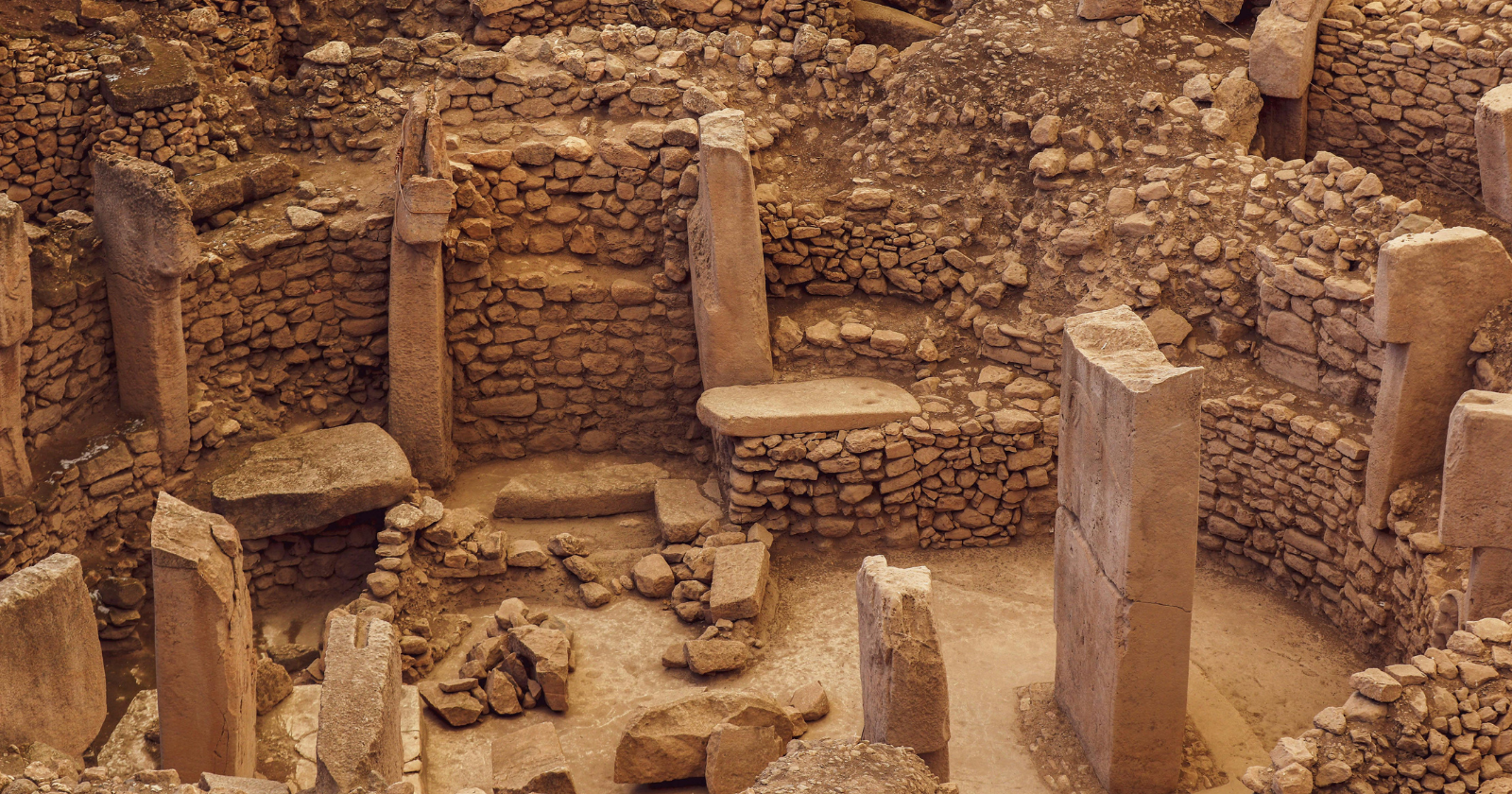
Göbekli Tepe consists, in the parts that have been excavated so far, of approximately twenty circular and oval enclosures cut into the bedrock of the hilltop. Each enclosure is bounded by a low limestone wall and contains a ring of T-shaped limestone pillars, with two larger pillars standing at the centre of the ring. The UNESCO World Heritage Centre, which inscribed Göbekli Tepe on the World Heritage List in 2018, dates the construction to between 9,600 and 8,200 BCE on the basis of the radiocarbon analyses conducted during the German Archaeological Institute’s excavations.
The pillars range in height from approximately 3 metres for the smaller examples to 5.5 metres for the largest, and they weigh between 10 and 50 tonnes each. The pillars are carved from limestone quarried from outcrops within several hundred metres of the site, shaped using only chipped stone tools, and set vertically into sockets cut directly into the bedrock. The largest known pillar at the site, still partially embedded in the limestone bedrock of a nearby unfinished quarry, would have stood 7 metres tall and weighed approximately 50 tonnes if the builders had ever extracted it.
The surfaces of the pillars carry detailed relief carvings of wild animals. Foxes appear on multiple pillars. So do lions, boars, gazelles, vultures, scorpions, and snakes. Some pillars carry abstract symbols whose meaning has not been determined. Several pillars carry stylised representations of human arms and hands carved along their sides and fronts, suggesting that the pillars themselves were understood as anthropomorphic figures rather than as architectural elements. A few carry images of human heads alongside the animals, including one widely discussed example showing a human head in the wings of a vulture.
The site was, on the available evidence, used for somewhere between one and two thousand years, and then deliberately buried. The Pre-Pottery Neolithic builders filled in their own enclosures with stone, debris, and animal bones, raising the level of the surrounding ground until the pillars were entirely concealed. The hilltop was then abandoned. The reasons for the burial are not understood. The preservation of the site by its own builders is the reason any of it has survived for archaeologists to find.
Why it should not exist
The standard model of how human civilisation developed, established across roughly a century of archaeological work between the late nineteenth century and the late twentieth, held that monumental architecture was a product of agricultural societies. The reasoning was straightforward. Building enclosures with limestone pillars weighing tens of tonnes requires sustained, coordinated labour by large numbers of people over extended periods. Sustained coordinated labour at that scale requires a reliable food supply that does not depend on each individual hunting and gathering daily. A reliable food supply at that scale requires agriculture. Therefore, the model held, monumental architecture appears only after agriculture, and agriculture appears only in settled communities, and settled communities appear only after the Neolithic Revolution.
The earliest dated layers at Göbekli Tepe were laid down in approximately 9,600 BCE, which is approximately 11,600 years ago. That is several centuries before the earliest archaeological evidence of agriculture anywhere on Earth. The excavated layers contain no domesticated plants. They contain no domesticated animals. As Schmidt set out in his 2000 paper on the first five years of excavation, published in the journal Paléorient, the animal bones recovered from the site, in quantities reaching the tens of thousands, are all wild species: gazelles, wild boars, wild aurochs, wild sheep, and various deer. The cereal grains recovered are wild varieties of einkorn wheat and barley. The Göbekli Tepe builders were, by the unambiguous evidence of their refuse, hunter-gatherers.
They were also building one of the largest monumental complexes anywhere in the world for the next four thousand years.
The site predates the construction of Stonehenge by approximately 6,000 years. It predates the construction of the Egyptian pyramids by approximately 7,000 years. It predates writing by approximately 6,000 years. It predates the wheel by approximately 6,000 years. It predates pottery in the region by approximately 1,500 years. It was built by people who had not yet domesticated any plant or animal, did not yet live in permanent settlements year-round, did not have any form of metal, and were using exclusively chipped stone tools of the kind found at hunter-gatherer sites elsewhere in Eurasia and the Near East at the same date.
What it implies about agriculture
The most consequential implication of Göbekli Tepe, in the published interpretations of Schmidt and the subsequent excavation teams, is not the bare temporal fact that monumental architecture preceded agriculture. It is the suggestion that the conventional causal direction may be reversed.
The standard model held that agriculture created the food surpluses that allowed complex society, which in turn allowed monumental ritual architecture. Göbekli Tepe inverts the sequence. The site appears to have been a regional gathering place to which hunter-gatherer groups travelled from significant distances, possibly for ritual purposes connected with the wild animal imagery on the pillars. Sustaining such gatherings, on the scale the construction work would have required, would have placed substantial pressure on the wild food resources of the surrounding landscape. The earliest archaeological evidence for the domestication of einkorn wheat, set out by Heun and colleagues in Science in 1997, comes from a region called Karaca Dağ, located approximately 30 kilometres from Göbekli Tepe.
The inference some archaeologists have drawn from this geographic and temporal proximity is that the demands of sustaining the Göbekli Tepe gatherings may have driven the experiments in selective cultivation that produced the first domesticated cereals. On that interpretation, agriculture is the consequence of the ritual gathering rather than its prerequisite. Humans did not invent farming and then build temples. They built temples and then invented farming to keep the gatherings fed.
The interpretation is contested. Other archaeologists have argued that the connection is correlational rather than causal, that domestication may have been underway elsewhere in the Fertile Crescent independently, and that Göbekli Tepe’s relationship to early agriculture is one of contemporaneity rather than causation. A 2020 paper in the Cambridge Archaeological Journal by Gil Haklay and Avi Gopher used computer modelling to argue that the three main enclosures at Göbekli Tepe were planned as a single geometric whole rather than built piecemeal over generations, which adds a further layer of complication to the model of how the work was coordinated. The dispute remains live in the literature. What is not contested is the temporal sequence itself. The monumental construction came first. The agricultural revolution followed it.
What has not yet been found
The excavation Schmidt began in 1995 has been continuous for thirty years. Approximately twenty enclosures have been investigated in some detail. The ground-penetrating radar surveys that have been conducted across the rest of the hilltop indicate that the buried complex is substantially larger than what has been excavated so far. The current estimates suggest that fewer than 10 per cent of the site’s structures have been uncovered, and that the total number of T-shaped pillars at the site may eventually exceed 200.
The Yıldız family’s ploughs have been working ground that lies, at most, two or three metres above limestone pillars 11,500 years old. The 1963 survey team walked across the same hilltop and saw the same stones the family had been turning up. They did not recognise them. The pillars Schmidt identified in 1994 had been visible at the surface of the hill for at least three decades, and probably much longer, before any archaeologist looked at them with the right eye.
The site that has now produced the most consequential revision of the established model of how human civilisation developed was, until thirty years ago, an unploughed corner of farmland that local people had been reporting to the museum in the nearest city for years, and that the international archaeological community had walked past.
What else is buried in the rest of the hilltop has not been excavated yet.
What else is buried in other hilltops that the surveys have walked past, or never visited, is a question the published literature does not address.
