
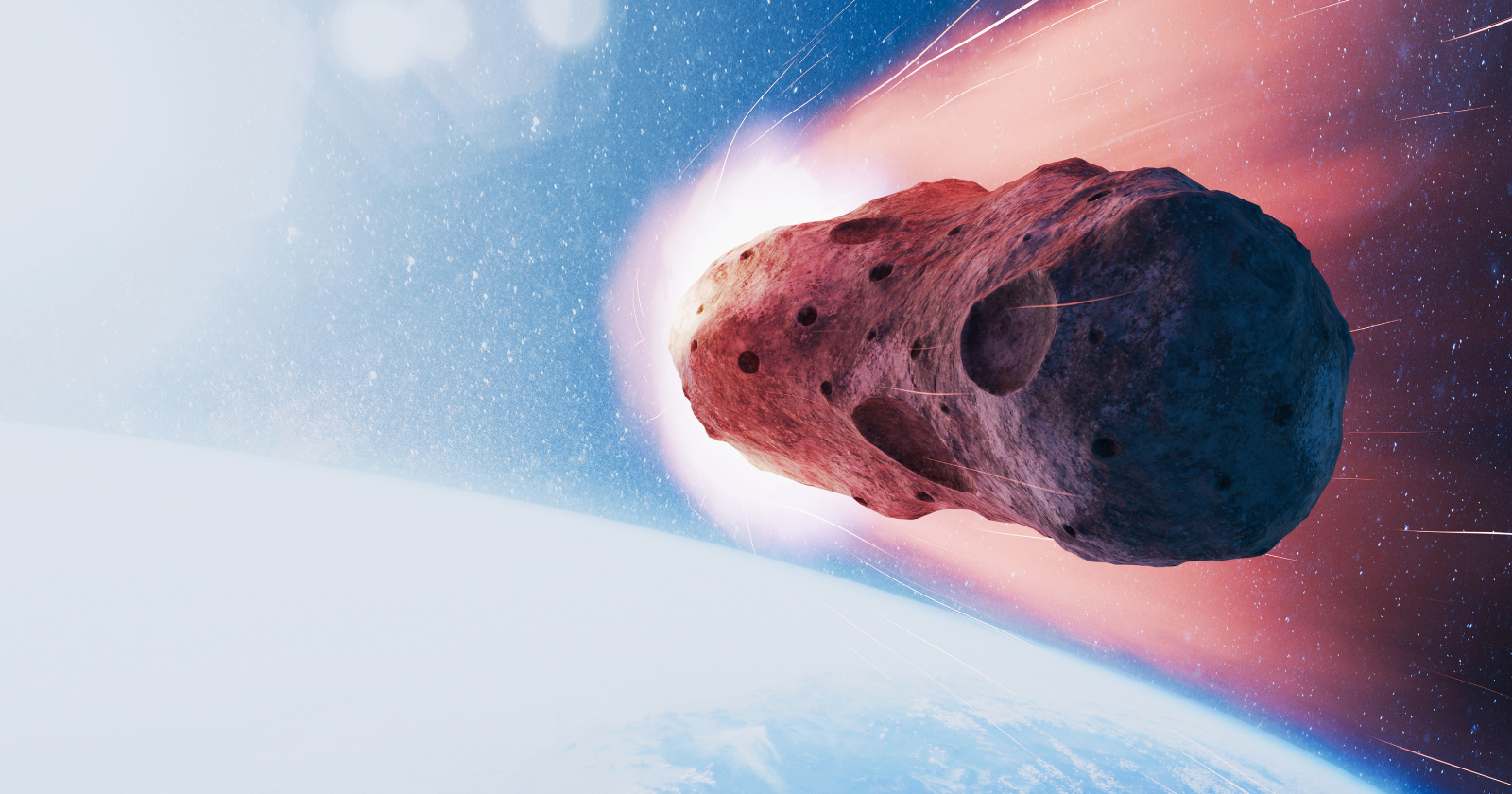
In October 2017, a survey telescope on Maui caught a faint, fast point of light that did not belong here. The object was moving too quickly, on the wrong kind of orbit, to have formed around our Sun. It had come from somewhere else, passed close to the Sun a few weeks earlier, and was already on its way back out.
The object was found on 19 October 2017 by Robert Weryk, working with the Pan-STARRS1 telescope run by the University of Hawaii and funded through NASA’s near-Earth object program. The International Astronomical Union later gave it the designation 1I/2017 U1, the “1I” marking it as the first confirmed interstellar object on record. The Pan-STARRS team named it ‘Oumuamua, Hawaiian for a messenger from afar arriving first.
It was a genuine first. What it was, exactly, is a question that has not fully closed.
What the observations actually showed
‘Oumuamua was found late and seen briefly. By the time anyone noticed it, it had already passed perihelion, its closest approach to the Sun, on 9 September 2017, and was heading away. Astronomers had roughly a fortnight of useful observation before it faded.
From that short window, a few things were established. Its orbit was steeply hyperbolic, with an eccentricity near 1.2, far outside the range of anything bound to the Sun. Its incoming interstellar speed was about 26 kilometres per second, and after swinging past the Sun it was moving far faster. Its brightness swung dramatically as it tumbled, which pointed to an extreme elongated shape, though whether it was closer to a cigar or a flattened disc has never been resolved. Estimates put its longest dimension at a few hundred metres.
By colour and surface it looked broadly like the icy nuclei of comets. It did not behave like one in the way that mattered most.
The push that did not add up
In June 2018, a team led by Marco Micheli of the European Space Agency reported in Nature that ‘Oumuamua’s path could not be explained by gravity alone. As it left the inner Solar System it carried a small extra push directed away from the Sun. The deviation was tiny, but the orbit had been measured carefully enough to be confident it was real.
For a comet, this would be unremarkable. Comets warm as they near the Sun, ices turn to gas, and that escaping material acts like a weak, off-centre thruster. The trouble was that ‘Oumuamua showed no sign of doing this. No tail. No coma. No dust. Repeated searches found nothing being shed.
So there was a force consistent with outgassing, and no outgassing anyone could see.
That is the puzzle that has kept the object in the literature for years.
The competing explanations
Most of the serious proposals try to keep ‘Oumuamua natural while accounting for an invisible push. One line of argument is that it was venting something hard to detect. Nitrogen ice was suggested, with the idea that the object was a fragment of a nitrogen-rich body. Hydrogen has also been proposed.
In 2023, Jennifer Bergner and Darryl Seligman published a hydrogen-based explanation in Nature. Their model argues that radiation in interstellar space could produce trapped molecular hydrogen inside water-rich ice, which is later released as the object warms near the Sun, giving a push with no visible dust tail. It is a plausible mechanism. It is also one model, built to fit a single object whose data is limited, and it has not been tested against a second case.
A separate and far more contested suggestion came from Harvard astronomer Avi Loeb, who argued the acceleration might point to an artificial origin, such as a thin, sail-like structure pushed by sunlight. Most researchers working on the object do not accept this. The natural explanations, unsettled as they are among themselves, remain the mainstream reading, and there is no direct evidence the object was anything other than a strange natural body.
Why the question stays open
The honest limitation is the data. ‘Oumuamua was caught on its way out, observed for a short time, and is now far beyond reach. No spacecraft visited it. No sample exists. Every explanation is being fitted to one faint, fast, briefly seen object, which is why no single account has won.
What has changed since is the company it now keeps. In 2019, a clearly cometary interstellar object, 2I/Borisov, passed through and behaved exactly as a comet should, complete with a visible tail. In July 2025 a third, 3I/ATLAS, was found, and it too shows ordinary cometary activity. The Vera C. Rubin Observatory, which recorded 3I/ATLAS in commissioning data ten days before its official discovery, is expected to turn up many more now that its decade-long survey has begun.
That is the value of more cases. If interstellar objects prove to be a varied population, ‘Oumuamua may simply have been an unusual member of it, seen at a bad angle and too late. If others show the same quiet push without a tail, the hydrogen and nitrogen models gain real support rather than a single fit.
For now, the first interstellar object remains the least explained of the three. The next ones, caught earlier and watched longer, are the ones likely to settle what ‘Oumuamua could not.
