
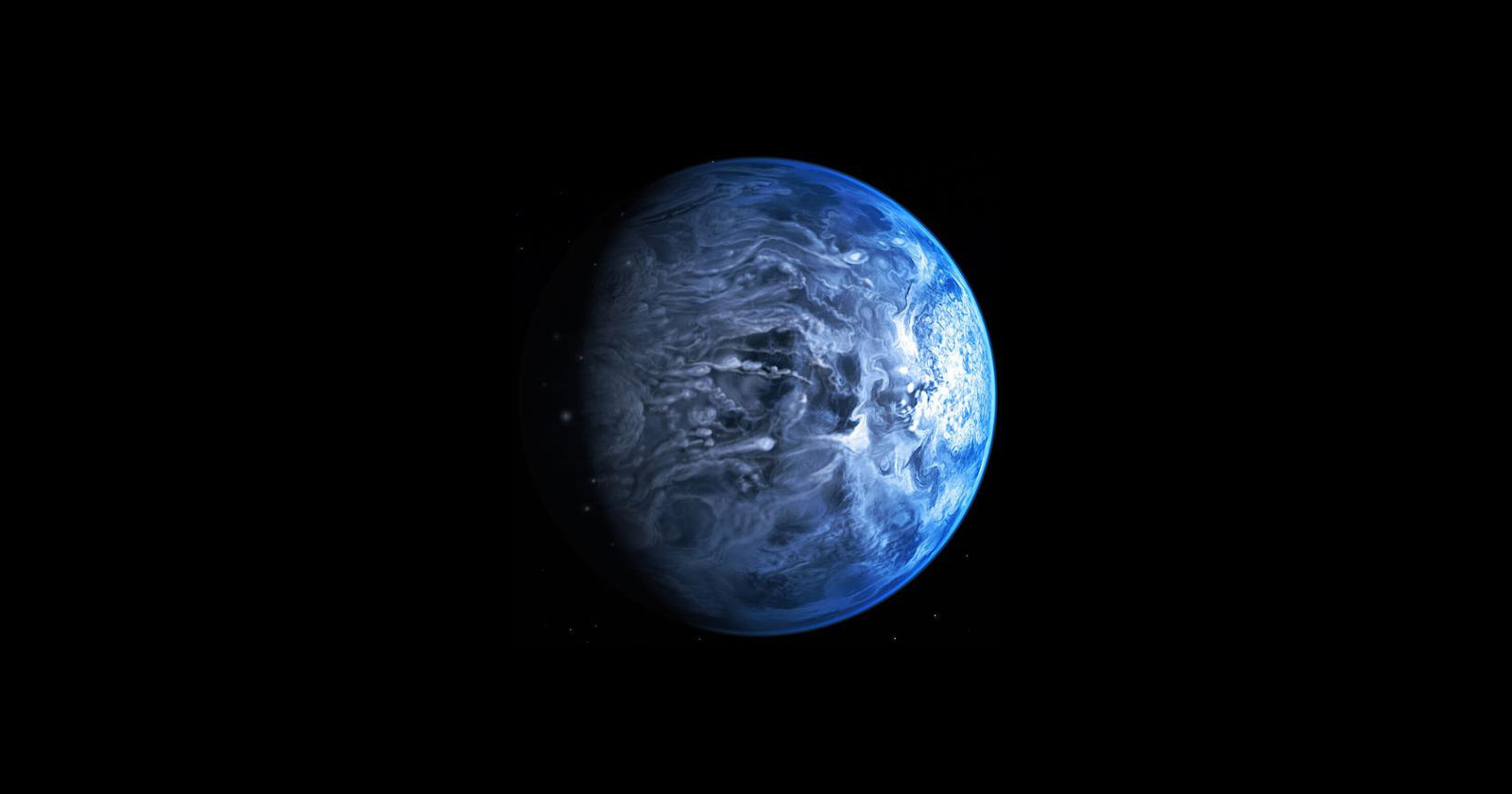
Point the right instrument at HD 189733b and the colour that comes back is a deep cobalt blue, the kind of blue a person who grew up with photographs of Earth from orbit would recognise in an instant. Astronomers determined the colour in 2013 using the Hubble Space Telescope, and the resemblance to a pale blue dot is almost uncanny. It is also a trap.
The assumption underneath that blue, that a blue world is a watery world and therefore something like home, is exactly what HD 189733b dismantles. As NASA puts it: “To the human eye, this far-off planet looks bright blue. But any space traveler confusing it with the friendly skies of Earth would be badly mistaken.”
The blue does not come from water. HD 189733b is a hot Jupiter, with no ocean to reflect a sky. The colour comes from the atmosphere itself. NASA describes it this way: “The cobalt blue color comes not from the reflection of a tropical ocean, as on Earth, but rather a hazy, blow-torched atmosphere containing high clouds laced with silicate particles.”
It might look a bit like home but it’s not so hospitable. NASA puts the temperature at nearly 2,000 degrees during the day!
Then there is the wind. A University of Warwick team led by Tom Louden measured air moving from the planet’s dayside to its nightside at extraordinary speed.As Louden said: “This is the first-ever weather map from outside of our solar system. Whilst we have previously known of wind on exoplanets, we have never before been able to directly measure and map a weather system.” The figure that came out of that work is the one that sticks. NASA describes winds that “blow up to 5,400 mph (2 km/s) at seven times the speed of sound, whipping all would-be travelers in a sickening spiral around the planet.” Combine that with a sky of molten silicate and you get the planet’s signature: possible horizontal rain made of glass. NASA, in its Halloween-themed framing, calls getting caught in that rain “more than an inconvenience; it’s death by a thousand cuts.” Please note that this glass-rain picture is an inference drawn from the temperature and wind data rather than a directly imaged event, best read as the likely consequence of what has been measured.
It would be easy to file this planet under the gallery of hostile worlds and move on. HD 189733b earns its place in the literature for a quieter reason. It is one of the most heavily studied exoplanets we have, which is why it could be measured in this much detail in the first place. It became the proving ground for techniques, mapping a wind system and reading a visible colour, that now get pointed at fainter and stranger targets.
Perhaps the deeper use of the planet is as a correction to a habit of mind. The search for worlds like ours leans, understandably, on familiar signals: the right size, the right distance from a star, a hint of blue. HD 189733b satisfies one of those cues and fails every test that follows. A colour that reads as ocean on Earth reads as molten glass here, and the only way to tell the two apart is to keep measuring past the first impression. The blue dot 63 light-years away is a reminder that resemblance, at interstellar distance, is perhaps the easiest thing to mistake for kinship.
