
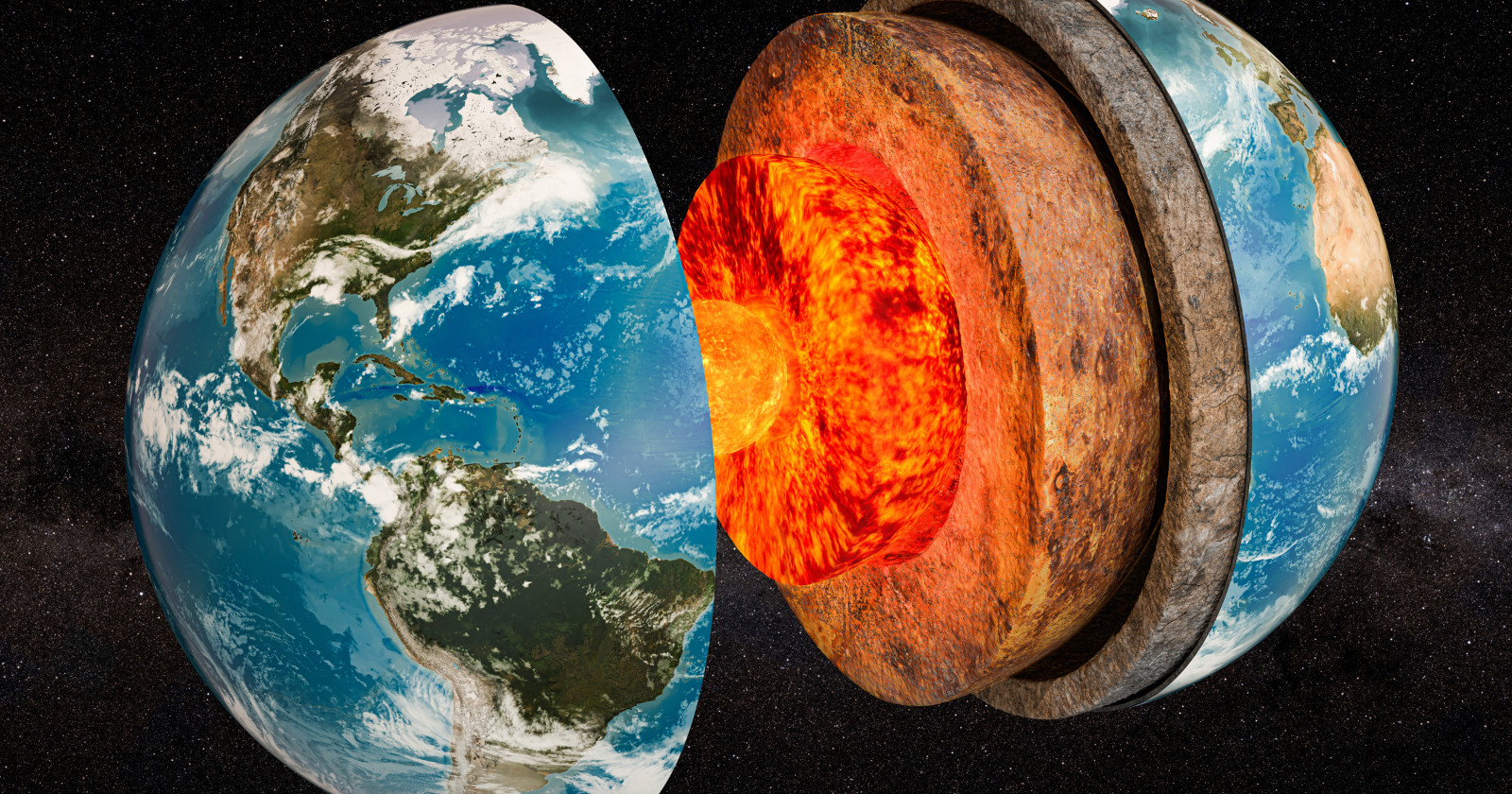
Roughly 5,100 kilometres beneath the surface, Earth’s inner core is usually estimated to sit somewhere around 5,000 to 6,000 degrees Celsius, close to the temperature of the Sun’s visible surface. It is also solid. That pairing sounds like a contradiction, and it is worth taking the time to understand why it is not.
The short version is that pressure, not temperature alone, decides whether iron stays liquid or solid. At the centre of the planet the pressure is so high that iron remains locked in a solid state well past the point where it would melt at the surface.
The longer version is more interesting, because it involves how anyone arrived at a number for a place no one has ever sampled.
How anyone knows the temperature at all
There are no samples of the core. The deepest holes humans have drilled barely scratch the crust, and the inner core begins about 5,100 kilometres down. Everything we say about it is inferred.
The structure itself was worked out from earthquakes. In 1936 the Danish seismologist Inge Lehmann noticed seismic-wave behaviour that pointed to a distinct inner core inside the liquid outer core, an interpretation later confirmed and refined by better seismology. That basic picture has held for nearly ninety years.
The temperature is harder, and it comes from the laboratory rather than from listening to earthquakes. The core is mostly iron, with some nickel and lighter elements, so the question becomes the melting point of iron under the pressure found at the inner core boundary. Researchers reproduce those pressures in diamond-anvil cells and shock-wave experiments, then read off where iron melts. According to Scientific American’s account of the method, estimates for that melting temperature still range from about 4,500 to 7,500 kelvin, which is a wide band.
That spread is the honest part of the story. The often-quoted figure of roughly 5,400 degrees Celsius is a central estimate, not a measured fact, and different methods land in different places. A 1993 paper by Reinhard Boehler in Nature, based on melting-point measurements of iron at high static pressures, sits towards the lower end of the modern range. Later first-principles simulations, including work by Dario Alfè, put the melting point near the inner core boundary higher, closer to 6,000 kelvin. The comparison with the Sun’s surface is a useful image, but the underlying number carries error bars that are easy to lose.
Why the pressure keeps it solid
Heat pushes a material towards melting. Pressure pushes it back towards solid, because squeezing atoms together makes it harder for them to break out of an ordered lattice and flow.
At the inner-core boundary the pressure is about 330 gigapascals, rising higher toward the centre of the planet, more than three million times the pressure at sea level. In simple terms, the melting point of iron rises sharply under pressure, so the temperature at the centre, high as it is, sits below the raised melting point. That is why the core can be both extraordinarily hot and solid at once.
The outer core, sitting at lower pressure, does melt, which is why the inner core is a solid ball inside a liquid shell rather than one continuous mass.
The solid ball is not as static as it looks
For much of the last century, the inner core was often presented in simple diagrams as a fixed, solid sphere. Recent seismology has complicated that picture.
In a 2024 paper in Nature, Wei Wang, John Vidale and colleagues argued that the inner core’s rotation relative to the surface has changed direction, with the inner core moving back through the same path more slowly after about 2008. The conclusion rests on a set of repeating earthquakes near the South Sandwich Islands recorded between 1991 and 2023, read as showing the core moving backward relative to the mantle. Other groups have read similar data differently.
It is one well-argued position in a long-running debate, not a closed case.
A follow-up study in Nature Geoscience in 2025, with the same group, went further and suggested that the near surface of the inner core is not only rotating but deforming, with the boundary between solid and liquid possibly developing bulges as iron freezes and melts. This is a single study built on the same family of seismic observations, and the authors present the deformation as a tentative reading of subtle changes in wave shape rather than a settled result. The narrower, more defensible point is that the boundary between the inner and outer core appears to be an active place, not a frozen one.
What is worth watching
None of this overturns the basic picture. The inner core is solid, it is roughly as hot as the surface of the Sun, and pressure is the reason those two facts sit together.
What stays open is the detail. The exact temperature depends on which iron-melting experiments hold up. The behaviour of the boundary depends on seismic readings that a handful of groups are still arguing over. The next round of evidence will come from the same slow source it always has, which is earthquakes large enough to send waves through the centre of the planet, recorded carefully enough to notice when something down there has shifted.
